Lesson 14 — Two Ways of Caring for Land
Learners compare indigenous and other place-based stewardship practices — cultural burning, common-pool rules, the Honorable Harvest, and re-greening movements — with industrial resource use, and argue what each teaches about sustainability. Neither is offered as the whole answer; the skill is learning from each without ranking people or cultures.
Objectives
Objectives
- D10.S4.11.02 Compare indigenous and other place-based stewardship practices with industrial resource use, and what each teaches about sustainability.
Essential question
What do indigenous and other place-based stewardship practices and industrial resource use each teach about sustainability?
Key vocabulary
Materials
Standard materials
- Comparison chart · 1 per learner A two-column organizer — place-based stewardship, industrial resource use — with a space for what each teaches about sustainability
- Stewardship journal · 1 per learner
Low-tech / no-cost
- Practice cards on paper (cultural burning, the Honorable Harvest, common-pool rules, the Green Belt Movement, extract–make–use–waste, the ecological footprint) · 1 set per group Cards naming real practices, to sort into the two columns and discuss
- Paper and pencil To draw the chart by hand
Enriched / lab & device
- Two short accounts (an Indigenous fire/cultural-burning practice and its benefits; an industrial resource-use measure like the ecological footprint) · 1 per pair So learners compare real, documented practices on each side
Works in different contexts
- large-group Sort the practices whole-class into two columns, then pairs each argue what one practice on each side teaches about sustainability
- multi-age Younger learners name one way they care for a place; older learners compare the two columns and argue what each teaches that the other forgets
- self-directed A learner sorts the cards, fills the chart, and writes what each approach teaches — and what each misses
- level-grouped A ready group also asks whether the two can be combined (and under what conditions), rather than only contrasted
- outdoor-only Two marked areas — stewardship, industrial use; learners place each practice card where it belongs, then stand where they'd want a future practice to lean and explain
Lesson 14 — Two Ways of Caring for Land
Summary
Learners compare indigenous and other place-based stewardship practices — cultural burning, common-pool rules, the Honorable Harvest, and re-greening movements — with industrial resource use, and argue what each teaches about sustainability. Neither is offered as the whole answer; the skill is learning from each without ranking people or cultures.
Objectives
- Compare indigenous and other place-based stewardship practices with industrial resource use, and what each teaches about sustainability. (D10.S4.11.02)
Connection
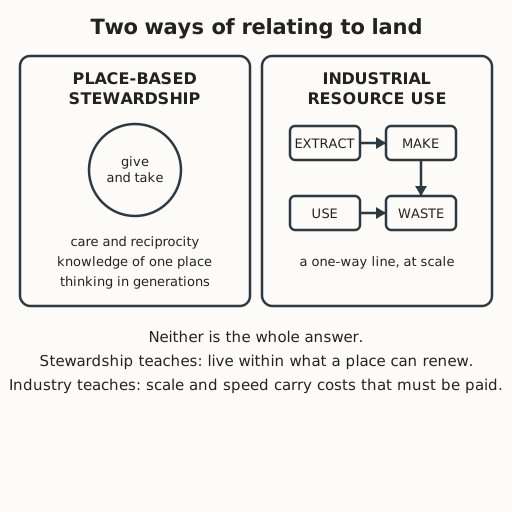
There are, broadly, two ways humans have related to land. One is place-based stewardship: people who know one place deeply, take what it can renew, and give back — burning to keep a forest healthy, harvesting with rules of reciprocity, managing a shared commons by agreed rules. The other is industrial resource use: a one-way line — extract, make, use, waste — at a scale no single place can absorb. Both are real, both are still practiced, and each teaches something the other forgets. Stewardship teaches living within what a place can renew; industry teaches that scale and speed carry costs that must be paid. The question is not which people are better — it is what each way of living knows.
Materials
- Comparison chart
- Stewardship journal
- Practice cards (low-tech: paper)
Preparation
- Copy or draw the comparison chart; prepare the practice cards.
- Retrieval: from Lesson 12 (the more-than-human world) and Lesson 13 (policy). Today we compare two ways of living with land.
- Prepare the practices, each real and documented. Cultural burning: Indigenous fire practices in Australia manage Country, reduce fuel load, and support life, as described by Indigenous-led organizations (Firesticks/Living Knowledge Network, S-321; CSIRO, S-320). Common-pool rules: communities across many societies have governed shared forests, fisheries, and irrigation by their own rules (Ostrom, S-416). The Honorable Harvest: the ethic of taking only what is offered and giving back, so that “all flourishing is mutual” (Kimmerer, S-427). The Green Belt Movement: Wangari Maathai’s grassroots tree-planting that countered deforestation (S-059). Industrial use: the ecological footprint measures how much nature a person or place uses against how much there is (Global Footprint Network, S-277); industrial drivers — land and sea use change, extraction, pollution — are the leading causes of biodiversity loss (IPBES, S-437).
Facilitator note
This lesson is written to the learner (“you”). The idea to land: two real ways of relating to land — place-based stewardship (cultural burning, S-321/S-320; common-pool rules, S-416; the Honorable Harvest, S-427; re-greening movements, S-059) and industrial resource use (the ecological footprint, S-277; industrial drivers of biodiversity loss, S-437) — each teach something about sustainability: stewardship teaches living within what a place can renew; industry teaches that scale and speed carry costs that must be paid. The unit closes here because this is where the whole year lands: neither worship nor fear of technology, but honest judgment about which way of living sustains life.
Two things to hold firmly. First, do not romanticize or rank: place-based traditions are living, contemporary, and specific — name the people and the practice (the Firesticks/Living Knowledge Network, the Citizen Potawatomi Nation, the Green Belt Movement), and do not reduce them to a generic “wisdom.” Second, do not collapse into “industry is bad”: industrial methods feed and power billions, and the honest question is what they cost and whether those costs are paid — not whether they exist. The skill is comparison with respect, and the mature conclusion is that the two can learn from each other rather than one “winning.”
The environment lens is core. The ethics lens: each way of living embodies a claim about what land is owed. The egalitarianism lens: industrial harms, like technological harms, land on the least powerful — and stewardship knowledge has often been suppressed by the very systems that now seek it. The global lens: the practices come from every inhabited continent. The critical-thinking lens: comparing without ranking, and naming what each teaches and what each forgets.
Procedure
- Recall (5 min). From Lesson 12, what is the more-than-human world? Today: two ways of living with it.
- Meet the practices (15 min). Sort the cards. Stewardship: cultural burning that manages Country and reduces risk (S-321; S-320); common-pool rules for shared forests and fisheries (S-416); the Honorable Harvest — take only what is offered, give back (S-427); the Green Belt Movement’s tree-planting (S-059). Industrial use: the one-way extract–make–use–waste line, measured by the ecological footprint (S-277), driving biodiversity loss (S-437).
- Fill the chart (12 min). For each column, write what it values, what it tends to forget, and one real practice as an example.
- Argue what each teaches (12 min). With a partner: what does stewardship teach that industrial use forgets? What does industrial use teach that stewardship, at a small scale, may not? Write one sentence for each direction.
- Test the combination (8 min). Can the two be combined? Under what conditions — where scale is needed, where local knowledge is needed? Write one sentence of your judgment.
- Close (3 min). Say, in your own words, why “neither is the whole answer” is a stronger conclusion than “one is right.”
Differentiation
- Support: Sort three practices (one stewardship, one industrial, one chosen) and name one thing each teaches, leaving the combination aside.
- Extension: Research one place where a place-based practice and industrial use meet (e.g., cultural burning alongside modern fire management) and evaluate the result.
Assessment
- Formative (peer + self): Can the learner sort real practices into the two columns, name what each teaches and forgets, and argue a reasoned judgment about combining them?
- Portfolio artifact (unit): The completed comparison chart with the written “what each teaches” and “combination” judgments, opened in the stewardship journal as the unit’s closing artifact.
Home connection
Ask someone at home about one way your family or community has cared for a place — or one thing it has taken from a place faster than it can renew. Write one sentence on what that teaches about sustainability.
Resources
- On cultural burning: Firesticks Alliance / Living Knowledge Network (S-321); CSIRO (S-320).
- On common-pool governance: Ostrom, Governing the Commons (S-416).
- On the Honorable Harvest and reciprocity: Kimmerer, Braiding Sweetgrass (S-427).
- On the Green Belt Movement: Nobel Prize, Wangari Maathai (S-059).
- On industrial resource use and its footprint: Global Footprint Network (S-277); IPBES, Global Assessment (S-437).
- On worked examples and guided practice for comparison: Kirschner, Sweller & Clark (2006) (S-011).