Lesson 13 — Governing the Climate
Learners analyze a global environmental agreement — the UN climate process and the Paris Agreement — and separate its two hard problems: coordination (no country can solve it alone, and each can wait for others) and justice (those who emitted most and those who feel the impacts most are often not the same). They evaluate how the agreement tries to hold both together.
Objectives
Objectives
- D10.S4.11.01 Analyze global environmental policy, such as a climate agreement, and the coordination and justice questions it raises.
Essential question
How does global environmental policy — such as a climate agreement — work, and what coordination and justice questions does it raise?
Key vocabulary
Materials
Standard materials
- Policy-analysis organizer · 1 per learner A two-column organizer — coordination questions, justice questions — for analyzing a climate agreement
- Stewardship journal · 1 per learner
Low-tech / no-cost
- Question cards on paper (coordination: no one can solve it alone, each can wait for others; justice: who emitted most, who feels it worst, who pays) · 1 set per group Cards naming the two kinds of questions, to sort against a real agreement's features
- Paper and pencil To draw the organizer by hand
Enriched / lab & device
- One page on a real agreement (the UN climate process and the Paris Agreement's structure; and the IPCC's framing of who is most exposed) · 1 per pair To ground the analysis in documented policy and science
Works in different contexts
- large-group Introduce the agreement whole-class, then small groups each analyze one coordination question and one justice question and teach them back
- multi-age Younger learners name one shared problem no single person can fix; older learners analyze the full agreement and argue the hardest justice question
- self-directed A learner reads the agreement summary, sorts the question cards, and writes which question they find hardest and why
- level-grouped A ready group also evaluates whether the agreement's "common but differentiated responsibilities" actually resolves the justice question, and argues
- outdoor-only Stand in a wide space — one side is 'emit most,' the other 'feel it worst'; learners physically move to where they'd place responsibility and explain
Lesson 13 — Governing the Climate
Summary
Learners analyze a global environmental agreement — the UN climate process and the Paris Agreement — and separate its two hard problems: coordination (no country can solve it alone, and each can wait for others) and justice (those who emitted most and those who feel the impacts most are often not the same). They evaluate how the agreement tries to hold both together.
Objectives
- Analyze global environmental policy — a climate agreement — and the coordination and justice questions it raises. (D10.S4.11.01)
Connection
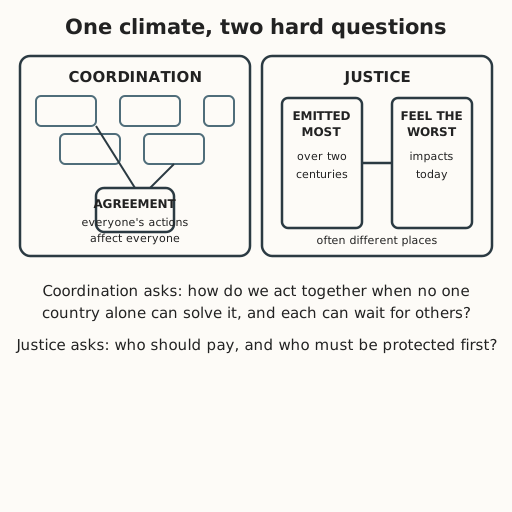
Climate change is the clearest example of a problem no one can solve alone. The carbon one country burns warms every country, so acting alone is costly and waiting is tempting — yet if everyone waits, everyone loses. That is the coordination problem. And the problem has a second face: the countries that emitted the most over two centuries are often not the countries feeling the worst impacts today. That is the justice problem — who should pay, and who must be protected first. The agreements nations sign are attempts to hold these two problems together in one document, and reading them well means seeing both at once.
Materials
- Policy-analysis organizer
- Stewardship journal
- Question cards (low-tech: paper)
Preparation
- Copy or draw the organizer; prepare the question cards.
- Retrieval: from Lessons 9–11, the cycles (and from Lesson 3, uneven distribution). Today we analyze the policy that responds to those systems.
- Prepare the policy facts: the IPCC is the authoritative intergovernmental body summarizing climate science, including who is most exposed and least able to adapt (S-005). The places that emitted most greenhouse gases over two centuries are often not the places that feel the worst impacts (Our World in Data, S-006). The UN climate process and the Paris Agreement are the central multilateral attempts to coordinate a response, with the principle of “common but differentiated responsibilities” (IPCC, S-005, as the authoritative frame). The idea that development and environment must be pursued together traces to the Brundtland Report’s “sustainable development” (S-395).
Facilitator note
This lesson is written to the learner (“you”). The idea to land: a climate agreement is an attempt to solve two problems at once — coordination (a shared system no one can fix alone, where each can wait for others) and justice (the biggest historical emitters and the most exposed are often not the same places; IPCC, S-005; Our World in Data, S-006). The agreement’s central principle — “common but differentiated responsibilities” — is the document’s answer to the justice problem, and it is exactly what makes the negotiation hard. The Brundtland framing of “sustainable development” (S-395) is the older idea these agreements build on.
Two things to hold. First, teach the structure of the problem, not a scoreboard of which country is good or bad — the point is that coordination and justice pull in different directions, and policy is the art of holding both. Second, distinguish evidence (what the science and data show — who emits, who is exposed) from value (what is fair — who should pay), and mark plainly that “common but differentiated responsibilities” is a value choice embodied in a document, not a scientific fact.
The environment lens is core (the system being governed). The ethics lens: what the rich and the exposed owe each other. The egalitarianism lens: justice is the second half of this lesson. The global lens is the frame itself — multilateral policy. The critical-thinking lens: separating coordination from justice so each can be analyzed, then seeing how the agreement braids them.
Procedure
- Recall (5 min). From Lessons 9–11, what did you learn about how the carbon cycle connects everyone? Today: how do nations govern that shared system?
- Meet the two problems (12 min). Coordination — the carbon one country burns warms every country; no one can solve it alone, and each can wait for others to act first. Justice — the places that emitted most over two centuries are often not the places feeling the worst impacts (S-006; S-005). Name each problem in your own words.
- Read the agreement (12 min). The UN climate process and the Paris Agreement are the central attempts to coordinate a response, built on “common but differentiated responsibilities” (S-005) and the older idea of sustainable development (S-395). In your organizer, list the agreement’s main features.
- Sort the questions (12 min). With a partner, sort each feature: does it answer a coordination question or a justice question? Mark the ones that try to do both.
- Evaluate the hardest question (9 min). Choose the single hardest question the agreement faces — coordination or justice — and write one paragraph on why it is hard and what would count as progress on it.
- Close (5 min). Say, in your own words, why a climate agreement is not a science document but a justice document about a scientific fact.
Differentiation
- Support: Name one coordination problem and one justice problem, leaving the feature-sorting aside.
- Extension: Compare the climate agreement’s structure to another global environmental agreement (e.g., the Convention on Biological Diversity, S-279) and note one coordination or justice question they share.
Assessment
- Formative (peer + self): Can the learner name the two problems, connect them to the agreement’s features, and evaluate the hardest question it raises?
- Portfolio artifact (unit): The completed organizer with the “hardest question” paragraph, opened in the stewardship journal.
Home connection
Ask someone at home how they would divide responsibility for a shared problem that no one caused alone — the litter on a shared street, or the shared air. Write one sentence on their answer and one on whether it matches “common but differentiated responsibilities.”
Resources
- On climate science and who is most exposed: IPCC (S-005).
- On who emitted versus who is exposed: Our World in Data (S-006).
- On sustainable development: Brundtland Report, Our Common Future (S-395).
- On another global environmental agreement: Convention on Biological Diversity (S-279).
- On worked examples and guided practice for analysis: Kirschner, Sweller & Clark (2006) (S-011).