Lesson 01 — What Trust Is Made Of
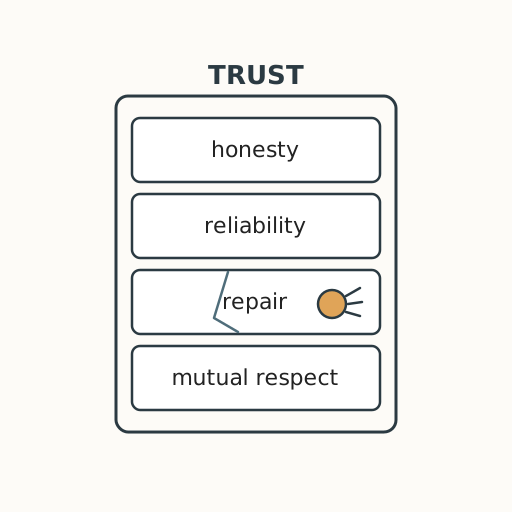
Learners name what trust is actually made of — honesty, reliability, repair, and mutual respect — and see it as something built and rebuilt by repeated small acts, not a single promise. They work a model example, sort real moments by which block they show, and write one example of their own without disclosing anything private.
Objectives
Objectives
- D02.S1.12.01 Sustain intimate, trusting relationships through honest communication, repair, and mutual respect.
Essential question
What is trust actually made of, and how is it built and rebuilt over time?
Key vocabulary
Materials
Standard materials
- Trust-building-blocks diagram · 1 per learner A four-block diagram — honesty, reliability, repair, respect — with space to write one small real example under each
- Care journal · 1 per learner The unit-long notebook for reflections, maps, and capstone portfolio artifacts
Low-tech / no-cost
- Paper and pencil To draw the four blocks by hand and write one example under each
- A short story shared aloud, in sign, or in print The facilitator tells (or signs, or shares in print) a two-minute story of a friendship that survived a broken promise, so no printed text is required
Enriched / lab & device
- One plain-language page on trust in relationships · 1 per pair A page distinguishing trust (built by repeated honest, reliable, respectful acts) from blind faith, to ground the model step
Works in different contexts
- large-group Build the four blocks whole-class on the board, then pairs each add their own example to one block
- multi-age Younger learners name one person they trust and one thing that person does to earn it; older learners analyze which block is hardest to rebuild after it breaks
- self-directed A learner draws the four blocks alone and writes one example under each from a story, film, or their own observation — without naming anyone private
- level-grouped A ready group also distinguishes trust from obedience and from blind faith, and argues where the line falls
- outdoor-only Stand at four marked spots in a wide space — honesty, reliability, repair, respect — and move to the one a story most shows, then say (or write, sign, or gesture) why
Lesson 1 — What Trust Is Made Of
Summary
Learners name what trust is actually made of — honesty, reliability, repair, and mutual respect — and see it as something built and rebuilt by repeated small acts, not a single promise. They work a model example, sort real moments by which block they show, and write one example of their own without disclosing anything private.
Objectives
- Analyze what sustains intimate, trusting relationships — honesty, repair, and mutual respect — and name the small repeated acts that build them. (D02.S1.12.01)
Connection
Think of someone you trust enough to tell the truth to. You did not decide to trust them in one dramatic moment; you built it, quietly, over many small moments — times they kept a promise, owned a mistake, and treated you as your equal. The same is true in reverse: you are trusted because of small repeated acts, not one grand declaration. This unit begins with those small acts, because that is what intimate trust is actually made of — and what lets it be repaired when it cracks.
Materials
- Trust-building-blocks diagram
- Care journal
- Paper and pencil (low-tech)
- Trust in relationships page (enriched)
Preparation
- Copy or draw the trust-building-blocks diagram.
- Retrieval: from Grade 11 (D02.S1.11.02), building and maintaining close, trusting relationships; from Unit 1 this year (D01.S1.12.01), how feeling shapes judgment. Today we name the ingredients of trust.
- Prepare plain definitions (model once: Kirschner, Sweller & Clark, S-011): trust is the confidence that another will act with your wellbeing in mind, built by repeated honest (truthful), reliable (keeps promises), and respectful (treats you as an equal) acts — and restored by repair after harm.
Facilitator note
This lesson is written to the learner (“you”). The idea to land: trust is a structure of repeated small acts — honesty, reliability, respect — that survives because it can be repaired when it cracks. This is a description of how trust works, not a demand that learners trust more or trust specific people. Keep the lesson about the pattern, not about any learner’s private relationships.
The ethics lens: what we owe someone who trusts us, and what we owe when we break trust, is the open question this lesson plants. The egalitarianism lens: respect — treating the other as an equal — is the block that keeps trust from curdling into control or dependence. The global lens: how trust is built and signaled differs across cultures — a promise kept may be shown by a word, a gift, a shared meal, or showing up; none is the default. The technology lens: digital life changes the evidence of trust — a delayed reply, a read receipt, a message stripped of tone all carry different weight than a face-to-face promise, so the same small acts read differently online (Suler, S-343). The environment lens: we also build a kind of trust with the living world — a garden that is tended, a river kept clean — a relationship of reliability whose breakage (a dry season, a poisoned stream) we can also feel as a betrayal. Preview: Lessons 2–4 take up honesty, repair, and growth as a listener.
Safeguarding: no learner is asked to name or disclose a real, private relationship. All examples are fictional or from observation/story, and learners may always write “a character” instead of a person they know.
Procedure
- Recall (5 min). From Grade 11: what makes a relationship close and trusting rather than merely friendly? Today we open the box and name the ingredients.
- Meet the four blocks (10 min). Work a model example first (S-011): two friends, one breaks a promise to keep the other’s secret. Name what kept the friendship standing: honesty (they finally told the truth), reliability (they usually kept promises), repair (they owned it and made it right), and mutual respect (they treated each other as equals, not as boss and follower).
- Sort real moments (12 min). With a partner, sort small everyday moments — keeping a promise, admitting a lie, listening without interrupting, showing up on time, blaming someone else — by which block each one builds or chips away. Argue (aloud or in writing) the borderline ones.
- Argue the hardest block (8 min). Which block is hardest to rebuild once it breaks — honesty, reliability, or respect? Choose one, argue (aloud or in writing), then agree on a place.
- Draw your own blocks (12 min). In your care journal, draw the four blocks and write one small, real act under each — from a story, a film, or your own observation (no private names needed). Mark with a small crack the one that is hardest to repair.
- Close (4 min). Say (or write, sign, type, or gesture), in one sentence, what trust is made of — and why a single promise is not enough to build it.
Differentiation
- Support: Name just two blocks and one small act for each, leaving repair and respect for later.
- Extension: Compare how one of the four blocks behaves in a face-to-face friendship versus an online one, and write two sentences on the difference.
- Communication access: Every step that asks a learner to say or argue can be completed in writing, signing, typing, AAC, or gesture — including pointing to a block or handing over a written note. Learners who are non-speaking, d/Deaf, or hard-of-hearing complete every task in their preferred mode.
Assessment
- Formative (peer + self): Can the learner name the four blocks, sort moments with reasons, and write one real example of each without disclosing anything private?
- Portfolio artifact (unit): The four-block diagram with examples, opened in the care journal.
Home connection
Ask someone at home what one small repeated act makes them trust a person — and what it takes to earn back trust after it breaks. Write one sentence on each.
Resources
- On trust as a relationship skill within social-emotional learning: CASEL (S-001).
- On how digital communication strips the tone and timing cues that signal trust: Suler, “The Online Disinhibition Effect” (2004) (S-343).
- On worked examples for a new analytical skill: Kirschner, Sweller & Clark (2006) (S-011); on spaced retrieval across the unit: Dunlosky et al. (2013) (S-039).