Lesson 02 — The Hard Conversation
Learners practice saying something hard honestly and without blame, using a four-part sentence — observation, feeling, need, request — drawn from needs-based communication (Rosenberg, S-148). They convert blame sentences into honest ones, work a model example, and practice a fictional hard conversation, then notice their own habit of blaming or softening.
Objectives
Objectives
- D02.S1.12.01 Sustain intimate, trusting relationships through honest communication, repair, and mutual respect.
- D02.S1.12.02 Reflect on their own communication and relationship habits and commit to growing as a listener and partner.
Essential question
How do I say something hard — honestly and without blame — so that a relationship gets stronger instead of weaker?
Key vocabulary
Materials
Standard materials
- Four-part sentence frame · 1 per learner A fill-in frame — 'When I saw/heard ____, I felt ____, because I need ____. Would you be willing to ____?' — for honest, blame-free talk
- Hard-conversation scenario cards · 1 set per pair Fictional situations (a friend broke a promise; a partner kept canceling; a sibling borrowed without asking) written gently, no graphic detail
Low-tech / no-cost
- Paper and pencil To write the four-part sentence by hand
- Voice and body (or pen, screen, or hands) Practice the sentence aloud — or write, sign, type, or gesture it — so no printed cards are needed
Enriched / lab & device
- One plain-language page on nonviolent communication · 1 per pair A page explaining observation, feeling, need, and request as four moves that carry hard truths without blame
Works in different contexts
- large-group Model one scenario whole-class on the board, then pairs each write and practice a second
- multi-age Younger learners fill in "When you ____, I felt ____"; older learners complete all four moves and test them on a tough scenario
- self-directed A learner fills the frame for a fictional situation, reads it aloud or silently (or signs/types it) to themselves, and revises once to remove any blame
- level-grouped A ready group also rewrites a blame sentence ("You always…") into the four-part form and compares the two
- outdoor-only Walk through the four moves as four steps on the ground — observe, feel, need, ask — then speak them in order, or write/sign/gesture each move as you step to it
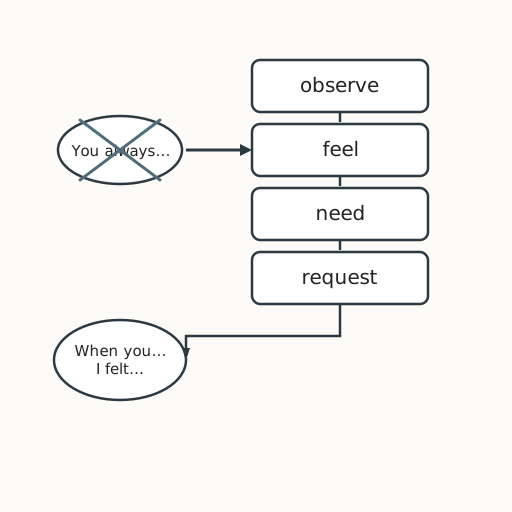
Lesson 2 — The Hard Conversation
Summary
Learners practice saying something hard honestly and without blame, using a four-part sentence — observation, feeling, need, request — drawn from needs-based communication (Rosenberg, S-148). They convert blame sentences into honest ones, work a model example, and practice a fictional hard conversation, then notice their own habit of blaming or softening.
Objectives
- Use honest, needs-based communication to sustain an intimate, trusting relationship through a hard conversation. (D02.S1.12.01)
- Reflect on one’s own habit of blaming or softening, and take one step toward speaking honestly without blame. (D02.S1.12.02)
Connection
Every close relationship hits a moment where the truth is uncomfortable to say: a promise broken, a pattern that hurts, a need that keeps going unmet. The temptation is to do one of two things — say it as blame (“You always…”), which puts the other person on the defensive, or swallow it entirely, which lets the hurt fester. There is a third way: name what happened, own what you felt, name what you need, and make a request. This lesson practices that third way, because a relationship grows through honest words, not around them.
Materials
- Four-part sentence frame
- Hard-conversation scenario cards
- Paper and pencil (low-tech)
- Nonviolent communication page (enriched)
Preparation
- Copy or draw the four-part sentence frame; prepare the scenario cards, kept fictional and gentle.
- Retrieval: from Lesson 1, the four blocks of trust. Today we practice the honesty block in a hard moment.
- Prepare plain definitions (model once: Kirschner, Sweller & Clark, S-011): observation (what happened, without judgment), feeling (your own emotion), need (what matters to you), request (a concrete, negotiable ask) — the four moves of needs-based communication (Rosenberg, S-148). Blame is naming the other as the problem (“you always…”); honest talk names the situation and my own need.
Facilitator note
This lesson is written to the learner (“you”). The idea to land: honest communication names what happened, what I felt, what I need, and what I ask — without turning the other person into the villain. The four-part form is a widely used, needs-based approach (Rosenberg, S-148); hold it as a useful tool, not the only way people speak honestly across cultures.
The ethics lens: honesty has a shape — it aims at the truth and at the relationship, not at wounding. The egalitarianism lens: blame puts one person above the other as judge; the four-part form treats both as equals with needs of their own. The global lens: how directly people speak hard truths differs across cultures — some value directness, some indirectness, some third-party mediation; the frame is a tool to adapt, not a universal script. The technology lens: a hard truth sent by text arrives without tone, face, or a chance to repair in real time, so digital honesty needs extra care — or a decision to speak in person (Suler, S-343). The critical-thinking lens: separate the observation (what happened) from the story you are telling yourself about it, and you are halfway to honest talk. Preview: Lesson 3 turns to repair after harm.
Safeguarding: all scenarios are fictional. No learner is asked to script a real private conflict; they may always use a character.
Procedure
- Recall (5 min). From Lesson 1: what are the four blocks of trust? Today we work on honesty in the moment it is hardest.
- Meet the four moves (10 min). Work a model example first (S-011): a friend keeps canceling plans at the last minute. Blame sounds like “You’re so selfish — you never show up.” Honest talk sounds like: “When you canceled three times this month (observation), I felt hurt and unimportant (feeling), because I need to feel my time and my friendship are valued (need). Would you be willing to let me know earlier, or pick a time you can keep (request)?” Name each move.
- Convert blame into honesty (12 min). In pairs, take blame sentences (“You always ignore me,” “You never listen”) and rewrite each into the four-part form. Check each other’s: is it an observation, or still a judgment?
- Practice a hard conversation (12 min). Choose one scenario card. Write your four-part sentence, then deliver it to your partner as the other character — say it aloud, or write, sign, type, or gesture it. The listener responds (in their preferred mode), and you revise once to keep it honest and unblaming.
- Reflect on your own habit (8 min). In your care journal: when you have to say something hard, do you tend to blame, or to soften and stay silent? Write one sentence on each, and one step you will try.
- Close (4 min). Say (or write, sign, type, or gesture) the four moves in order, and why the order matters.
Differentiation
- Support: Complete only the observation and feeling moves, and speak them aloud once — or write, sign, type, or gesture them.
- Extension: Take a real hard truth you want to say (privately) and draft it in the four-part form — then revise it for tone, and test it against the “is it still blame?” check.
- Communication access: “Saying” a hard truth here means delivering it — aloud, in writing, in sign, by typing, by AAC, or by gesture. Learners who are non-speaking, d/Deaf, or hard-of-hearing deliver and receive each part in their preferred mode; a written or signed four-part sentence is a complete four-part sentence.
Assessment
- Formative (peer + self): Can the learner name the four moves, convert a blame sentence into honest talk, and practice delivering it with a partner — aloud, in writing, in sign, or by AAC?
- Portfolio artifact (unit): The rewritten four-part sentence plus the written reflection on their own blaming/softening habit, in the care journal.
Home connection
Notice one small moment at home where someone said something hard (or avoided it). Write one sentence on how it was said and one on how it could have been said without blame.
Resources
- On needs-based, blame-free communication (observation, feeling, need, request): Rosenberg, Nonviolent Communication (S-148).
- On how digital messages strip tone and invite misreading in hard conversations: Suler (2004) (S-343).
- On worked examples for a new communication skill: Kirschner, Sweller & Clark (2006) (S-011); on spaced retrieval: Dunlosky et al. (2013) (S-039).