Lesson 11 — A Personal Ethic of Care
Learners articulate their own personal ethic of care, cooperation, and mutual aid in words they can live by. They distinguish a value (what I hold matters) from a commitment (what I will actually do), meet the ethic of reciprocity with people and the living world, and write a three-line ethic statement — I care about, because, therefore I will — then test it for honesty.
Objectives
Objectives
- D02.S4.12.01 Articulate a personal ethic of care, cooperation, and mutual aid for a just and thriving world.
Essential question
What is my own ethic of care, cooperation, and mutual aid — and how do I put it into words I can live by?
Key vocabulary
Materials
Standard materials
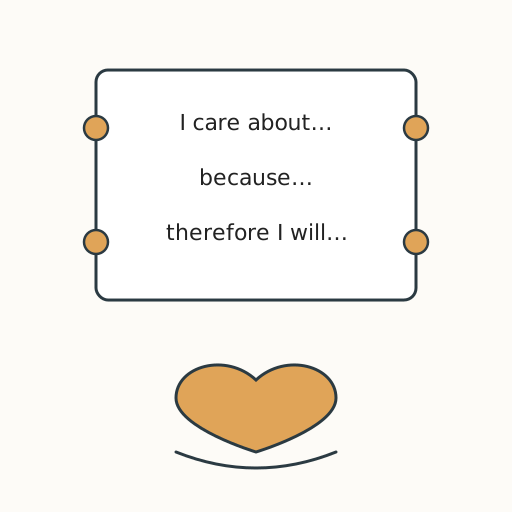
- Ethic-statement scaffold · 1 per learner A fill-in scaffold — 'I care about…; because…; therefore I will…' — for articulating a personal ethic of care, cooperation, and mutual aid
- Care journal · 1 per learner The unit-long notebook for reflections and capstone portfolio artifacts
Low-tech / no-cost
- Paper and pencil To write the ethic statement by hand
- Voice and body (or pen, screen, or hands) Deliver the ethic to a partner — aloud, in writing, or in sign — so no printed scaffold is needed
Enriched / lab & device
- One plain-language page on care and reciprocity · 1 per pair A page on the ethic of reciprocity with people and the living world — care as relationship, not duty alone — to ground the statement"
Works in different contexts
- large-group Build one model ethic statement whole-class, then each learner writes their own and shares one line
- multi-age Younger learners say (or write, sign, or gesture) one thing they care about and one way they care for it; older learners write and defend a full ethic statement
- self-directed A learner fills the scaffold alone, revises it once for honesty, and reads it aloud or silently (or signs/types it) to themselves
- level-grouped A ready group also distinguishes a value (what I hold matters) from a commitment (what I will actually do) and tests their statement for both
- outdoor-only Walk while composing the three lines — care about, because, therefore I will — then stop and deliver the whole ethic to a partner, aloud, in writing, or in sign
Lesson 11 — A Personal Ethic of Care
Summary
Learners articulate their own personal ethic of care, cooperation, and mutual aid in words they can live by. They distinguish a value (what I hold matters) from a commitment (what I will actually do), meet the ethic of reciprocity with people and the living world, and write a three-line ethic statement — I care about, because, therefore I will — then test it for honesty.
Objectives
- Articulate a personal ethic of care, cooperation, and mutual aid for a just and thriving world. (D02.S4.12.01)
Connection
An ethic is not a poster on a wall; it is a sentence you can actually steer by. Most of us carry care as a loose feeling — we would help, we are not cruel — but a feeling that is never put into words is easy to forget in the moment it matters. Putting your ethic into three plain lines — what you care about, why, and what you will therefore do — turns a vague warmth into a commitment you can keep or break, and therefore examine. This lesson asks you to write yours.
Materials
- Ethic-statement scaffold
- Care journal
- Paper and pencil (low-tech)
- Care and reciprocity page (enriched)
Preparation
- Copy or draw the ethic-statement scaffold.
- Retrieval: from Lessons 5–10, empathy into reasoning, dignity for the more-than-human, nested communities, solidarity, and the common good. Today we distill it into one ethic.
- Prepare plain definitions (model once: Kirschner, Sweller & Clark, S-011): an ethic of care is a stance that sees relationship and need as central to right action. Cooperation is acting together toward a shared good; mutual aid is meeting one another’s needs as equals (Kropotkin, S-163; Spade, S-345). Reciprocity is the pattern of taking and giving back that keeps relationships alive (Kimmerer, S-427).
Facilitator note
This lesson is written to the learner (“you”). The idea to land: a personal ethic is a value plus a commitment — what I hold matters, and what I will therefore do — and putting it into words is what makes it liveable and examinable. Mutual aid is a well-documented human practice (Kropotkin, S-163), and the care-vs-charity distinction (where the power sits) is a real one (Spade, S-345). Hold “care is good” as a value the curriculum affirms, distinct from the fact that mutual aid traditions are widespread.
The ethics lens: this is the lesson where the learner states, rather than only analyzes, what they hold right — the capstone of the unit’s ethical strand. The egalitarianism lens: an ethic of care that serves only people who look like me is only half an ethic; test yours against the person least like you. The global lens: ethics of care and reciprocity are not one culture’s possession — they appear in Indigenous reciprocity, in African harambee, in Indonesian gotong royong, in Andean mink’a (S-164) — many names for one recognition. The environment lens: a just and thriving world includes the living Earth; an ethic of care that stops at humans leaves out the world that holds us (Kimmerer, S-427). The technology lens: technology is a servant of the ethic — the question is whether the tools I use extend care or only efficiency; name one tool you will use for your ethic, and one you will not let override it. Preview: Lesson 12 turns the ethic into practice, distinguishing mutual aid from charity.
Safeguarding: the ethic is personal and may be shared only in part; there is no single correct ethic, only honesty and the test that it serves others, not only oneself.
Procedure
- Recall (5 min). From Lessons 5–10, name three ideas you want your own ethic to carry. Today we write it.
- Meet value vs. commitment (10 min). Work a model example (S-011): “I value fairness” is a value; “I will divide shared work so no one carries more than their share” is a commitment. An ethic needs both. Name the difference, and the ethic of reciprocity — taking and giving back (Kimmerer, S-427).
- Write your ethic (15 min). On the scaffold, write three lines: I care about… (name it), because… (say why it matters), therefore I will… (name a concrete commitment). Make the commitment real — small enough to keep, big enough to mean something.
- Test it against the least-like-you (8 min). Does your ethic serve someone very unlike you — distant, poor, older, or not yet born? Does it serve the living world? If not, revise one line until it does.
- Share it (8 min). In pairs, deliver your three lines to a partner — aloud, in writing, in sign, or by typing. The partner asks one question — “what would that actually look like this month?” — and you answer (in any mode), then revise once for honesty.
- Close (4 min). Say (or write, sign, type, or gesture), in one sentence, the ethic you will carry out of this lesson — and one way you will keep it from staying just words.
Differentiation
- Support: Complete two lines — what you care about and one thing you will do — and deliver them aloud, in writing, or in sign.
- Extension: Write a one-page statement that connects your ethic to the unit’s ideas — trust, empathy, nested communities, solidarity, and the more-than-human — and name one place it will be tested.
- Communication access: An ethic statement is written here, and may be shared aloud, in sign, by typing, or by AAC — or kept written only. Learners who are non-speaking, d/Deaf, or hard-of-hearing write and share their ethic in their preferred mode; the written statement is the artifact, not the speaking of it.
Assessment
- Formative (self + peer): Can the learner distinguish value from commitment, write a three-line ethic that includes a concrete commitment, and test it against someone unlike themselves and the living world?
- Portfolio artifact (unit): The ethic statement, in the care journal — the unit’s central capstone artifact, returned to in Lesson 14.
Home connection
Share your ethic statement with someone at home — read it aloud, or show them the written or signed version — and ask them to name one place they think it will be hard to keep. Write one sentence on their answer.
Resources
- On mutual aid as a widespread human practice: Kropotkin, Mutual Aid (S-163).
- On the distinction between charity and mutual aid (where the power sits): Dean Spade, Mutual Aid (S-345).
- On reciprocity with the living world: Kimmerer, Braiding Sweetgrass (S-427).
- On named mutual-aid traditions worldwide (harambee, gotong royong, mink’a, barn raising): the “Communal work” entry (S-164).
- On worked examples for a new writing skill: Kirschner, Sweller & Clark (2006) (S-011); on spaced retrieval: Dunlosky et al. (2013) (S-039).