Lesson 10 — Weighing Solidarity
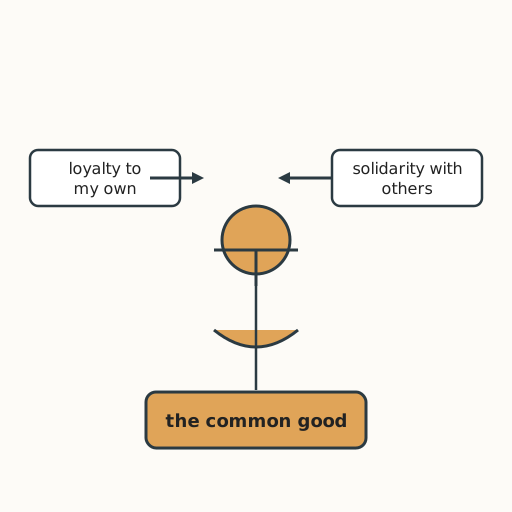
Learners weigh belonging, solidarity, and collective responsibility when they pull in different directions, and decide how to act for the common good. They meet the free-rider problem — when individual or in-group advantage pulls against the shared good — and practice a disciplined weighing: name the loyalties, name the costs, then decide with reasons.
Objectives
Objectives
- D02.S3.12.02 Weigh belonging, solidarity, and collective responsibility in deciding how to act for the common good.
Essential question
When belonging, solidarity, and collective responsibility pull in different directions, how do I decide what to do for the common good?
Key vocabulary
Materials
Standard materials
- Solidarity weighing sheet · 1 per learner A decision sheet — the choice, the loyalties pulling each way, the cost to each side, and a reasoned decision — for one real common-good dilemma
- Common-good dilemmas · 1 set per group Real dilemmas where belonging and solidarity pull apart — a community protecting its own water, a nation deciding on refugees, a neighborhood sharing a scarce resource — described factually
Low-tech / no-cost
- Paper and pencil To write the weighing by hand
- Voice and body (or pen, screen, or hands) Argue each side and take a stand — aloud, in writing, or in sign — so no printed sheets are needed
Enriched / lab & device
- One plain-language page on commons and free-riding · 1 per pair A page on shared resources and the free-rider problem — when individual advantage pulls against the common good — and how communities meet it"
Works in different contexts
- large-group Weigh one dilemma whole-class on the board, then groups each take a second and report their decision and reasoning
- multi-age Younger learners name who would be helped and who would lose in one dilemma; older learners weigh the trade-off and defend a reasoned decision
- self-directed A learner fills the weighing sheet alone for one dilemma and writes a three-sentence reasoned decision
- level-grouped A ready group also identifies the free-rider problem in the dilemma and proposes how the community could meet it fairly
- outdoor-only Stand at three marked spots — my group's good, others' good, the common good — and physically move to where you would act, then defend the spot (aloud, in writing, or in sign)
Lesson 10 — Weighing Solidarity
Summary
Learners weigh belonging, solidarity, and collective responsibility when they pull in different directions, and decide how to act for the common good. They meet the free-rider problem — when individual or in-group advantage pulls against the shared good — and practice a disciplined weighing: name the loyalties, name the costs, then decide with reasons.
Objectives
- Weigh belonging, solidarity, and collective responsibility in deciding how to act for the common good. (D02.S3.12.02)
Connection
Sometimes the thing that is good for my people and the thing that is good for everyone are not the same. A village may need the river’s water that a downstream city also drinks. A nation may want to keep its wealth to itself while others starve. A neighborhood may want a forest for timber while the region needs it for flood control. In those moments, solidarity is not automatic — it is a decision, made by weighing loyalties and costs, and it is exactly the decision this lesson practices. Because a common good is not a thing that happens to you; it is a thing you help choose.
Materials
- Solidarity weighing sheet
- Common-good dilemmas
- Paper and pencil (low-tech)
- Commons and free-riding page (enriched)
Preparation
- Copy or draw the solidarity weighing sheet; prepare the dilemmas, kept factual.
- Retrieval: from Lesson 9, the us/them line; from Grade 8 (D02.S4.08.02), the difference between charity and solidarity. Today we weigh solidarity as a decision.
- Prepare plain definitions (model once: Kirschner, Sweller & Clark, S-011): solidarity is acting with others across difference for a shared good. The common good is what benefits the whole, not only one part. A free-rider is someone who takes the benefit of a shared effort without paying its cost — the pull of individual advantage against the common good. Collective responsibility is what we owe because we share the outcome.
Facilitator note
This lesson is written to the learner (“you”). The idea to land: solidarity is a decision, made by honestly weighing loyalty to one’s own against obligation to the whole — and the common good is chosen, not automatic. The free-rider problem is a well-documented feature of shared resources (Ostrom, S-416); hold it as description, not as a claim that people are selfish. Ostrom’s work shows communities can govern commons fairly by their own rules — so the dilemma is real but not hopeless.
The ethics lens: the weighing itself is the ethical act — naming the loyalties and costs before deciding. The egalitarianism lens: the common good is often invoked to hide who actually pays — so ask who bears the cost and who reaps the benefit. The global lens: the same dilemma recurs worldwide — water, borders, forests, fisheries — and communities answer it differently; none is the default. The technology lens: technology changes the commons — a global commons like the atmosphere or the ocean is harmed by actions in many places at once, and digital networks can either coordinate solidarity across borders or let free-riding hide in plain sight (IPCC, S-005; Britannica, S-481). The environment lens: the largest commons are environmental — clean air, stable climate, shared water — where one place’s gain is everyone’s loss, the purest case of the weighing. Preview: Lesson 11 turns the weighing into a personal ethic of care.
Safeguarding: dilemmas are structural (water, borders, resources), never about a learner’s identity; no one is asked to argue against their own people’s survival.
Procedure
- Recall (5 min). From Lesson 9: the us/them line and who pays it. Today we decide across that line.
- Meet the free-rider problem (10 min). Work a model example (S-011): a shared fishery where each boat gains by taking more, but if all take more the fish vanish. Name the pull: individual gain vs. the common good — and that communities can and do make rules to meet it (Ostrom, S-416).
- Weigh a dilemma (15 min). In a group, take a common-good dilemma. On the sheet, name the choice, the loyalties pulling each way, the cost to each side, and who bears it.
- Decide and defend (12 min). Decide how to act for the common good, and defend it — aloud or in writing — but you must name the cost of your decision and who pays it. A decision that denies its cost is not a decision; it is a wish.
- Find the free-rider (8 min). In your care journal, name where the free-rider pull shows up in the dilemma — who could take the benefit without paying the cost — and one fair rule that could meet it.
- Close (4 min). Say (or write, sign, type, or gesture), in one sentence, what the common good is — and why it is chosen, not automatic.
Differentiation
- Support: Name who is helped and who is hurt by one choice, and say (or write/sign) which choice you would make and why in one sentence.
- Extension: Write a short argument that applies the weighing to a real current common-good dilemma (a river, a border policy, a climate choice), naming loyalties, costs, and a reasoned decision.
- Communication access: Defending a decision may be spoken, written, signed, typed, gestured, or AAC; a written or signed defense that names its own cost is complete. Learners who are non-speaking, d/Deaf, hard-of-hearing, or AAC users complete every step in their preferred mode.
Assessment
- Formative (peer + self): Can the learner name solidarity, the common good, and the free-rider problem, weigh a dilemma’s loyalties and costs, and defend a decision that names its own cost?
- Portfolio artifact (unit): The solidarity weighing sheet, in the care journal.
Home connection
Notice one shared resource your household or neighborhood uses together — water, electricity, a shared space — and ask who pays its cost and who free-rides. Write one sentence on what you noticed.
Resources
- On communities governing shared resources fairly by their own rules: Elinor Ostrom, Governing the Commons (S-416).
- On climate and the shared atmosphere/ocean as a global commons: IPCC (S-005).
- On digital networks and the coordination of (or flight from) solidarity: Encyclopaedia Britannica, “Social media” (S-481).
- On worked examples for a new decision skill: Kirschner, Sweller & Clark (2006) (S-011); on spaced retrieval: Dunlosky et al. (2013) (S-039).