Lesson 13 — Local Action, Global Solidarity
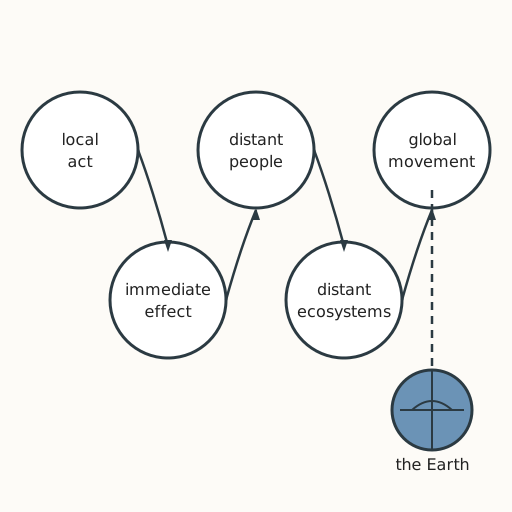
Learners connect local action to global solidarity, and plan one real act of collective responsibility for people and the Earth. They trace a chain — a local act, its immediate effect, its connection to distant people and ecosystems, and its contribution to a global movement — and study documented cases where local action scaled worldwide.
Objectives
Objectives
- D02.S4.12.02 Act on collective responsibility for people and the Earth, connecting local action to global solidarity.
Essential question
How does what I do *here* connect to people and the Earth *everywhere* — and how do I act on collective responsibility so local action becomes global solidarity?
Key vocabulary
Materials
Standard materials
- Local-to-global chain map · 1 per learner A chain — my local act, its immediate effect, its connection to distant people or ecosystems, its contribution to a global movement — for planning one real action
- Local-to-global case cards · 1 set per group Documented cases where local action scaled to global solidarity — a tree-planting movement that crossed borders, a community defending its water, a neighborhood mutual-aid network that inspired others — described factually
Low-tech / no-cost
- Paper and pencil To draw the chain and write the plan by hand
- Voice and body (or pen, screen, or hands) Tell the chain, link by link — aloud, in writing, or in sign — so no printed cards are needed
Enriched / lab & device
- One plain-language page on environmental justice and the commons · 1 per pair A page on how environmental burdens fall unevenly and how communities defend shared resources, connecting local harm to global patterns"
Works in different contexts
- large-group Build one chain whole-class, then each learner plans their own local action and names its global link
- multi-age Younger learners name one local act and who far away it might help; older learners map the full chain and argue which link is strongest
- self-directed A learner plans one local action alone and writes the chain linking it to distant people or ecosystems
- level-grouped A ready group also analyzes where a local action could *harm* distant people or ecosystems, and redesigns it to avoid that
- outdoor-only Stand in one place, then walk the chain — here, then downstream, then across the world — naming each link as you go, aloud or by writing/signing at each stop
Lesson 13 — Local Action, Global Solidarity
Summary
Learners connect local action to global solidarity, and plan one real act of collective responsibility for people and the Earth. They trace a chain — a local act, its immediate effect, its connection to distant people and ecosystems, and its contribution to a global movement — and study documented cases where local action scaled worldwide.
Objectives
- Act on collective responsibility for people and the Earth, connecting local action to global solidarity. (D02.S4.12.02)
Connection
No action stays where it happens. A tree planted on one street shades one block and, multiplied across a movement, becomes millions of trees on another continent — Wangari Maathai began with seedlings in a Nairobi backyard and the Green Belt Movement crossed borders. A neighborhood that defends its water is part of a worldwide pattern: the people who bear environmental harm are rarely the people who caused it, and the same fight is fought in a thousand places. This lesson asks you to see your local act as one link in a chain that reaches the whole Earth — and to plan it that way.
Materials
- Local-to-global chain map
- Local-to-global case cards
- Paper and pencil (low-tech)
- Environmental justice and the commons page (enriched)
Preparation
- Copy or draw the local-to-global chain map; prepare the case cards, kept factual.
- Retrieval: from Lesson 12, mutual aid and shared power; from Lesson 10, the commons and the common good. Today we scale the commons to the planet.
- Prepare plain definitions (model once: Kirschner, Sweller & Clark, S-011): local action is what I do where I am; global solidarity is acting with distant others across difference for a shared good. Environmental justice is the fair treatment of all people in environmental decisions — because burdens fall unevenly (Bullard, S-484). The commons are shared resources governed for the whole (Ostrom, S-416).
Facilitator note
This lesson is written to the learner (“you”). The idea to land: local action and global solidarity are one chain, not two separate things — and collective responsibility means planning the link, not just the act. The cases are documented: the Green Belt Movement began locally and planted over thirty million trees across Africa (S-059); environmental burdens fall unevenly — the field’s founding finding (Bullard, S-484); climate is a planetary commons harmed by many local acts at once (IPCC, S-005). Hold “we should act” as a value, distinct from these facts about how the world is connected.
The ethics lens: responsibility does not stop at the edge of my street — the chain is the ethical fact, and ignoring the far end of it is a choice. The egalitarianism lens: who causes harm and who bears it are often different people, in different places — the environmental-justice fact (Bullard, S-484) — so solidarity must cross the gap. The global lens: this is the global lens in action — one chain from a Nairobi backyard to a continent (S-059), from a North Carolina community to a worldwide movement (Bullard, S-484). The environment lens: the Earth is the largest commons, and every local act is a vote in how it is kept or spent (IPCC, S-005; Ostrom, S-416). The technology lens: digital networks are what let a local act find its global kin — a neighborhood group can join a movement on three continents in an afternoon (Britannica, S-481) — the tool that shortens the chain, for better and for worse. Preview: Lesson 14 gathers the whole unit into the ethic you will carry forward.
Safeguarding: the action is small, real, and optional; no one is asked to take on danger or to fix the world alone — one link is enough.
Procedure
- Recall (5 min). From Lesson 12: what makes mutual aid different from charity? Today we scale that “we” to the planet.
- Meet the chain (10 min). Work a model example (S-011): planting a tree in a Nairobi backyard (local act) shades a family (effect), and joined with millions of others (movement) rebuilds watersheds across Africa — the Green Belt Movement (S-059). Name the chain’s links.
- Study local-to-global cases (10 min). Read the cards: a community defending its water against a pipeline; a neighborhood mutual-aid network that others copied; a community that bore environmental harm and organized. Note what each case connected.
- Plan your local action (15 min). On the chain map, plan one real, small act you can take where you are. Then fill each link: its immediate effect, its connection to distant people or ecosystems, and the global movement or pattern it joins.
- Check the far end (8 min). Does your local act harm anyone or anything far away — a product you buy, a resource you use, a stream downstream? If so, revise one link to avoid it. Solidarity means not exporting the harm.
- Close (4 min). Say (or write, sign, type, or gesture), in one sentence, how your local act is one link in a global chain — and which link you will actually take first.
Differentiation
- Support: Name one local act and one person or ecosystem far away it might touch, in one sentence.
- Extension: Write a short account of one documented local-to-global movement (the Green Belt Movement, a water defense, an environmental-justice struggle), naming each link of the chain and what made it scale.
- Communication access: Tracing and naming the chain is a written (or signed, typed, gestured, or AAC) task; the chain map is the answer. Learners who are non-speaking, d/Deaf, hard-of-hearing, or AAC users complete every step in their preferred mode.
Assessment
- Formative (peer + self): Can the learner trace the local-to-global chain, plan one real local action, connect it to distant people/ecosystems, and check the far end for harm?
- Portfolio artifact (unit): The local-to-global chain map, in the care journal.
Home connection
Choose one thing your household buys or uses, and trace its chain back — where it came from and whom its making affected. Write one sentence on what you found.
Resources
- On a local movement scaling globally (Green Belt Movement, over thirty million trees): Nobel Prize, Wangari Maathai (S-059).
- On environmental burdens falling unevenly (the founding finding): Robert Bullard, Dumping in Dixie (S-484).
- On the Earth as a shared commons governed for the whole: Elinor Ostrom, Governing the Commons (S-416); on climate as a planetary commons: IPCC (S-005).
- On digital networks connecting local to global: Encyclopaedia Britannica, “Social media” (S-481).
- On worked examples for a new planning skill: Kirschner, Sweller & Clark (2006) (S-011); on spaced retrieval: Dunlosky et al. (2013) (S-039).