Lesson 14 — The Ethic I Carry Forward
Learners gather the unit into a single carried ethic. They retrieve each of the unit's artifacts — trust, honest talk, repair, listening, empathy into reasoning, many views, more-than-human dignity, nested belonging, solidarity, mutual aid, local-to-global action — and assemble a capstone portfolio that answers one question: what will I actually carry out of here?
Objectives
Objectives
- D02.S4.12.01 Articulate a personal ethic of care, cooperation, and mutual aid for a just and thriving world.
- D02.S4.12.02 Act on collective responsibility for people and the Earth, connecting local action to global solidarity.
- D02.S3.12.01 Articulate their own place within nested communities, from family to the global community of all life.
Essential question
What do I actually carry out of this unit — as a person in relationships, in communities, and in the living world?
Key vocabulary
Materials
Standard materials
- Capstone portfolio sheet · 1 per learner A one-page cover that gathers the unit's artifacts — trust blocks, hard conversation, repair frame, listening commitment, two-column reasoning, perspective matrix, dignity action, nested map, solidarity weighing, ethic statement, mutual-aid plan, local-to-global chain — into a single carried ethic
- Care journal · 1 per learner The unit-long notebook, now assembled into the capstone portfolio
Low-tech / no-cost
- Paper and pencil To write the cover sheet and the carried-ethic statement by hand
- Voice and body (or pen, screen, or hands) Deliver the carried ethic to a partner — aloud, in writing, or in sign — so no printed sheet is needed
Enriched / lab & device
- One plain-language page on spaced retrieval · 1 per pair A page explaining that recalling ideas across time strengthens them — the science-of-learning payoff of the capstone"
Works in different contexts
- large-group A quiet gallery walk of ethic statements, then a closing circle where each learner shares one line they will carry — spoken, written, or signed
- multi-age Younger learners share one thing they learned to do; older learners assemble the full portfolio and deliver their carried ethic — spoken, written, or signed
- self-directed A learner assembles the portfolio alone, writes the carried ethic, and reads it aloud or silently (or signs/types it) to themselves as a promise
- level-grouped A ready group also writes a one-sentence answer to "what would make me abandon this ethic?" — the honest stress-test
- outdoor-only Gather the artifacts in a circle outdoors and, one by one, share a single line of the ethic you will carry into the world — spoken, written, or signed
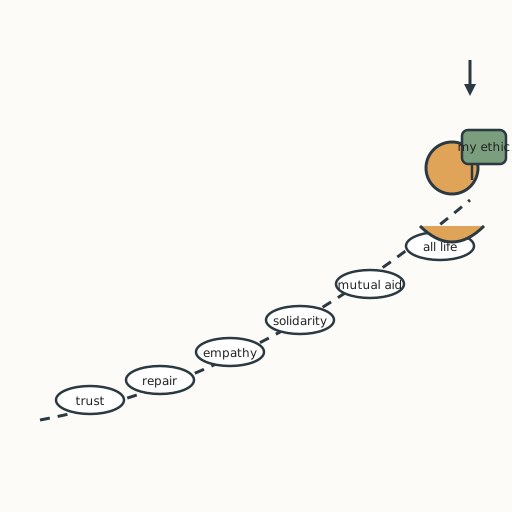
Lesson 14 — The Ethic I Carry Forward
Summary
Learners gather the unit into a single carried ethic. They retrieve each of the unit’s artifacts — trust, honest talk, repair, listening, empathy into reasoning, many views, more-than-human dignity, nested belonging, solidarity, mutual aid, local-to-global action — and assemble a capstone portfolio that answers one question: what will I actually carry out of here?
Objectives
- Articulate a personal ethic of care, cooperation, and mutual aid, and commit to acting on it for people and the Earth. (D02.S4.12.01; D02.S4.12.02)
- Articulate one’s place within nested communities, from family to the global community of all life. (D02.S3.12.01)
Connection
An ethic is only real if it survives the walk out the door. Everything this unit built — the trust you can name, the hard conversation you can hold, the repair you know how to make, the empathy you can reason with, the dignity you can extend to a tree or a river, the rings you can locate yourself in, the solidarity you can weigh, the mutual aid you can practice, the local act you can link to the world — was practice for one thing: carrying a way of being into the rest of your life. This lesson is the act of picking it all up and walking forward with it.
Materials
- Capstone portfolio sheet
- Care journal
- Paper and pencil (low-tech)
- Spaced retrieval page (enriched)
Preparation
- Copy or draw the capstone portfolio sheet; have learners bring their care journals.
- Retrieval across the unit: this lesson is the spaced-retrieval payoff — recalling each idea now, after the spacing of fourteen lessons, strengthens it (Dunlosky, S-039).
- Prepare the one organizing question: what will I actually carry out of this unit — as a person in relationships, in communities, and in the living world?
Facilitator note
This lesson is written to the learner (“you”). The idea to land: the unit’s parts are not separate lessons but one ethic, and the capstone’s job is to integrate them — by recall, not by re-reading. Spaced retrieval across the unit is the evidence-backed way to make the learning last (Dunlosky, S-039); this lesson is that technique enacted, not just described. The capstone is a promise, not a grade; a learner’s ethic is theirs to carry, not yours to judge.
The ethics lens: the capstone is the learner’s own statement of what they hold right — the unit’s ethical strand completed. The egalitarianism lens: the stress-test — “does this ethic serve someone unlike me, and the living world?” — is the egalitarian check, kept to the end. The global lens: the ethic travels — it is one person’s, but it was built from harambee and mink’a, from tree-hugging and tree-planting, from rivers on every continent. The technology lens: name the tool that will serve the ethic and the one that will tempt it — the carried ethic includes a decision about technology. The environment lens: the ethic includes the more-than-human world, because a thriving world is not only a human one (Kimmerer, S-427).
Safeguarding: the carried ethic is shared only in the part the learner chooses; there is no single correct ethic, only honesty, and the invitation to keep revising it for life.
Procedure
- Retrieve the unit (10 min). Without opening your journal, write down, from memory, the key idea of each lesson — trust’s four blocks, the four moves of honest talk, the three questions of repair, the listening commitment, the two columns of reasoning, steelmanning, more-than-human dignity, the nested rings, the us/them line, the common good, the ethic statement, mutual aid, local-to-global. Then open your journal and check what you recalled and what you missed (retrieval: S-039).
- Assemble the portfolio (12 min). Lay out your artifacts on the capstone sheet. Notice the thread that runs through them — what each one was really for.
- Write the carried ethic (12 min). Write, in your own words, the ethic you will carry out of this unit — no more than five lines — answering: how I will be in relationships, in communities, and toward the living world.
- Stress-test it (8 min). Ask yourself the hard question and write one honest answer: what would make me abandon this ethic — and how will I not? Then ask: does it serve someone unlike me, and the living world?
- Share the promise (8 min). In a circle or with a partner, share one line of your carried ethic — the line you most want to keep — spoken, written, or signed. Receive others’ lines (by ear, eye, or hand) without judging them.
- Close (5 min). Write the date on your ethic and one word for what you hope it becomes: a habit, a promise, a compass. Close the journal.
Differentiation
- Support: Recall three ideas and write a two-line carried ethic; share one line — spoken, written, or signed.
- Extension: Write a one-page letter to your future self, naming where this ethic will be tested and what you will do then — and seal it to reopen in a year.
- Communication access: The capstone is written; sharing the carried ethic is available in speech, sign, writing, typing, or AAC, and the written statement is the graded artifact. Learners who are non-speaking, d/Deaf, or hard-of-hearing share and receive the circle’s lines in their preferred mode; no step requires hearing or producing sound.
Assessment
- Summative (portfolio): The assembled capstone portfolio — all unit artifacts, the retrieved-ideas check, and the written carried ethic — assessed for completeness, honesty, and the stress-test (does it serve others and the living world?), not for agreement with any single view.
- Self + peer: The shared line (spoken, written, or signed) and the retrieval check, shared without ranking.
Home connection
Share your carried ethic with someone who matters to you — read it aloud, or show them the written or signed version — and ask them to remind you of it in a year. Write one sentence on what they said.
Resources
- On spaced retrieval and integration across a unit: Dunlosky et al. (2013) (S-039).
- On the ethic of reciprocity with the living world, carried forward: Kimmerer, Braiding Sweetgrass (S-427).
- On worked examples and guided practice (the pattern that built each skill this unit): Kirschner, Sweller & Clark (2006) (S-011).