Lesson 01 — The Deliberative Stance
Learners contrast two postures toward disagreement — arguing to *win* and deliberating to *understand and decide together* — and adopt the four talk moves that keep deliberation open (restate, question, add, weigh). They open the unit's first contested issue by hearing many voices and moving, deliberately, toward one reasoned position rather than a scored victory.
Objectives
Objectives
- D04.S1.12.01 Engage in complex, sustained deliberation on contested issues, hearing many voices and reaching reasoned positions.
Essential question
What does it mean to deliberate — to hear many voices and reach a reasoned position — rather than to argue in order to win?
Key vocabulary
Materials
Standard materials
- Deliberation journal · 1 per learner The unit-long notebook for issue logs, position drafts, and portfolio artifacts
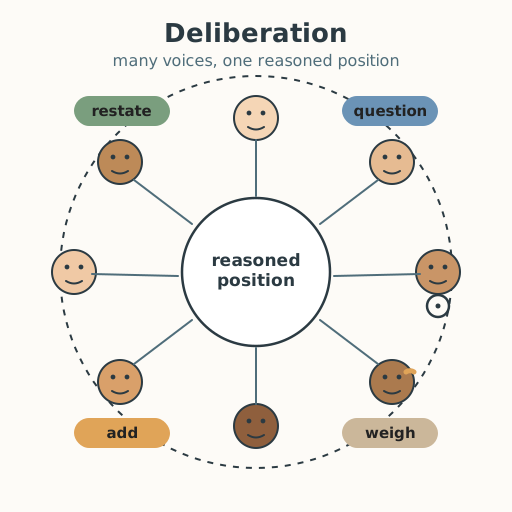
- Deliberation-circle diagram · 1 per learner A circle of voices feeding a central "reasoned position" — to annotate with the moves that keep deliberation open
Low-tech / no-cost
- Paper and pencil To draw the deliberation circle by hand when no printed organizer is available
- Issue slips Everyday contested questions (how a shared well is divided in a dry season, whether a road or a forest should come first, how a market stall's rent is set) to practice deliberating rather than winning
Enriched / lab & device
- One transcript or short recording of a real public consultation · 1 per group A town-hall, participatory-budget, or community-assembly record to watch for 'many voices' in action, in any language
Works in different contexts
- large-group Run a fishbowl: an inner circle deliberates one issue aloud — or in writing, sign, typing, or AAC passed around — while the outer circle tracks which talk moves keep it open; then rotate
- multi-age Younger learners name a time they argued to win versus to understand; older learners analyze which moves turn argument into deliberation
- self-directed A learner sorts the issue slips, then writes two "moves" that would open up each question instead of closing it
- level-grouped A ready group also distinguishes consensus (agreement) from compromise (giving ground) and argues when each fits
- outdoor-only Stand in a physical circle and pass a found object as the "speaking stick"; only the holder speaks — or writes, signs, or types their turn to pass on — and each next speaker must first restate the last point, aloud or in writing, sign, or AAC
Lesson 1 — The Deliberative Stance
Summary
Learners separate two postures toward disagreement: arguing to win and deliberating to understand and decide together. They adopt four talk moves that keep a discussion open — restate, question, add, weigh — and practice them on a real contested issue. Deliberation is presented as a skill with a long, global history, not as one culture’s invention.
Objectives
- Engage in sustained deliberation on a contested issue, hearing many voices and moving toward a reasoned position rather than a scored victory. (D04.S1.12.01)
Connection
Think of the last argument you were in — online or in person. Chances are each side was trying to win: to land the better line, to have the last word. Now think of a decision a group has to make that affects everyone, and cannot be undone cheaply: how a shared water source is divided in a dry season, whether a road or a forest should come first, how a clinic should spend a thin budget. Winning that argument does not solve the problem; hearing everyone and deciding together does. That different posture has a name — deliberation — and it is a skill, not a temperament.
Materials
- Deliberation journal
- Deliberation-circle diagram
- Issue slips (low-tech: paper)
Preparation
- Copy or draw the deliberation-circle diagram; prepare the issue slips.
- Retrieval: from Grade 11 (D04.S1.11.01), listening across accents, dialects, and viewpoints and naming assumptions; from Grade 8 (D04.S1.08.02), structured debate. Today we add the capstone turn: deliberation — hearing many voices toward a reasoned position (worked example first: Kirschner, Sweller & Clark, S-011).
- Prepare a plain definition: deliberation is reasoning together on a contested issue — hearing many voices, weighing reasons, and reaching a position — as distinct from debate, which is scored by winning, and from consensus, one possible outcome of deliberation.
Facilitator note
This lesson is written to the learner (“you”). The idea to land, held as description: structured discussion of contested issues — with reasons and genuine engagement with opposing views — is a core, learnable civic skill (Hess, S-349), and productive discussion rests on named “talk moves” that build on others’ ideas and disagree respectfully (Michaels & O’Connor, S-238). Deliberation is not a single culture’s invention: consensus-based councils are a living, centuries-old way of deciding among the Haudenosaunee, whose Grand Council deliberates until members agree (S-142). Offer this as one tradition among many, never as “the original” or the only model.
The ethics lens: deliberation asks not only “who has the better case?” but “what should we, together, do — and what are the consequences for others?” The egalitarianism lens: deliberation is only honest if the quieter voices are heard, not only the loudest or most fluent. The global lens: ways of deciding together differ across cultures; no single one is the default. The technology lens: much of today’s disagreement happens in fast, flattened online threads, where the deliberation moves are harder to practice — notice that. The environment lens: many of the hardest contested issues (water, forests, energy) are about shared environmental goods, so deliberation is an environmental skill too. The critical-thinking lens: “restate before you answer” is a test you run on your own hearing, not a verdict on a person. Preview: Lesson 2 builds the architecture of a reasoned position.
Procedure
- Recall (5 min). From Grade 11: what does it mean to listen across a difference — an accent, a dialect, a viewpoint — instead of listening only to confirm your own?
- Meet the two postures (10 min). Work a model example first (S-011): two people disagree about whether a village road or a wetland should come first. In arguing to win, each interrupts, exaggerates, and scores points. In deliberating, each first restates the other’s point, then questions, then adds, then weighs reasons toward a decision both can live with. Name the four moves and what each one does to keep the discussion open.
- Practice the moves (12 min). In a circle of four, take up one issue slip. Each speaker must begin by restating the previous speaker’s point before adding their own — or restate that point in writing, sign, typing, or AAC, then add the next one. Use the moves deliberately; a recorder notes which moves open the discussion and which close it.
- Weigh toward a position (10 min). After several rounds, stop and ask: what reasoned position is emerging? Try to state it — aloud, or in writing, sign, typing, or AAC — in one sentence that names the strongest reason on each side, then the position the group now leans toward.
- Log it (8 min). In your deliberation journal, write the issue, the voices you heard, and the emerging reasoned position — marked clearly as “tentative,” not final.
- Close (5 min). Say — or write, sign, type, or use AAC for — one sentence stating the difference between winning an argument and deliberating, and which move you found hardest to do honestly.
Differentiation
- Support: Use only the two simplest moves (restate, add) and deliberate on one low-stakes issue, leaving weighing for later.
- Extension: Analyze a recorded public consultation: which talk moves appear, whose voices are missing, and how that shapes the position reached.
- Communication access: Every step that asks a learner to say, restate, or speak can be completed in writing, signing, typing, or AAC instead — including the turn-taking restate and the closing one-sentence summary. Learners who are non-speaking, d/Deaf, hard-of-hearing, or who use AAC take every turn in their preferred mode; the deliberation circle runs fully in written or signed form, and no step requires producing or hearing sound.
Assessment
- Formative (peer + self): Can the learner name the four moves, restate before answering, and state a tentative reasoned position that names reasons on both sides?
- Portfolio artifact (unit): The annotated deliberation-circle diagram and the first issue-log entry, opened in the deliberation journal.
Home connection
Ask someone at home about a decision the family or community made together and how everyone was heard. Write one sentence about how the decision was reached and one about whose voice might have been missed.
Resources
- On structured discussion of contested issues as a learnable civic skill: Hess (2009), Controversy in the Classroom (S-349).
- On “talk moves” that build on others’ ideas and disagree respectfully: Michaels & O’Connor, Accountable Talk (S-238).
- On consensus-based councils as a living way of deciding: Britannica Kids — Haudenosaunee (S-142).
- On worked examples for a new skill: Kirschner, Sweller & Clark (2006) (S-011); on retrieval and spacing across the unit: Dunlosky et al. (2013) (S-039).