Lesson 02 — The Architecture of a Reasoned Position
Learners name the parts that hold a reasoned position together — claim, grounds, warrant, backing, qualifier, and rebuttal — and assemble them on a contested issue. They learn that a strong position is not one that admits no doubt, but one that states its evidence, names the bridge between evidence and claim, and answers the strongest objection honestly.
Objectives
Objectives
- D04.S1.12.01 Engage in complex, sustained deliberation on contested issues, hearing many voices and reaching reasoned positions.
Essential question
What holds a reasoned position together — and what lets it admit doubt without collapsing?
Key vocabulary
Materials
Standard materials
- Position-architecture organizer · 1 per learner A Toulmin-style scaffold — claim, grounds, warrant, backing, qualifier, rebuttal — to fill in for a contested issue
- Deliberation journal · 1 per learner Continuing the unit-long issue log
Low-tech / no-cost
- Paper and pencil To draw the position-architecture scaffold by hand
- Claim strips Short contested claims (e.g., 'a wind farm should be built here,' 'school should begin later') to attach grounds, warrants, and rebuttals to
Enriched / lab & device
- One short evidence dossier · 1 per group Two or three real source excerpts on a contested local issue (any language), to practice grounding a claim in evidence rather than assertion
Works in different contexts
- large-group Build one position-architecture on the board whole-class, then pairs each build a second on their own issue
- multi-age Younger learners distinguish a claim from a reason; older learners attach a warrant, a qualifier, and a rebuttal and test them
- self-directed A learner fills the scaffold for one claim of their choosing, then writes one qualifier and one rebuttal in their own words
- level-grouped A ready group also stress-tests a warrant against a counterexample and revises it
- outdoor-only Write each part of the scaffold on a card and lay it on the ground in order; walk from claim through grounds and warrant to a position that admits doubt
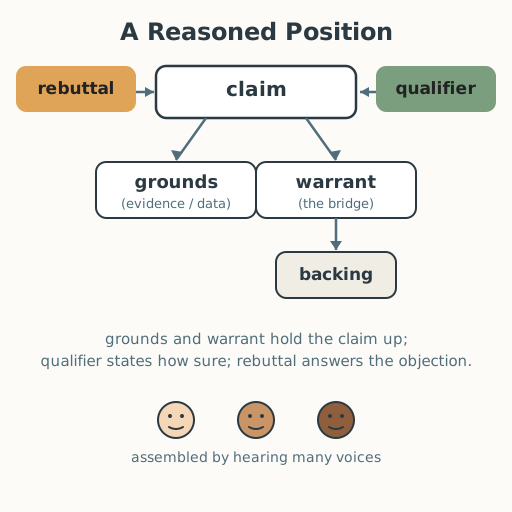
Lesson 2 — The Architecture of a Reasoned Position
Summary
Learners name the parts of a reasoned position — claim, grounds, warrant, backing, qualifier, and rebuttal — and assemble them on a contested issue. A strong position is reframed as one that admits doubt honestly: it states its evidence, names the bridge between evidence and claim, and answers the strongest objection rather than ignoring it.
Objectives
- Build a reasoned position on a contested issue by naming its claim, evidence, warrant, backing, qualifier, and rebuttal. (D04.S1.12.01)
Connection
When you say, “I think we should do this,” the first question anyone should ask is why? — and the second is so what connects your reason to your conclusion? A position that rests only on strong feeling collapses the moment it is pressed. A position that rests on visible evidence, a stated bridge between that evidence and the claim, and an honest answer to the best objection can survive disagreement. Those parts are not mysterious; they have names, and you can learn to assemble them.
Materials
- Position-architecture organizer
- Deliberation journal
- Claim strips (low-tech: paper)
Preparation
- Copy or draw the position-architecture organizer; prepare the claim strips.
- Retrieval: from Lesson 1, the four deliberation moves and the difference between arguing to win and deliberating. Today we build the thing deliberation produces — a reasoned position (worked example first: Kirschner, Sweller & Clark, S-011).
- Prepare a plain definition of each part, from the standard functional model of argument (Toulmin, S-236): claim (what I am asserting), grounds (the evidence), warrant (the bridge that says why the grounds support the claim), backing (support for the warrant), qualifier (how certain I am), and rebuttal (the strongest objection and my answer to it).
Facilitator note
This lesson is written to the learner (“you”). The idea to land: a reasoned position has a structure, and that structure is the standard functional model of argument — claim, grounds, warrant, backing, qualifier, and rebuttal — named by Stephen Toulmin (S-236). Hold it as one useful scaffold among many, not the only way humans reason: other cultures and traditions have their own arts of reasoning and persuasion, and the scaffold serves those rather than replacing them. The Greek rhetorical tradition named persuasion through character (ethos), emotion (pathos), and argument (logos) (Aristotle, S-346); Toulmin’s model is one precise way to build the logos half.
The ethics lens: a rebuttal is not a weakness to hide but a duty — answering the strongest objection is a form of honesty toward those who disagree. The egalitarianism lens: the parts are learnable, which means a clear, evidenced position is not reserved for the fluent or the privileged. The global lens: what counts as convincing evidence and how openly doubt is admitted differ across cultures — none is the default. The technology lens: online, claims circulate detached from their grounds and warrants; reassembling the parts is a defense against that flattening. The environment lens: use a contested environmental-claim example (a wind farm, a dam, a forest road) so the scaffold is practiced on questions where evidence about the living world matters. The critical-thinking lens: naming a qualifier and a rebuttal is the opposite of overclaiming — it is where careful thinking becomes visible. Preview: Lesson 3 turns a reasoned position into public speech.
Procedure
- Recall (5 min). From Lesson 1: what four moves keep deliberation open? Today we build the position those moves lead toward.
- Meet the parts (10 min). Work a model example first (S-011). Claim: a wind farm should be built on the ridge. Grounds: the wind there is strong and steady, and the region needs power. Warrant: steady wind plus need is a reason to build a wind farm there. Backing: wind measurements and energy-demand records. Qualifier: probably, if the local wildlife and people are protected. Rebuttal: some argue it would harm birds and views — my answer is that careful siting and community co-ownership address those. Name each part — aloud or in writing, sign, or AAC — and what it does.
- Assemble a position (12 min). With a partner, take a claim strip and fill the organizer: grounds, warrant, backing, qualifier, and — hardest — a real rebuttal with an honest answer.
- Stress-test the warrant (8 min). Swap with another pair. Attack only the warrant: is the bridge sound? Could the same grounds support the opposite claim? Revise the warrant until it holds.
- Admit doubt (8 min). Rewrite the qualifier so it states exactly how sure you are, and state the rebuttal in one sentence a fair opponent would recognize as their own.
- Close (5 min). Say — or write, sign, type, or use AAC for — why a position with a qualifier and a rebuttal is stronger, not weaker, than one that admits no doubt.
Differentiation
- Support: Fill only claim, grounds, and warrant; leave qualifier and rebuttal for a later pass.
- Extension: Take a public claim from the news (any language) and reconstruct its missing grounds, warrant, and rebuttal — or show that it has none.
- Communication access: Every step that asks a learner to name, say, or argue can be completed in writing, signing, typing, or AAC instead. Learners who are non-speaking, d/Deaf, hard-of-hearing, or who use AAC assemble, stress-test, and present the position in their preferred mode; no step requires producing or hearing sound.
Assessment
- Formative (peer + self): Can the learner name all six parts, assemble them on a claim, and state a rebuttal a fair opponent would recognize?
- Portfolio artifact (unit): The completed position-architecture organizer, filed in the deliberation journal.
Home connection
Find one claim someone at home makes often (“the weather is changing,” “this is worth the cost”). Ask them their grounds and their warrant, and write the claim, the reason, and the bridge in one line each.
Resources
- On the claim/grounds/warrant/backing/qualifier/rebuttal model of argument: Toulmin, The Uses of Argument (S-236).
- On persuasion through character, emotion, and argument (one classical tradition among many): Aristotle, Rhetoric (S-346).
- On worked examples for a new analytical skill: Kirschner, Sweller & Clark (2006) (S-011); on retrieval and spacing: Dunlosky et al. (2013) (S-039).