Lesson 13 — Bridging Across Languages and Cultures
Learners distinguish translation (written, revisable) from interpretation (spoken, in the moment), and build a personal plurilingual toolkit for bridging across languages and cultures. They practice carrying *meaning* — not word-for-word — across a gap, and learn that bridging is an act of respect: it honors both languages as complete, and the person between them as a skilled mediator.
Objectives
Objectives
- D04.S4.12.02 Move confidently and respectfully across languages and cultures, hearing many voices and speaking with clarity and care in a multilingual world.
Essential question
How do I bridge between speakers of different languages — translating, interpreting, and drawing on every language I know — with confidence and respect?
Key vocabulary
Materials
Standard materials
- Bridging organizer · 1 per learner Two columns — translation (written, revisable) and interpretation (spoken, in the moment) — with a third row for the learner's own plurilingual toolkit
- Deliberation journal · 1 per learner Continuing the unit-long log
Low-tech / no-cost
- Paper and pencil To draw the bridging organizer by hand
- Bridging scenario cards Real moments that need a bridge (a clinic intake, a market negotiation, a community meeting, a phone call) to plan a bridging strategy for
Enriched / lab & device
- One machine-translation tool and one human interpretation of the same sentence · 1 per pair To compare what a tool gets, misses, and flattens against what a person carries across
Works in different contexts
- large-group Run a live interpretation: one learner speaks — or writes, signs, or types — and a second interprets — aloud, or in writing, sign, or AAC — while the class notes what was kept and what was adjusted
- multi-age Younger learners practice a greeting bridge; older learners interpret a short exchange and reflect on what they carried across
- self-directed A learner plans a bridge for one scenario, then writes what translation can carry and what only interpretation can
- level-grouped A ready group also maps their own plurilingual repertoire and names when they code-switch and why
- outdoor-only Stand on two "banks" of an imagined river and pass a message across, first word-by-word, then meaning-by-meaning, and compare
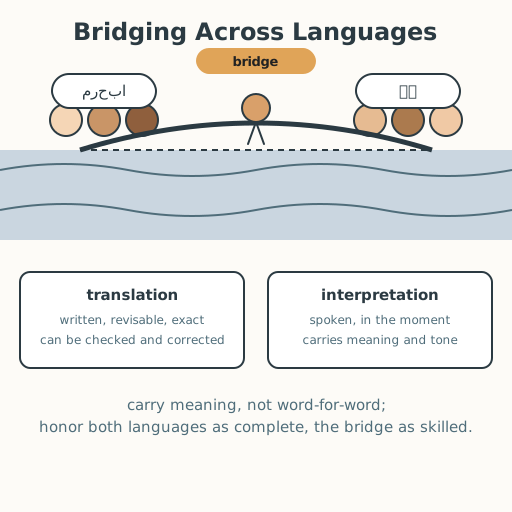
Lesson 13 — Bridging Across Languages and Cultures
Summary
Learners distinguish translation (written, revisable) from interpretation (spoken, in the moment), and build a personal plurilingual toolkit for bridging across languages and cultures. Bridging carries meaning — not word-for-word — across a gap, and is an act of respect: it honors both languages as complete, and the person between them as a skilled mediator.
Objectives
- Bridge between speakers of different languages and cultures, translating and interpreting with accuracy, confidence, and respect. (D04.S4.12.02)
Connection
You have been a bridge without calling it that: explaining a form to an elder, ordering for a friend, telling a joke that does not quite translate, and finding the version that does. Bridging is not “knowing two languages perfectly”; it is the skill of carrying meaning from one person to another — written or spoken — while keeping both people’s dignity intact. Some bridges are built in writing and can be revised; others are spoken and happen only once, in the moment. Both are learnable.
Materials
- Bridging organizer
- Deliberation journal
- Bridging scenario cards (low-tech: paper)
Preparation
- Copy the bridging organizer; prepare the bridging scenario cards.
- Retrieval: from Lesson 12, language justice; from Grade 11 (D04.S4.11.02), interpreting main ideas across a language difference. Today we add the capstone turn: confident, respectful bridging (worked example first: Kirschner, Sweller & Clark, S-011).
- Prepare the frame: plurilingual competence is the ability to draw on more than one language to communicate, including mediation — the literature’s term for bridging (Council of Europe CEFR, S-237). Translation is written and revisable; interpretation is spoken and in the moment; machine translation helps with gist but is uneven across languages and cannot carry nuance (Britannica, S-350).
Facilitator note
This lesson is written to the learner (“you”). The idea to land, held as description: plurilingual competence — drawing on several languages, including mediating between speakers — is the literature’s term for the bridging skill (Council of Europe CEFR, S-237); translation (written, revisable) and interpretation (spoken, in the moment) are distinct practices; and machine translation is a real but uneven tool, not a substitute for a person (Britannica, S-350). The value — that both languages are complete systems, and the person between them a skilled mediator — is a commitment, not a fact, and should be named as such. Honor home languages first: a learner who bridges in their own languages is an expert in this room, not a novice.
The ethics lens: a bridge carries both meanings and responsibility — an inaccurate interpretation can mislead, and a careless one can wound; accuracy and care are the bridge’s two pillars. The egalitarianism lens: the bridge’s job is not to make the “weaker” language conform, but to meet both on equal ground. The global lens: a lingua franca is one historical solution to many languages, but it is not the only one, and plurilingual mediation is another — no single strategy is the default. The technology lens: translation tools are fast and useful for gist, but they flatten tone, idiom, and nuance and serve low-resource languages poorly — so a human bridge remains necessary where it matters (S-350). The environment lens: languages carry knowledge of the living world — plants, weather, seasons, places — so when a language is lost, environmental knowledge can be lost with it (Kimmerer, S-427); bridging helps keep that knowledge in circulation. The critical-thinking lens: “what did the tool get right, and what did it flatten?” is the test a careful bridge runs on any machine output. Preview: Lesson 14 assembles the whole unit into one many-voiced capstone.
Procedure
- Recall (5 min). From Lesson 12: why is language justice a matter of safety and dignity? Today we become the bridge that justice requires.
- Meet translation and interpretation (10 min). Work a model example first (S-011). Read one sentence, then see it handled two ways: translated (written, revised, exact) and interpreted (spoken once, carrying the meaning and tone). Name what each can do and what each cannot.
- Plan a bridge (12 min). Take a bridging scenario card and fill the organizer: what needs to cross (a question, a warning, a feeling), whether it is written or spoken, and your bridging strategy — including every language you can draw on.
- Practice the bridge (12 min). With a partner, role-play the scenario. One of you speaks in one language — or writes, signs, or types it, in a slowed or simplified form — and the other bridges the meaning, aloud or in writing, sign, or AAC. Then switch. Notice what you carried and what you adjusted.
- Test the tool (8 min). Compare a machine translation of one sentence against your own human version. Mark what the tool got, missed, and flattened.
- Close (5 min). Say — or write, sign, type, or use AAC for — why bridging is an act of respect, not just of skill — and what you now know you can do as a bridge.
Differentiation
- Support: Bridge a single greeting or question, and name one thing you carried across accurately.
- Extension: Interpret a short, live exchange in front of the group — aloud, or in writing, sign, or AAC — then reflect in writing on what you kept, adjusted, and could not fully carry.
- Communication access: Interpretation here is not only spoken. A learner may bridge by writing, typing (AAC), or signing, and a d/Deaf or hard-of-hearing learner bridges between a signed and a written form, or between two written forms, just as fully as a spoken bridge. Learners who are non-speaking, d/Deaf, hard-of-hearing, or who use AAC plan, practice, and perform the bridge in their preferred mode; the performance assessment is the carrying of meaning, not the voice.
Assessment
- Formative (peer + self + performance): Can the learner distinguish translation from interpretation, plan and perform a bridge, and name what a machine tool gets and misses? The bridge may be performed aloud, in writing, in sign, or via AAC; what is assessed is the bridging of meaning, not the voice that carries it.
- Portfolio artifact (unit): The completed bridging organizer and a one-paragraph reflection on the practiced bridge, filed in the deliberation journal.
Home connection
Ask someone at home for a word or saying that does not translate cleanly, and together find the best you can do. Write the word, the attempt, and what was lost.
Resources
- On plurilingual competence and mediation (the bridging skill): Council of Europe, CEFR Companion Volume (S-237).
- On translation versus interpretation and what each carries: CEFR (S-237); on machine translation’s capabilities and limits: Encyclopaedia Britannica, Machine translation (S-350).
- On languages carrying ecological knowledge: Kimmerer, Braiding Sweetgrass (S-427).
- On worked examples for a new skill: Kirschner, Sweller & Clark (2006) (S-011); on feedback: Hattie, Visible Learning (S-012).