Lesson 14 — The Many-Voiced Capstone
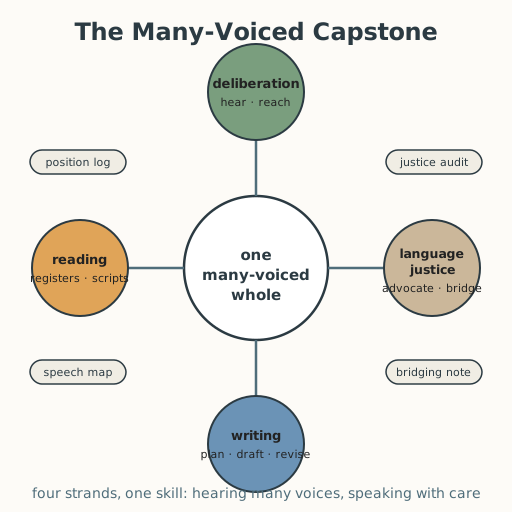
Learners assemble the unit's artifacts into a capstone portfolio organized under its four strands — deliberation, reading, writing, and language justice — and write a closing reflection naming one idea from each strand they will carry forward. The lesson is a spaced-retrieval synthesis: recalling the whole unit's ideas at once strengthens them, and shows the learner the many-voiced whole they now command.
Objectives
Objectives
- D04.S1.12.01 Engage in complex, sustained deliberation on contested issues, hearing many voices and reaching reasoned positions.
- D04.S1.12.02 Speak with clarity, care, and integrity in public and professional settings, adapting to diverse audiences and purposes.
- D04.S2.12.01 Read, evaluate, and integrate scholarly, technical, and literary texts across registers and disciplines.
- D04.S2.12.02 Reason across multiple writing systems and languages, recognizing how each encodes meaning differently.
- D04.S3.12.01 Produce a sustained, polished piece of writing that demonstrates command of structure, style, and evidence for a chosen audience.
- D04.S3.12.02 Write with clarity and care across disciplines and registers, using language ethically and precisely in a multilingual world.
- D04.S4.12.01 Advocate for language justice, making communication accessible to people of all languages in public life.
- D04.S4.12.02 Move confidently and respectfully across languages and cultures, hearing many voices and speaking with clarity and care in a multilingual world.
Essential question
How do the four strands of this unit — deliberation, reading, writing, and language justice — come together into one many-voiced whole I can carry forward?
Key vocabulary
Materials
Standard materials
- Capstone portfolio map · 1 per learner A one-page map of the unit's eight artifacts, arranged under the four strands, with a space for a closing reflection
- Deliberation journal · 1 per learner The unit-long log, now assembled into the capstone portfolio
Low-tech / no-cost
- Paper and pencil To draw the portfolio map by hand and bind the artifacts together
- Artifact sorting space A clear surface to lay the unit's artifacts in order and see the whole
Enriched / lab & device
- One digital portfolio tool · 1 per learner To assemble the artifacts into a shareable portfolio, with accessibility features turned on
Works in different contexts
- large-group Hold a gallery walk: learners post their portfolio maps and rotate, leaving one specific, appreciative note on each
- multi-age Younger learners show one artifact and name the strand it belongs to; older learners write the closing synthesis across all four strands
- self-directed A learner assembles the portfolio alone and writes a closing reflection that names one idea from each strand they will carry forward
- level-grouped A ready group also peer-reviews each other's portfolios against the unit's eight objectives and notes any gap to revisit
- outdoor-only Lay the artifacts in four strand circles on the ground and walk from strand to strand, speaking — or writing, signing, or typing — one line from each
Lesson 14 — The Many-Voiced Capstone
Summary
Learners assemble the unit’s artifacts into a capstone portfolio organized under its four strands — deliberation, reading, writing, and language justice — and write a closing reflection naming one idea from each strand they will carry forward. The lesson is a spaced-retrieval synthesis: recalling the whole unit’s ideas at once strengthens them, and shows the learner the many-voiced whole they now command.
Objectives
- Synthesize the unit’s four strands into one capstone: deliberating, reading, writing, and advocating across languages with clarity, care, and integrity. (D04.S1.12.01, D04.S1.12.02, D04.S2.12.01, D04.S2.12.02, D04.S3.12.01, D04.S3.12.02, D04.S4.12.01, D04.S4.12.02)
Connection
Over these four weeks you have done eight distinct things: deliberated, spoken in public, read across registers, reasoned across scripts, planned, drafted, revised, and advocated for language justice. Looked at one by one they seem separate. But they are one skill — the skill of a person who can hear many voices and speak with care in a many-voiced world. This final lesson is not new content; it is the act of seeing the whole, and deciding what of it you will carry.
Materials
- Capstone portfolio map
- Deliberation journal
Preparation
- Copy the capstone portfolio map; set out a surface to assemble artifacts.
- Retrieval (spaced, across the whole unit): this lesson is a retrieval-practice and spacing payoff — recalling and organizing the unit’s ideas strengthens long-term memory (Dunlosky et al., S-039). Prepare a one-line reminder of each strand’s core idea.
- Prepare the four-strand frame: deliberation (hear many voices, reach a reasoned position), reading (evaluate and integrate texts, reason across scripts), writing (sustained, polished, precise, ethical), language justice (advocate for access; bridge across languages).
Facilitator note
This lesson is written to the learner (“you”). The idea to land: the capstone is a spaced-retrieval synthesis — recalling the unit’s ideas at once, which is evidence-supported for durable learning (Dunlosky et al., S-039) — and a portfolio that makes the learning visible to the learner. It is summative in the sense of showing mastery, never of ranking: a gap in the portfolio is information (“not yet assembled”), not a verdict. Honor home languages first: the reflection may be written in whichever language the learner thinks and feels in most clearly.
The ethics lens: the reflection asks not just “what did I learn?” but “how will I use this to treat others fairly?” The egalitarianism lens: the portfolio belongs to the learner — it is evidence of their growth, not a competition with anyone else’s. The global lens: the unit’s through-line is multilingualism as wealth; the reflection should name that the many voices are the point, not a problem. The technology lens: a digital portfolio can be made accessible (captions, readable type, alt text), which is itself an act of the language justice the unit taught. The environment lens: among the unit’s voices are voices for the living world — a deliberation about water, a warning about a storm, a language that carries plant knowledge — and the reflection may name that language serves the Earth as well as people. The critical-thinking lens: “which artifact is weakest, and what would I do next?” is a self-check run with honesty, not shame.
Procedure
- Recall (10 min). Without looking, name the unit’s four strands and one thing you did in each. Then check yourself against the capstone portfolio map. (This recall is the point — it strengthens what you learned, S-039.)
- Assemble the artifacts (15 min). Gather your eight artifacts — the deliberation log, the reasoned-position organizer, the speech map, the three-register organizer, the synthesis matrix, the writing-systems sheet, the many-scripts organizer, the writing plan, the draft, the revision, the cross-discipline organizer, the language-justice audit, and the bridging reflection — and sort them under the four strands. Where an artifact is thin, note it as “to revisit,” not “failed.”
- See the whole (10 min). Stand back. What do the eight artifacts, together, say about the kind of communicator you are becoming? Write that in one sentence.
- Write the closing reflection (15 min). For each strand, write one idea you will carry forward, in your own words and your own language. Then one sentence on how the four strands are really one.
- Share and receive (10 min). In a pair or small group, show your portfolio map and read one line of your reflection — aloud, or in writing, sign, typing, or AAC. Leave each person one specific, appreciative note — naming a real thing you saw in their work.
- Close (5 min). Say — or write, sign, type, or use AAC for — in one sentence, what it means to be a person who can hear many voices and speak with clarity, care, and integrity.
Differentiation
- Support: Assemble four artifacts (one per strand) and write one carry-forward idea for two strands, leaving the rest for a later pass.
- Extension: Write a short “capstone statement” addressed to a future reader — an employer, a community, a younger learner — explaining what you can now do as a communicator.
- Communication access: Every shared step — reading a line, or closing aloud — can be completed in writing, signing, typing, or AAC instead. Learners who are non-speaking, d/Deaf, hard-of-hearing, or who use AAC share, receive notes, and reflect in their preferred mode; the reflection may be written, signed, or typed in the learner’s own language, and no step requires producing or hearing sound.
Assessment
- Summative (portfolio + peer + self): Does the portfolio show evidence across all four strands, and does the reflection name one carry-forward idea from each strand with honesty and care?
- Portfolio artifact (unit): The completed capstone portfolio map and the closing reflection — the unit’s capstone.
Home connection
Show someone at home your portfolio map and read them your one-sentence whole — or share it in writing, sign, or AAC. Ask them which strand they see strongest in you, and write down what they say.
Resources
- On retrieval practice and spacing as the highest-utility learning techniques: Dunlosky et al. (2013) (S-039).
- On feedback as a strong influence on learning: Hattie, Visible Learning (S-012).
- The unit’s cited sources, assembled: Hess (S-349), Toulmin (S-236), Aristotle (S-346), Daniels & Bright (S-165), DeFrancis (S-166), Fortson (S-103), WALS (S-169), Graham & Perin (S-102), IES (S-170, S-171), UNESCO (S-019), Ethnologue (S-426), CEFR (S-237), Britannica machine translation (S-350), Kimmerer (S-427).