Lesson 01 — The Idea of Getting Closer
Learners meet the limit informally: a quantity that gets closer and closer to a value without needing to reach it, and continuity as "no gap, no jump." They work the half-step sum 1/2 + 1/4 + 1/8 + …, watch it approach 1, and connect the idea to everyday settling — a cooling drink, a filling cup, a population nearing its ceiling — and to the early limit ideas of more than one mathematical tradition.
Objectives
Objectives
- D05.S1.12.01 Apply the ideas of limits and continuity informally to describe change, approximation, and the behavior of quantities.
Essential question
How does the idea of a limit — getting closer and closer to a value — describe change and approximation?
Key vocabulary
Materials
Standard materials
- Limit-and-continuity diagram sheet · 1 per learner A half-line diagram and a "does it jump?" continuity checker for sorting examples
- Math journal · 1 per learner The unit-long notebook for worked examples, reflections, and portfolio artifacts
Low-tech / no-cost
- Paper strip or string Fold or mark a strip into halves repeatedly to watch the distance shrink toward a wall or a line
- A cup, water, and a target line Pour toward a fill line and notice how you slow as you "approach" it — the everyday feel of a limit
Enriched / lab & device
- Spreadsheet or graphing tool · 1 per learner or pair Generate the partial sums 1/2, 3/4, 7/8, … and watch them level off toward 1
Works in different contexts
- large-group Run the half-strip demonstration whole-class, then pairs sort "approaches a value" vs "jumps" examples
- multi-age Younger learners fold paper halves; older learners compute partial sums and argue why they never overshoot 1
- self-directed A learner follows the worked example, builds the table of partial sums, and writes the limit in their own words
- level-grouped A ready group also states the informal definition of continuity (no gap, no jump) and tests a step function against it
- outdoor-only Walk halfway to a tree, then halfway again, then again — and name what you are "approaching"
Lesson 1 — The Idea of Getting Closer
Summary
Learners meet the limit informally: a quantity that gets closer and closer to a value without needing to arrive, and continuity as “no gap, no jump.” They work the half-step sum 1/2 + 1/4 + 1/8 + …, watch it approach 1, and connect the idea to everyday settling — a cooling drink, a filling cup, a population nearing its ceiling — and to early limit ideas from more than one mathematical tradition.
Objectives
- Apply the idea of a limit and of continuity informally to describe change, approximation, and the behavior of quantities. (D05.S1.12.01)
Connection
You already do limits without naming them. You pour toward a fill line and slow down as you get close; you wait for a hot drink to cool to room temperature; you walk halfway to a door, then halfway again, and you never quite reach it in a finite number of steps — but you get as close as you like. “Getting as close as you like” is the whole idea, and it is one every person, in every place, can describe.
Materials
- Limit-and-continuity diagram sheet
- Math journal
- Low-tech: paper strip, cup and water
Preparation
- Copy or draw the half-line diagram; prepare a paper strip for the folding demo.
- Retrieval: from Grade 11 (D05.S1.11.01), sequences that get larger or smaller; from Unit 2 (D05.S2.11.01), reading the slope of a graph. Today we ask what a sequence is heading toward.
- Prepare the worked example (partial sums of halves) to model first (S-011).
Facilitator note
This lesson is written to the learner (“you”). The idea to land: a limit describes where a quantity is heading as it gets arbitrarily close to a value — it does not require arrival; continuity means no gap and no jump. Teach the worked example explicitly, then let learners describe limits in their own words (S-011). Hold the concept as description, not mystery: the limit of 1/2 + 1/4 + 1/8 + … is 1, a claim anyone can check.
The ethics lens: “approaching a goal without arriving” is honest about what a limit is and is not — we never claim the sum equals 1 by fiat; we show what it approaches. The egalitarianism lens: a limit is checkable by anyone with a strip of paper — it needs no special instrument or status. The global lens: the “approaches but never quite reaches” puzzle appears in many traditions — the Greek Zeno’s dichotomy paradox, and the infinite series for π and trigonometric quantities developed by the Kerala school in southern India (Madhava of Sangamagrama, 14th–15th c.), centuries before European calculus (S-272, S-240). The technology lens: every calculator and computer approximates — it stops after finitely many steps, which is exactly the limit idea made practical. The environment lens: a population growing toward its carrying capacity is a living limit — it approaches a ceiling rather than growing forever (S-436). Preview: Lesson 2 turns limits into rates of change.
Procedure
- Recall (5 min). From Grade 11: a sequence is a list of numbers with a pattern. Say — or write, sign, gesture, or use AAC to show — where the sequence 1/2, 1/4, 1/8, 1/16, … is heading — not where it stops.
- Walk halfway (8 min). Stand an arm’s length from a wall. Step halfway there, then halfway of what remains, then again. Name what you are doing: you get closer and closer to the wall, as close as you like, without a “final” step. That is a limit.
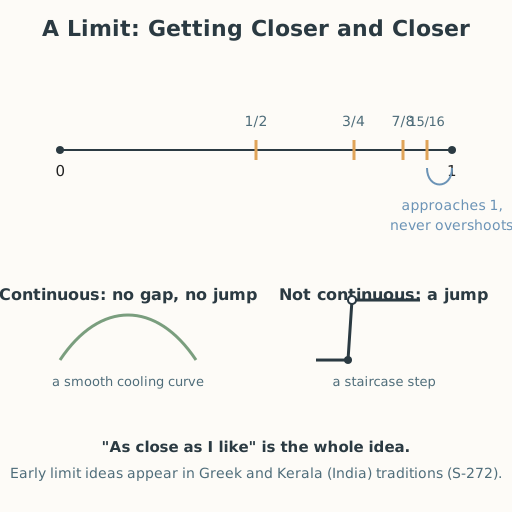
- Worked example — the half-step sum (12 min). Add the steps you just walked: 1/2, then 1/2 + 1/4 = 3/4, then 3/4 + 1/8 = 7/8, then 15/16, 31/32, …. Write the table. The sums get closer and closer to 1 and never overshoot. We write: the limit is 1. You do not need the “last” term; closeness is the point.
- Name the terms (8 min). The sum tends to 1; it converges to 1. A quantity that does this has a limit. A graph is continuous if it has no gap and no jump — you could draw it without lifting the pencil. A staircase is not continuous; a smooth cooling curve is.
- Sort examples (12 min). With a partner, sort each as “approaches a limit” or “jumps”: a cooling drink; a filling cup; a staircase step; the partial sums above; a population slowing as food runs short. For each, say what it approaches or where it jumps — aloud or in writing, sign, gesture, or AAC.
- Guided practice (8 min). In your journal, write the limit of 0.9, 0.99, 0.999, … in words and one sentence on why “as close as I like” matters more than “the last one.” Self-check against the worked example.
- Close (2 min). Say — or write, sign, gesture, or use AAC to express — what it means for a quantity to approach a value without arriving.
Differentiation
- Support: Fold the paper strip into halves and halves again, and read the fractions off the folds before writing any symbols.
- Extension: State why 0.999… (the pattern above) and 1 have no number between them, and test a step function at its jump point against the “no gap, no jump” rule.
- Number access (dyscalculia): Keep the step-3 half-step-sum worked example visible as a card to copy, with the partial sums 1/2, 3/4, 7/8, 15/16 already written; provide the table pre-printed so the learner only fills the next partial sum; and offload the fraction addition to a partner or calculator — or take the verbal route, folding the paper strip in halves and saying in words or gesture that “each fold removes half of what remains, so I get closer and closer to 1,” without writing any numeral.
- Communication access: Every spoken step — saying, naming, reading aloud, discussing, or closing — can be done in writing, sign, gesture, or AAC instead. Learners who are non-speaking, d/Deaf, hard-of-hearing, or who use AAC complete every task in their preferred mode; no step requires producing or hearing sound.
Assessment
- Formative (peer + self): Can the learner explain (in speech, writing, sign, or AAC) “closer and closer,” build the half-step sum table, and sort “approaches” vs “jumps” with a reason?
- Portfolio artifact (unit): The half-step sum table with a written sentence naming the limit and what “closer and closer” means, opened in the math journal.
Home connection
Ask someone at home to walk halfway to a door, then halfway again, and describe what is happening. Write one sentence about their description and one about whether you agreed on “as close as you like.”
Resources
- On worked examples and guided practice for a new concept: Kirschner, Sweller & Clark (2006) (S-011).
- On the Kerala school and non-European roots of the infinite-series/limit idea: Joseph, The Crest of the Peacock (S-272); MacTutor History of Mathematics (S-240).
- On populations approaching a carrying capacity (the logistic/S-shaped curve): Britannica — Carrying capacity (S-436).