Lesson 02 — Approximation and the Shape of Change
Learners turn the limit idea into a rate of change: the average slope over an interval (a secant) shrinks toward the slope at a single instant (a tangent), which is the informal derivative. They connect it to speed at a moment, a plant's growth, and a population's changing rate — and to the long human habit of approximating quantities ever more finely, from Babylonian root tables to the calculus written down in Europe.
Objectives
Objectives
- D05.S1.12.01 Apply the ideas of limits and continuity informally to describe change, approximation, and the behavior of quantities.
Essential question
How does the idea of a limit turn an average rate of change into the rate at a single instant?
Key vocabulary
Materials
Standard materials
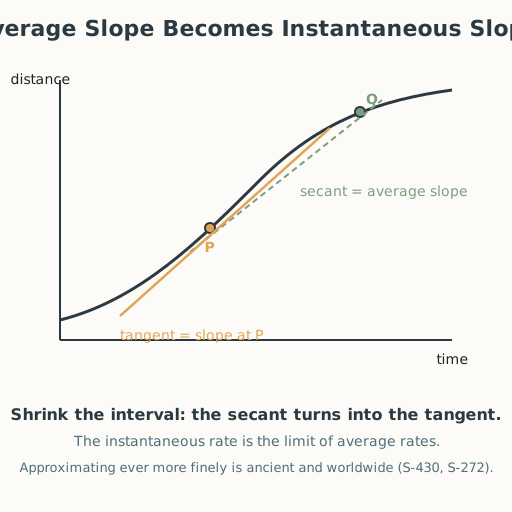
- Rate-of-change diagram sheet · 1 per learner A curve with a secant and a tangent, plus a table for shrinking time intervals
- Math journal · 1 per learner
Low-tech / no-cost
- A curved track or a rolling object Roll a ball and notice that "average speed over the whole trip" hides the fast and slow moments
- String and a ruler Lay a string against a drawn curve to see a short segment look nearly straight
Enriched / lab & device
- Spreadsheet or graphing tool · 1 per learner or pair Compute average slopes over shorter and shorter intervals and watch them settle on one number
Works in different contexts
- large-group Build the average-slope table whole-class, then pairs compute one shrinking interval each and compare
- multi-age Younger learners describe where a trip is fastest and slowest; older learners compute secant slopes and the limit
- self-directed A learner follows the worked example, fills the table, and writes what the slopes are heading toward
- level-grouped A ready group also explains why a smooth curve is required (a corner has no single tangent)
- outdoor-only Roll a ball down a slope and mark distances at equal times, then compute the average speed of each stretch
Lesson 2 — Approximation and the Shape of Change
Summary
Learners turn the limit idea into a rate of change: the average slope over an interval (a secant) shrinks toward the slope at a single instant (a tangent) — the informal derivative. They connect it to speed at a moment, a plant’s growth, and a population’s changing rate, and to the long human habit of approximating quantities ever more finely, from Babylonian root tables to the calculus written down in Europe.
Objectives
- Apply the idea of a limit and of continuity to describe change and approximation, and use average rates of change to approach an instantaneous rate. (D05.S1.12.01)
Connection
A speedometer reads “60” at a single moment, yet any measured speed is distance over time — an average. The number on the dial is the limit of those averages as the time interval shrinks toward zero. The same move — shrink the interval, watch what the slope approaches — describes a plant’s fastest growth week, a river’s peak flow, or a fever’s peak. Approximating ever more finely is one of the oldest and most universal human moves in mathematics.
Materials
- Rate-of-change diagram sheet
- Math journal
- Low-tech: curved track or rolling object, string and ruler
Preparation
- Copy or draw the curve with secant and tangent; prepare the shrinking-interval table.
- Retrieval: from Lesson 1, “closer and closer” (the limit idea); from Grade 11, slope as rise over run. Today we shrink the run to zero and watch the slope settle.
- Prepare the worked example (a distance-time curve) to model first (S-011).
Facilitator note
This lesson is written to the learner (“you”). The idea to land: an average rate of change (secant slope) becomes an instantaneous rate (tangent slope) in the limit as the interval shrinks to a point — this is the informal derivative, and it needs the curve to be continuous and smooth. Teach the worked example explicitly — build the table of shrinking intervals, then let the number settle (S-011). The limit is what makes “at an instant” meaningful rather than mystical.
The ethics lens: honesty about what a speedometer is — a limit, not a direct measurement — is honesty about what numbers can and cannot claim. The egalitarianism lens: the derivative needs no special talent, only the shared move of shrinking an interval and watching. The global lens: the habit of approximating a value ever more finely is ancient and worldwide — the Babylonian tablet YBC 7289 (c. 1800–1600 BCE) carries √2 correct to about six decimal places (S-430), and the calculus we inherit was written up in 17th-century Europe by Newton and Leibniz (S-302) on top of much older, multi-rooted work (S-272, S-429). The technology lens: the derivative is the working language of physics, engineering, and the simulation engines behind every screen. The environment lens: a population’s growth rate is a derivative — it rises, then slows toward zero as the population nears its carrying capacity (S-436). Preview: Lessons 3–4 turn to reasoning about the size of large systems.
Procedure
- Recall (5 min). From Lesson 1, name what a limit is. From Grade 11, slope is rise ÷ run. Today the run shrinks toward zero.
- Average speed hides the moment (8 min). A ball rolls 3 m in 3 s: average speed is 1 m/s — but it was faster at the start and slower at the end. An average rate of change over an interval is one number; it cannot see the instant. To see the instant, shrink the interval.
- Worked example — shrinking the interval (15 min). A distance-time curve passes through (2, 4) and, later, (5, 13). The secant slope between them is (13 − 4)/(5 − 2) = 3. Now take points closer to (2, 4): at t = 3, 2.5, 2.1, 2.01, compute the slope each time. The slopes settle toward a single number — that number is the instantaneous rate, the slope of the tangent at (2, 4). Write: the limit of the secant slopes is the tangent slope.
- Name it (6 min). The instantaneous rate is the derivative (informally): how fast a quantity changes at a moment. A smooth curve has one; a corner does not (there is no single tangent).
- Guided practice (12 min). With a partner, take a curve and two points; compute the secant slope; move the second point closer; predict the limit; compare with the tangent drawn on the sheet. Check each other’s arithmetic.
- Retrieve and connect (8 min). In your journal, write one real quantity whose rate of change matters (a river’s flow, a plant’s height, a battery draining) and one sentence on why “average over a long stretch” is not enough.
- Close (2 min). Say — or write, sign, gesture, or use AAC to express — what the derivative approximates and what it is the limit of.
Differentiation
- Support: Compute only the secant slope for one wide interval, then one narrow one, and say which is closer to “the moment.”
- Extension: Explain why a graph with a sharp corner has left-hand and right-hand secant slopes that settle on different numbers, so no single tangent exists.
- Number access (dyscalculia): Pre-fill the step-3 shrinking-interval table (t = 3, 2.5, 2.1, 2.01) with the slope column left blank, so the learner copies the worked pattern rather than re-deriving each rise and run; offload the rise-over-run division to a partner or calculator; and take the verbal route — say where the ball is fastest and slowest, then describe in words or a sketch how the average slope “settles” on the slope at a single instant, without computing any quotient.
- Communication access: Every spoken step — saying, naming, reading aloud, discussing, or closing — can be done in writing, sign, gesture, or AAC instead. Learners who are non-speaking, d/Deaf, hard-of-hearing, or who use AAC complete every task in their preferred mode; no step requires producing or hearing sound.
Assessment
- Formative (peer + self): Can the learner compute a secant slope, shrink the interval, and state (in speech, writing, sign, or AAC) what the slope is approaching (the tangent slope)?
- Portfolio artifact (unit): The shrinking-interval table with the limit named, added to the math journal.
Home connection
Watch something change at home — a kettle heating, a plant growing, a phone charging. Describe in one sentence where the rate is fastest and one where it is slowest, and what “at a moment” would mean for it.
Resources
- On worked examples and guided practice: Kirschner, Sweller & Clark (2006) (S-011).
- On the Babylonian √2 approximation (YBC 7289): S-430; on the calculus of Newton and Leibniz and its multi-rooted history: Newton, Principia (S-302); Boyer & Merzbach, A History of Mathematics (S-429); Joseph, The Crest of the Peacock (S-272).
- On a population’s growth rate slowing near carrying capacity: Britannica — Carrying capacity (S-436).