Lesson 11 — Geometry in Real Design: Architecture and Mapping
Learners apply geometric reasoning to real design: they read the symmetry, repetition, and scale in architecture, patterns, and maps, and construct a geometric pattern with straightedge and compass. They meet patterned building traditions — Islamic girih and zellige, African woven and beaded geometry, Indian altar geometry — as evidence that geometric design is a shared, worldwide human practice, not one region's invention.
Objectives
Objectives
- D05.S3.12.02 Apply geometric reasoning to real-world design, such as architecture, mapping, or the layout of shared spaces, considering access and sustainability.
Essential question
How does geometric reasoning shape real design — architecture, patterns, and maps — across the world's traditions?
Key vocabulary
Materials
Standard materials
- Design-analysis sheet · 1 per learner A building plan, a pattern, and a map to analyze for symmetry, scale, and structure
- Math journal · 1 per learner
Low-tech / no-cost
- Paper, compass, and straightedge Reproduce a geometric pattern with ruler and compass — construction, not copying
- A hand-drawn map of a familiar place Read the map's scale and orientation as geometric choices
Enriched / lab & device
- Images of patterned architecture (girih, zellige, woven patterns) · 1 per pair Examine the underlying grid and repetition in real geometric art
Works in different contexts
- large-group Analyze one pattern whole-class, then pairs reproduce a construction and explain its symmetry
- multi-age Younger learners find symmetry and repetition; older learners construct the pattern with compass and reason about scale
- self-directed A learner analyzes a pattern or plan for symmetry and scale, then constructs it with straightedge and compass
- level-grouped A ready group also works out the scale factor between a plan and the real building and explains a map projection
- outdoor-only Measure a real space with paces, then draw it to scale on paper or in the dirt
Lesson 11 — Geometry in Real Design: Architecture and Mapping
Summary
Learners apply geometric reasoning to real design: they read the symmetry, repetition, and scale in architecture, patterns, and maps, and construct a geometric pattern with straightedge and compass. They meet patterned building traditions — Islamic girih and zellige, African woven and beaded geometry, Indian altar geometry — as evidence that geometric design is a shared, worldwide human practice, not one region’s invention.
Objectives
- Apply geometric reasoning to real-world design such as architecture, mapping, and patterns. (D05.S3.12.02)
Connection
A tiled wall, a woven cloth, a mosque’s star-and-polygon ceiling, a beaded bracelet, the street map you walk — each is geometry made real: shapes repeated, mirrored, and scaled so that a design holds together and a plan tells the truth about distance. Reading that geometry lets you see why a design works and reproduce it yourself, with nothing but a straightedge, a compass, and attention.
Materials
- Design-analysis sheet
- Math journal
- Low-tech: paper, compass, straightedge
Preparation
- Gather one pattern, one building plan, and one map for analysis.
- Retrieval: from Lessons 9–10, coordinates, vectors, and proof; from Grade 11, symmetry and similarity. Today we read design as geometry.
- Prepare the construction worked example (a repeating pattern from a grid) to model first (S-011).
Facilitator note
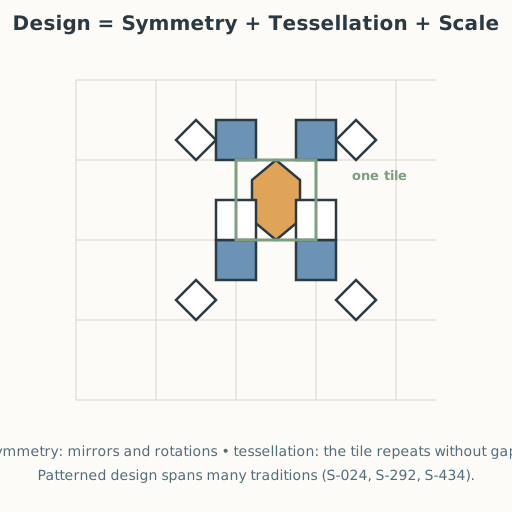
This lesson is written to the learner (“you”). The idea to land: geometric design = symmetry (mirrors and rotations), tessellation (repeating tiles that cover without gaps), and scale (the honest ratio between a plan and the real thing). Teach the construction as a procedure — draw the grid, then the tile — with a worked example and guided practice (S-011). The non-Western examples are essential and accurate: name them as living, specific traditions, never as curiosities.
The ethics lens: a map or plan that distorts scale or hides access is a geometric choice with ethical weight — geometry can clarify or mislead (S-024). The egalitarianism lens: pattern and proportion are the geometry everyone can build — compass and straightedge need no wealth, which is why patterned design flourishes in every part of the world. The global lens: geometric design is genuinely worldwide — Islamic girih and zellige star-and-polygon tiling, African woven and beaded patterns documented in Africa Counts (S-024), and the Indian Sulba Sutras’ altar-construction geometry (S-292, S-434). No one tradition is the default. The technology lens: the same symmetry and scaling rules drive computer-aided design and the maps on every phone. The environment lens: design geometry is also material geometry — a tile that repeats with less waste, a plan that uses local materials, a layout that fits its climate (S-395). Preview: Lesson 12 designs a shared space with access and sustainability in mind.
Procedure
- Recall (5 min). From Grade 11, name what symmetry and similarity mean. Today they become design tools.
- Read a design (10 min). Look at a patterned surface. Name its symmetries (where it mirrors or rotates onto itself), its tessellation (the tile that repeats to cover the surface with no gaps), and its grid (the invisible construction lines the tile sits on).
- Worked example — construct a pattern (15 min). Start with a square grid; place a compass point at each grid intersection and swing equal arcs; connect the crossings to form a star-and-polygon motif. Show that the motif repeats by translation and rotation — one tile, tessellated. This is the method behind patterned tilework in many traditions (S-024, S-434).
- Scale a plan (8 min). A building plan says 1 cm = 1 m. If a wall is 4.5 cm on the plan, it is 4.5 m in the world. Scale is the honest ratio between drawing and reality; change it and the plan lies.
- Guided practice (12 min). With a partner, construct a repeating pattern (your own or a given one) with compass and straightedge, then mark its symmetries and name its tile. Trade with another pair and find each other’s grid.
- Retrieve and connect (5 min). Write one sentence on why a map must keep its scale true, and one on a pattern you have seen in a building, cloth, or craft from your own region or another.
- Close (2 min). Say — or write, sign, gesture, or use AAC to express — what symmetry, tessellation, and scale each add to a design.
Differentiation
- Support: Trace an existing pattern and shade one repeating tile, then name its mirrors and rotations before constructing anything new.
- Extension: Construct a pattern with two different symmetries (e.g., mirror and 60° rotation) and explain how the grid generates both.
- Number access (dyscalculia): Provide the step-3 construction grid pre-printed (the square grid with intersection points marked) so the learner draws arcs and connects crossings without measuring; offload the step-4 scale arithmetic (4.5 cm → 4.5 m) to a partner or a pre-printed scale table; and take the verbal route — name the pattern’s mirrors and rotations and find its repeating tile by eye, saying “this one tile repeats to cover the surface” in words without computing any ratio.
- Communication access: Every spoken step — saying, naming, reading aloud, discussing, or closing — can be done in writing, sign, gesture, or AAC instead. Learners who are non-speaking, d/Deaf, hard-of-hearing, or who use AAC complete every task in their preferred mode; no step requires producing or hearing sound.
Assessment
- Formative (peer + self): Can the learner read symmetry, tessellation, and scale in a design, and construct a repeating pattern with straightedge and compass?
- Portfolio artifact (unit): One constructed pattern with its symmetries and tile labeled, in the math journal.
Home connection
Find a pattern at home or nearby — tiles, cloth, a gate, a basket weave — and draw its repeating tile, marking where it mirrors or rotates. Write one sentence on its grid.
Resources
- On worked examples and guided practice: Kirschner, Sweller & Clark (2006) (S-011).
- On African woven and beaded geometric patterns: Zaslavsky, Africa Counts (S-024). On Indian altar geometry: MacTutor — The Indian Sulbasutras (S-292); Shulba Sutras (S-434). On sustainable design: Brundtland Report (S-395).