Lesson 10 — Proving with Vectors
Learners use vectors to *prove* geometric results rather than merely measure them: they write points as position vectors and show, by algebra, that the diagonals of a parallelogram bisect each other. They learn that a proof is an argument anyone can check — stronger than any single measurement — and connect this to structures where the same vector reasoning holds a design together.
Objectives
Objectives
- D05.S3.12.01 Use coordinates and vectors to analyze geometric situations and prove results.
Essential question
How do I use vectors to prove geometric results, and why is a proof stronger than a measurement?
Key vocabulary
Materials
Standard materials
- Vector-proof sheet · 1 per learner A parallelogram and a triangle with vertices labeled for vector proofs
- Math journal · 1 per learner
Low-tech / no-cost
- Grid paper, ruler, and a straightedge Draw the figure, then express its points as position vectors from a chosen origin
- String or sticks pinned at vertices Build a parallelogram and mark the midpoint of the diagonals by eye, then prove it
Enriched / lab & device
- A graphing tool · 1 per pair Plot the vertices, compute midpoints, and watch the algebra confirm the picture
Works in different contexts
- large-group Prove the diagonal-bisection theorem whole-class, then pairs prove a second result and present it
- multi-age Younger learners check the result by measuring; older learners replace measurement with a vector proof
- self-directed A learner follows the worked proof, then writes a second proof and checks each step's reason
- level-grouped A ready group also proves a point divides a segment in a given ratio, or that three points are collinear
- outdoor-only Mark a parallelogram on the ground with pegs and string, and confirm the diagonals cross at their shared midpoint
Lesson 10 — Proving with Vectors
Summary
Learners use vectors to prove geometric results rather than merely measure them: they write points as position vectors and show, by algebra, that the diagonals of a parallelogram bisect each other. They learn that a proof is an argument anyone can check — stronger than any single measurement — and connect this to structures where the same vector reasoning holds a design together.
Objectives
- Use coordinates and vectors to analyze geometric situations and prove results. (D05.S3.12.01)
Connection
You could measure a parallelogram’s diagonals with a ruler and believe they cross at their midpoints — but a ruler is one sample, and a drawing is one case. A vector proof shows it for every parallelogram at once, from a truss to a gate to a roof beam. That is what a proof is: not a stronger opinion, but a chain of steps so public that anyone can follow it and agree. The same reasoning is what lets an engineer trust a bridge before it is built.
Materials
- Vector-proof sheet
- Math journal
- Low-tech: grid paper, ruler, straightedge
Preparation
- Copy or draw the parallelogram with vertices labeled.
- Retrieval: from Lesson 9, position vectors and vector addition. Today we reason with them.
- Prepare the worked proof (diagonals bisect) to model first (S-011).
Facilitator note
This lesson is written to the learner (“you”). The idea to land: a proof expresses points as position vectors and shows a geometric claim by algebra — every step reversible, every reason stated, so the result holds for all cases, not just the drawing. Teach the worked proof explicitly (S-011), insisting on a reason beside each equals sign. Distinguish evidence (measurement, one example) from proof (a checkable argument), per philosophy §5 — both have value, but only one is a proof.
The ethics lens: a proof is an honest argument — it says exactly what it assumes and exposes every step to checking, rather than asking for trust. The egalitarianism lens: because every step is public and reversible, a proof can be verified by anyone, anywhere, with no authority required — mathematical certainty is not reserved for a few. The global lens: geometric proof has deep and varied roots — the Indian Sulba Sutras stated the right-triangle relationship for altar construction, and the Chinese Nine Chapters proved geometric rules in its own way (S-292, S-289, S-429); no single tradition owns proof. The technology lens: the same vector equations run computer graphics and engineering simulation — a screen’s polygons are parallelograms of vectors. The environment lens: a bridge, a wind brace, a roof truss hold because their vector reasoning is sound — a structure that fails the algebra can fail in the world (S-005). Preview: Lesson 11 applies geometry to real design.
Procedure
- Recall (5 min). From Lesson 9, a position vector points from a chosen origin to a point. Say — or write, sign, gesture, or use AAC to show — what (a + b) means when a and b are vectors.
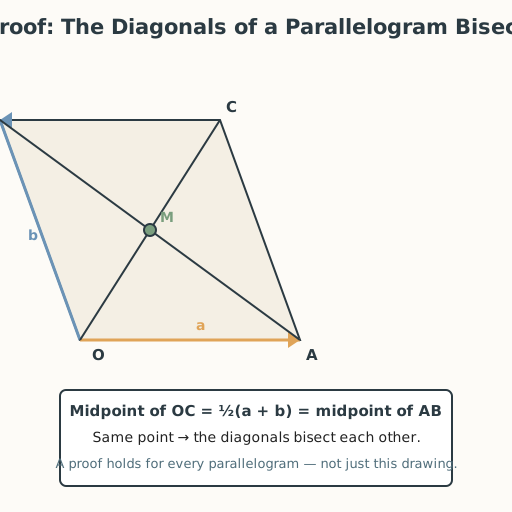
- Set the stage (8 min). Draw a parallelogram with vertices O, A, C, B so that a = position of A, b = position of B, and a + b = position of C (the far corner). Mark the two diagonals: OC and AB.
- Worked proof — diagonals bisect (18 min). Prove both diagonals meet at their shared midpoint. The midpoint of OC is ½(0 + (a + b)) = ½(a + b). The midpoint of AB is ½(a + b) = ½(a + b) — the same vector. Since both diagonals have the same midpoint, they bisect each other. Write every step with its reason: “midpoint formula,” “vector addition,” “equal vectors name the same point.”
- Why proof beats measuring (6 min). A measurement shows this drawing, approximately. The proof shows every parallelogram, exactly. Name the difference in one sentence.
- Guided practice — prove a second result (15 min). With a partner, prove the midsegment theorem: the segment joining the midpoints of two sides of a triangle is parallel to the third side and half its length — or, if that is too large a step, prove that the diagonals of a rectangle are equal in length. State each step’s reason; swap and check each other’s chain.
- Retrieve and connect (4 min). Write one real structure (a bridge, a gate, a roof) and one sentence on why proving its geometry matters before it is built.
- Close (2 min). Say — or write, sign, gesture, or use AAC to express — what a proof is, and what makes it stronger than a measurement.
Differentiation
- Support: Verify the diagonal-bisection result by measuring one drawing first, then follow the algebra step by step, matching each line to the picture.
- Extension: Prove that the point dividing a segment in the ratio 2:1 has position vector (a + 2b)/3, and use it to locate a triangle’s centroid.
- Number access (dyscalculia): Provide the step-3 worked proof pre-printed with the equals-chain already written but the reasons (“midpoint formula,” “vector addition”) left blank to fill, so the learner completes a template rather than deriving ½(a + b); offload the fraction handling to a partner or calculator; and take the verbal route — say the claim in words (“the two diagonals meet at the same point”) and match each line of the algebra to the picture, without re-deriving any arithmetic.
- Communication access: Every spoken step — saying, naming, reading aloud, discussing, or closing — can be done in writing, sign, gesture, or AAC instead. Learners who are non-speaking, d/Deaf, hard-of-hearing, or who use AAC complete every task in their preferred mode; no step requires producing or hearing sound.
Assessment
- Formative (peer + self): Can the learner express points as position vectors and write a chain of vector steps — each with a reason — to prove a geometric result?
- Portfolio artifact (unit): One completed vector proof with reasons, in the math journal.
Home connection
Find a parallelogram in a structure near home (a gate, a window frame, a truss). Check that its diagonals cross at the same midpoint, and write one sentence on how you could be sure for every such shape.
Resources
- On worked examples and guided practice: Kirschner, Sweller & Clark (2006) (S-011).
- On geometric proof across traditions: MacTutor — The Indian Sulbasutras (S-292); MacTutor — Nine Chapters (S-289); Boyer & Merzbach, A History of Mathematics (S-429).