Lesson 01 — Weighing Competing Explanations
Learners meet the core move of Grade 12 science: when two explanations compete for the same phenomenon, we weigh them against the same three criteria — evidence, coherence, and falsifiability — rather than trusting authority or first impressions. They work a historical case (why mothers died of childbed fever) and score two explanations, then apply the weigh to a fresh case.
Objectives
Objectives
- D06.S1.12.01 Evaluate competing scientific explanations of the same phenomenon using criteria of evidence, coherence, and falsifiability.
Essential question
When two explanations compete to explain the same phenomenon, how do I decide which one to trust?
Key vocabulary
Materials
Standard materials
- Explanation-weighing sheet · 1 per learner Three columns — evidence, coherence, falsifiability — and a verdict line, to score two competing explanations
- Science journal · 1 per learner The unit-long notebook for worked examples, reflections, and portfolio artifacts
Low-tech / no-cost
- Two written one-paragraph explanations of the same event Hand-copied or printed; any contested local or historical question works
- Scratch paper For jotting evidence for and against each explanation
Enriched / lab & device
- A short documentary or news clip presenting two scientific explanations · 1 per class To see competing explanations debated by real researchers
Works in different contexts
- large-group Weigh one case whole-class, then pairs each take a different case and report verdicts
- multi-age Younger learners answer "which explanation explains more of what I saw?"; older learners also test falsifiability
- self-directed A learner runs the three-criterion weigh on a real case and writes the verdict with reasons
- level-grouped A ready group also writes what evidence would *settle* the case — the decisive test each side must survive
- outdoor-only Pick a real outdoor puzzle — why a tree is dying, why a stream is muddy — and weigh two explanations for it
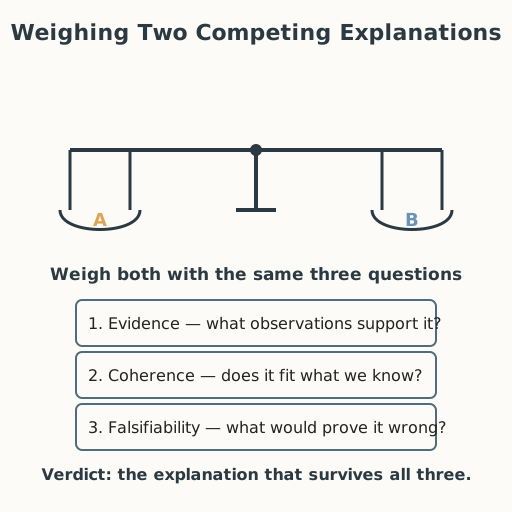
Lesson 1 — Weighing Competing Explanations
Summary
Learners meet the core move of Grade 12 science: when two explanations compete for the same phenomenon, we weigh them against the same three criteria — evidence, coherence, and falsifiability — instead of trusting authority or first impressions. They work a historical case and score two explanations, then apply the weigh to a fresh case of their own.
Objectives
- Evaluate competing scientific explanations of the same phenomenon using criteria of evidence, coherence, and falsifiability. (D06.S1.12.01)
Connection
Two people give you different answers for the same thing — why the fish are gone from the river, why a patient is sick, why the sky glows red at dawn. You cannot believe both, and you need not guess. You can ask each answer the same three questions: what evidence supports you, do you fit with everything else we know, and what would prove you wrong? That is weighing, and it is a move every person, in every place, can make.
Materials
- Explanation-weighing sheet
- Science journal
- Low-tech: two written explanations, scratch paper
Preparation
- Copy or draw the explanation-weighing sheet (evidence / coherence / falsifiability + verdict).
- Retrieval: from Grade 11 (D06.S1.11.01), designing a controlled investigation; from D06.S1.11.02, comparing ways of knowing. Today we aim those habits at choosing among competing explanations.
- Prepare the worked example (childbed fever) to model first (S-011).
Facilitator note
This lesson is written to the learner (“you”). The idea to land: competing explanations are weighed by the same three public criteria — evidence, coherence, and falsifiability — not by who said them or how they feel. Teach the worked example explicitly, then let learners run the weigh on a fresh case (S-011). Keep two things distinct: a factual question (which explanation fits the evidence better?) and a value question (which outcome would we prefer?) — because the strongest explanation can be one we wish were not true.
The ethics lens: weighing honestly means giving each explanation the same test and accepting the verdict even when it is inconvenient. The egalitarianism lens: the three criteria are open to anyone with curiosity and a record of observations — they need no laboratory, no title, no fee. The global lens: the same weigh appears wherever people reason — Semmelweis and John Snow tested germ explanations against “bad air” in 19th-century Europe (S-357, S-358), and every culture that has compared two accounts of a river, a sickness, or a sky has weighed evidence against belief. The technology lens: instruments change what counts as evidence — a microscope, a telescope, a particle detector each open a new court where explanations are tried (S-488). The environment lens: the weigh is exactly what we need for contested environmental questions — overfishing versus pollution versus a warming river — where more than one explanation is on offer. Preview: Lesson 2 sharpens each criterion into a working tool.
Procedure
- Recall (5 min). From Grade 11, name one thing a controlled investigation must hold constant. Today we ask a bigger question: when two whole explanations compete, how do we choose?
- Meet the three criteria (8 min). Write them down: evidence (what observations support it), coherence (does it fit with everything else we know), and falsifiability (could some possible observation show it wrong). An explanation that cannot be shown wrong under any observation is not testable.
- Worked example — childbed fever (15 min). In the 1840s Vienna hospital, many mothers died of “childbed fever.” Two explanations competed: (A) bad air (miasma) in the ward, or (B) something carried from the autopsy room on doctors’ hands. Score both: evidence — Ignaz Semmelweis found that having doctors wash hands made deaths fall sharply (S-357); coherence — B explains why the ward staffed by midwives (who did not do autopsies) had far fewer deaths, which A cannot; falsifiability — A makes no prediction that would differ between the two wards, so it is hard to test, while B predicts a difference we can check. Verdict: B fits better. Write the score on your sheet.
- Name the move (5 min). You did not “believe” B; you weighed it. The stronger explanation is not the one that feels right or comes from authority — it is the one that survives the same three questions.
- Weigh a fresh case (15 min). With a partner, choose a contested question — a local environmental change, a medical claim, a cosmological debate (such as steady-state versus Big Bang, S-497). List two explanations and score each on evidence, coherence, and falsifiability. Say — or write, sign, gesture, or use AAC to show — your verdict and the single strongest reason for it.
- Share and check (5 min). Pairs exchange verdicts and check each other’s scoring: did both explanations get the same three tests? Give one specific improvement.
- Close (2 min). Say — or write, sign, gesture, or use AAC to express — the three questions you now ask any competing explanation before you trust it.
Differentiation
- Support: Use the worked example’s two explanations as a pre-filled sheet; the learner adds one piece of evidence to each column rather than building the case from scratch.
- Extension: State the decisive test — the observation that would settle the case — for each side, and explain why a test that both sides would survive cannot settle anything.
- Number access (dyscalculia): The lesson’s few numbers (the year 1847, “far fewer deaths”) can all be read as comparisons rather than arithmetic; provide the explanation-weighing sheet as a pre-printed organizer with the three columns already labeled, and allow the verdict to be reached in words — “this one explains the difference between the two wards; the other one can’t” — with no computation at all.
- Communication access: Every spoken step — saying, naming, reading aloud, discussing, or closing — can be done in writing, sign, gesture, or AAC instead. Learners who are non-speaking, d/Deaf, hard-of-hearing, or who use AAC complete every task in their preferred mode; no step requires producing or hearing sound.
Assessment
- Formative (peer + self): Can the learner name the three criteria, apply them to two competing explanations, and write a verdict with a reason that names evidence rather than authority or feeling?
- Portfolio artifact (unit): One completed explanation-weighing sheet (evidence, coherence, falsifiability, verdict), opened in the science journal.
Home connection
Find two different explanations for the same thing in daily life — why a plant wilted, why a road flooded, why a device stopped working. Write one sentence scoring each against the three criteria and your verdict.
Resources
- On worked examples and guided practice for a new concept: Kirschner, Sweller & Clark (2006) (S-011).
- On Semmelweis and the germ explanation of childbed fever: Encyclopaedia Britannica — Ignaz Semmelweis (S-357); on John Snow and the Broad Street pump: S-358.
- On a competing cosmological model later weighed against evidence: Encyclopaedia Britannica — Steady-state theory (S-497); on the faster-than-light neutrino episode: S-488.