Lesson 02 — Evidence, Coherence, and Falsifiability
Learners sharpen each of the three criteria into a working tool: evidence (what observations, repeated and checked, support a claim), coherence (fitting with the wider web of established knowledge), and falsifiability (being disprovable by some possible observation). They see science correct itself in the faster-than-light neutrino episode, and distinguish correlation from causation with Bradford Hill's questions.
Objectives
Objectives
- D06.S1.12.01 Evaluate competing scientific explanations of the same phenomenon using criteria of evidence, coherence, and falsifiability.
Essential question
What makes evidence good, what makes an explanation coherent, and why does an explanation have to be falsifiable to count as scientific?
Key vocabulary
Materials
Standard materials
- Criterion cards · 1 set per pair Three cards — Evidence, Coherence, Falsifiability — with one-line definitions and a test question each
- Science journal · 1 per learner
Low-tech / no-cost
- Two news headlines making causal claims Hand-copied or printed; one real and one spurious-looking
- Scratch paper For writing what would falsify each claim
Enriched / lab & device
- A data page (Our World in Data or a spurious-correlation gallery) · 1 per pair To see how a pattern alone (correlation) is not yet evidence of a cause
Works in different contexts
- large-group Teach the three criteria whole-class, then pairs apply them to one claim each and report
- multi-age Younger learners focus on "what evidence would change my mind?"; older learners also write the falsifying observation
- self-directed A learner sharpens each criterion, applies all three to a real claim, and writes what would falsify it
- level-grouped A ready group also maps the Bradford Hill questions for causation onto a real claim
- outdoor-only State a causal claim about something outdoors ("the birds left because it got cold") and name what observation would falsify it
Lesson 2 — Evidence, Coherence, and Falsifiability
Summary
Learners turn the three criteria into working tools: evidence (observations, repeated and checked, that support a claim), coherence (fitting with the wider web of established knowledge), and falsifiability (being disprovable by some possible observation). They watch science correct itself in the faster-than-light neutrino episode, and learn why correlation is not yet causation.
Objectives
- Evaluate competing scientific explanations of the same phenomenon using criteria of evidence, coherence, and falsifiability. (D06.S1.12.01)
Connection
You have heard it a hundred times: “more ice cream is sold when more people drown, so ice cream causes drowning.” The pattern is real — both rise in summer — but the cause is wrong. Telling a pattern from a cause, and asking what would prove a claim wrong, is the difference between being carried by a claim and being able to check it. It is a skill you already use when you ask “but does that actually follow?”
Materials
- Criterion cards
- Science journal
- Low-tech: two causal headlines, scratch paper
Preparation
- Copy or draw the criterion cards.
- Retrieval: from Lesson 1, the three criteria. Today we make each one sharp enough to use on a single sentence.
- Prepare the worked example (correlation vs causation, and the neutrino episode) to model first (S-011).
Facilitator note
This lesson is written to the learner (“you”). The idea to land: evidence means repeated, checked observations; coherence means fitting the wider web of knowledge; falsifiability means some possible observation could show the claim wrong — and a claim that cannot be wrong under any observation is not yet science. Teach each criterion explicitly, then let learners apply them (S-011). Keep the distinction crisp: “is it true?” (evidence) is different from “is it good?” (values).
The ethics lens: a claim that is unfalsifiable is a closed door — it cannot be corrected, which is why we owe each other testable claims when we speak about how the world works. The egalitarianism lens: falsifiability puts every speaker on the same footing — the powerful and the powerless must both say what would prove them wrong. The global lens: the criteria are not one culture’s invention; they are the shared grammar of weighing evidence that appears wherever people have tested a claim against the world (S-306, S-250). The technology lens: instruments and replication are what let science correct itself — the 2011 “faster-than-light neutrinos” result, which would have overturned relativity if true, was traced to a loose fiber-optic cable and withdrawn, an honesty made possible by open checking (S-488, S-489). The environment lens: environmental claims are a falsifiability gymnasium — “this chemical is safe,” “this species is recovering” — each must say what observation would show it wrong. Preview: Lesson 3 turns from how we weigh to who asks the questions and who benefits.
Procedure
- Recall (5 min). From Lesson 1, say — or write, sign, gesture, or use AAC to show — the three criteria and what each one asks.
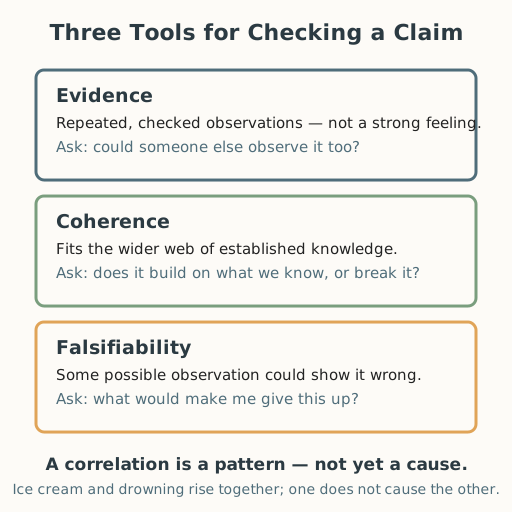
- Evidence (8 min). Evidence is not “what I believe strongly.” It is observations that others could repeat and check. Ask of a claim: what could I observe, and could someone else observe it too? A single anecdote is weak evidence; many independent, repeated observations are strong (S-489).
- Coherence (6 min). An explanation is coherent when it fits the rest of what we already know — it does not require the rest of science to be wrong. Ask: does this contradict well-established knowledge, or build on it?
- Falsifiability (8 min). An explanation is falsifiable when some possible observation could show it wrong. Ask: what would I have to see to give this up? If nothing would change your mind, the claim is not testable — it may be a belief, a value, or a preference, but it is not a scientific explanation.
- Worked example — science corrects itself (10 min). In 2011 one experiment reported neutrinos arriving faster than light — which, if true, would overturn Einstein’s relativity. The community did not reject it out of hand or accept it on faith: they asked what would falsify it and can it be replicated. Other labs could not reproduce it; the cause was a loose cable. The claim was withdrawn (S-488). That is evidence, coherence, and falsifiability working together.
- Correlation vs causation (10 min). Ice cream sales and drownings rise together (correlation) but ice cream does not cause drowning (S-307). Before saying one thing causes another, ask Bradford Hill’s questions: is the cause before the effect, is the effect bigger with a bigger dose, is there a plausible mechanism, do other explanations fail (S-306)? A pattern alone is not enough.
- Apply all three (6 min). Take one headline. Write: what evidence supports it, whether it coheres with what you know, and what observation would falsify it. Say — or write, sign, gesture, or use AAC to show — your verdict.
- Close (2 min). Say — or write, sign, gesture, or use AAC to express — why an explanation must be able to be wrong to be trustworthy.
Differentiation
- Support: Use the criterion cards as a checklist, and score only “falsifiable or not” for one claim before adding evidence and coherence.
- Extension: Write the falsifying observation for a real claim, and explain the difference between a claim that is unfalsifiable and one that is simply false.
- Number access (dyscalculia): Keep the correlation/causation examples verbal and diagram-based (two lines rising together) rather than numeric; provide the falsifiability question as a sentence frame (“I would change my mind if I saw ___”), and allow every verdict to be reached and stated in words, with any counting or dates offloaded to a partner.
- Communication access: Every spoken step — saying, naming, reading aloud, discussing, or closing — can be done in writing, sign, gesture, or AAC instead. Learners who are non-speaking, d/Deaf, hard-of-hearing, or who use AAC complete every task in their preferred mode; no step requires producing or hearing sound.
Assessment
- Formative (peer + self): Can the learner define the three criteria in their own words, tell a correlation from a causation claim, and write the observation that would falsify a given claim?
- Portfolio artifact (unit): A one-page “three-criteria check” of a real claim, with evidence, coherence, and falsifiability each answered, added to the science journal.
Home connection
Choose one claim you hear at home or in media. Write what evidence supports it, whether it coheres with what you know, and the one observation that would make you stop believing it.
Resources
- On worked examples and guided practice: Kirschner, Sweller & Clark (2006) (S-011).
- On causation criteria: Bradford Hill (1965) (S-306); on spurious correlations: Tyler Vigen (S-307).
- On self-correction and replication: OPERA neutrino anomaly (S-488); Understanding Science — peer review & replication (S-489); Understanding Science — what is science / bias (S-250).