Lesson 14 — A Considered Position on Origins
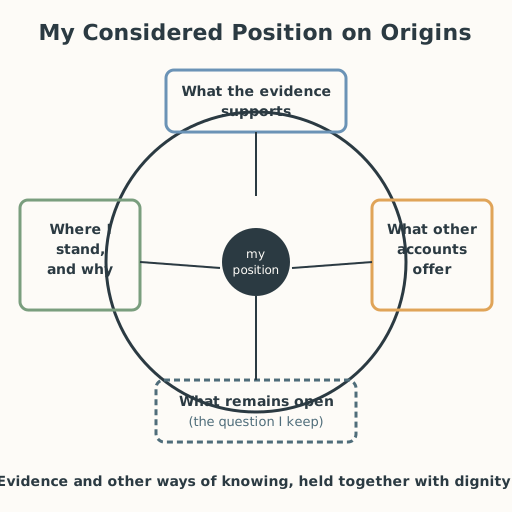
The unit's capstone: learners articulate their own considered position on the origins of the cosmos and of life, in four honest parts — what the evidence supports, what other accounts offer, where they stand and why, and what remains open. They review the unit's artifacts, draft and refine the position, and share only what they choose, holding evidence and other ways of knowing in respectful relation and never as creed.
Objectives
Objectives
- D06.S4.12.02 Articulate a considered position on the origins of the cosmos and life that holds scientific evidence and other ways of knowing in respectful relation.
Essential question
What is my own considered position on the origins of the cosmos and of life — one that holds scientific evidence and other ways of knowing in respectful relation?
Key vocabulary
Materials
Standard materials
- Position-statement frame · 1 per learner A scaffold — what the evidence supports, what other accounts offer, where I stand and why, what remains open
- Science journal · 1 per learner
Low-tech / no-cost
- All the unit's portfolio artifacts, laid out as a review The weigh sheets, traces, proposals, diagrams, and position drafts gathered across the unit
- Scratch paper For drafting the position statement
Enriched / lab & device
- A quiet reading or listening selection (a creation account or a scientist's reflection) · 1 per class To model a considered position held with both honesty and wonder
Works in different contexts
- large-group Share positions in small circles, each learner reading only what they choose to share
- multi-age Younger learners state "what the evidence shows and what I still wonder"; older learners write the full position
- self-directed A learner writes the position alone, then self-checks it against the four-part frame
- level-grouped A ready group also states the limit of the evidence and the boundary of the position's claims
- outdoor-only Compose the position aloud or in writing while looking at the sky or the land, naming what each way of knowing offers
Lesson 14 — A Considered Position on Origins
Summary
The unit’s capstone: learners articulate their own considered position on the origins of the cosmos and of life, in four honest parts — what the evidence supports, what other accounts offer, where I stand and why, and what remains open. They review the unit’s artifacts, draft and refine the position, and share only what they choose — holding evidence and other ways of knowing in respectful relation, never as creed.
Objectives
- Articulate a considered position on the origins of the cosmos and life that holds scientific evidence and other ways of knowing in respectful relation. (D06.S4.12.02)
Connection
You have spent this unit weighing explanations, tracing who asks and who benefits, mapping coupled systems, holding science and culture side by side, and reading the forces, the particles, and the night sky. Now the question turns to you: given all of it — what is your position? Not a final answer to be defended forever, but a considered position you can state honestly today, knowing it may grow. That is what a free, thinking person does with the oldest question there is.
Materials
- Position-statement frame
- Science journal
- Low-tech: the unit’s artifacts laid out, scratch paper
Preparation
- Copy or draw the position-statement frame.
- Retrieval: the whole unit — the weigh (L1–L2), the ethics of science (L3–L4), coupled systems and trade-offs (L5–L6), accounts of life and culture side by side (L7–L8), forces and particles (L9–L10), technology’s promise and risk (L11–L12), and cosmological and geological evidence (L13). Today we compose from all of it.
- Prepare the four-part frame to model first (S-011).
Facilitator note
This lesson is written to the learner (“you”). The idea to land: a considered position on origins has four honest parts — what the evidence supports, what other accounts offer, where I stand and why, and what remains open — and it holds evidence and other ways of knowing in respectful relation, never as creed. Model the frame, then let learners compose (S-011). This lesson is emotionally and culturally delicate: every learner’s tradition is to be held with dignity; no position is imposed, ranked, or mocked (philosophy §11). Sharing is always optional; use written or anonymous sharing if speaking up is not safe for some learners (contexts, cultural power dynamics). Distinguish evidence from values one last time: what the evidence supports is a factual claim; where I stand and why is a value, and each has its own kind of honesty.
The ethics lens: the position is an ethical act — it refuses both dogmatism (pretending a model is certain truth) and contempt (pretending another’s account is worthless), and chooses honesty and respect instead. The egalitarianism lens: every learner’s position, from every tradition and no tradition, stands on equal footing — the exercise is not to find the one right answer but to let each person speak their considered mind with dignity (S-202, S-203). The global lens: origins have been held by every people, in every place — and a considered position honors that the scientific account is one among many, standing beside, not above (S-002, S-427). The technology lens: our knowledge of origins is mediated by instruments — telescopes, dating methods, sequencers — which is why the position names what the evidence supports as distinct from what I believe. The environment lens: to hold a position on origins is also to hold a position on the living world that is here now — awe at the cosmos is incomplete without care for the planet it produced (S-361, S-437). Preview: the position closes the unit and opens the lifelong question.
Procedure
- Gather the unit (10 min). Lay out your artifacts — the weigh sheets, the traces, the proposals, the coupling diagram, the side-by-side chart, the forces table, the models-and- evidence sheet. Re-read your own words. What did you conclude at each step?
- Meet the four parts (8 min). The position has four parts: (1) what the evidence supports (the facts, e.g., the Big Bang and evolution are well-evidenced, S-002, S-303); (2) what other accounts offer (meaning, duty, belonging — what the stories carry, S-202, S-203, S-427); (3) where I stand and why (your value, named openly); and (4) what remains open (the first origin of life, the nature of what came before — S-499). Write the four as headings.
- Model the frame (10 min). Read a model position aloud — or follow one in writing: “The evidence supports an expanding universe and life’s shared ancestry. The stories of my people offer meaning and duty. I stand with both, because they answer different questions. I leave open how the first life began, and I remain in wonder.” Notice: no part is dogma, and no part is mocked.
- Compose your position (20 min). Write your own four-part position. Say — or write, sign, gesture, or use AAC to show — each part, especially what you leave open. You may share it or keep it private; both are complete.
- Refine with a peer (5 min). If you choose, exchange with a partner and check one thing: is the evidence part actually evidence, and the value part honestly labeled as value? Give one specific, respectful improvement.
- Close (2 min). Say — or write, sign, gesture, or use AAC to express — one sentence of your position, and one thing you leave open.
Differentiation
- Support: Complete only parts 1 and 4 (“what the evidence supports” and “what remains open”) and answer part 3 aloud or in a single sentence.
- Extension: State the limit of your position — the point at which the evidence stops and your belief begins — and write how your position would change if new evidence appeared.
- Number access (dyscalculia): The position is prose, not arithmetic; provide the four-part frame as a pre-printed scaffold with sentence starters, and allow every part to be spoken, signed, or recorded rather than written, with no numbers required.
- Communication access: Every spoken step — saying, naming, reading aloud, discussing, or closing — can be done in writing, sign, gesture, or AAC instead. Learners who are non-speaking, d/Deaf, hard-of-hearing, or who use AAC complete every task in their preferred mode; no step requires producing or hearing sound.
Assessment
- Formative (self + peer, optional sharing): Can the learner state a four-part position that separates what the evidence supports from what they value, names what other accounts offer, and leaves the open questions open — with dignity for all accounts?
- Portfolio artifact (unit capstone): The four-part position statement, added to the science journal as the unit’s closing artifact.
Home connection
If you wish, read your position to someone at home, and ask them what their own four parts would be. Listen without arguing, and write one sentence about where you differ and one about where you agree.
Resources
- On the evidence for the Big Bang: NASA — The Big Bang (S-002); on evolution: Darwin (S-303).
- On other accounts of origins held with dignity: Te Ara — Ranginui and Papatūānuku (S-202); Smithsonian NMAI — Haudenosaunee creation (S-203); Encyclopaedia Britannica — Olorun (S-500), Viracocha (S-501), Rigveda (S-502), Allah (S-503); Kimmerer, Braiding Sweetgrass (S-427).
- On the open first-origin question: NASA Astrobiology (S-499); on our place in the cosmos: NASA — Star Lifecycle (S-361); on caring for the living world: IPBES (S-437).