Lesson 13 — Cosmological Models and Geological Evidence
Learners weigh two competing cosmological models — the Big Bang and the steady-state theory — against the evidence that settled the question: galaxies receding, the cosmic microwave background, and the observed abundances of the light elements. They then read geological evidence — the age of the Earth, plate tectonics, fossils — as deep time, and see how scientific models of origins are held as models, not certainties, beside other ways of knowing.
Objectives
Objectives
- D06.S4.12.01 Weigh cosmological models and geological evidence, and the relationship between scientific and other ways of knowing about origins.
Essential question
How do I weigh competing cosmological models and geological evidence, and how do scientific and other ways of knowing about origins relate?
Key vocabulary
Materials
Standard materials
- Models-and-evidence sheet · 1 per learner Two cosmological models weighed against three lines of evidence (redshift, microwave background, element abundances) plus a geological deep-time line
- Science journal · 1 per learner
Low-tech / no-cost
- A long paper strip for deep time and two drawn diagrams One showing galaxies receding, one showing a background glow filling space
- Scratch paper For the models-and-evidence table
Enriched / lab & device
- A short NASA video or image set (cosmic microwave background, Hubble deep field) · 1 per class To see the evidence that distinguished the models
Works in different contexts
- large-group Weigh the two models whole-class, then pairs each take one line of evidence and report how it decides
- multi-age Younger learners retell the two stories; older learners also match each line of evidence to the model it favors
- self-directed A learner weighs the models against the evidence and writes which evidence was decisive
- level-grouped A ready group also explains why a model is held as a model, not a certainty
- outdoor-only Read the landscape as geological evidence — layered rock, a canyon, a shoreline — and place it in deep time
Lesson 13 — Cosmological Models and Geological Evidence
Summary
Learners weigh two competing cosmological models — the Big Bang and the steady-state theory — against the evidence that settled the question: galaxies receding, the cosmic microwave background, and the observed abundances of the light elements. They then read geological evidence — the age of the Earth, plate tectonics, fossils — as deep time, and see how scientific models of origins are held as models, not certainties, beside other ways of knowing.
Objectives
- Weigh cosmological models and geological evidence, and the relationship between scientific and other ways of knowing about origins. (D06.S4.12.01)
Connection
The night sky has always asked the same question: where did all of this come from? People have answered it a thousand ways — in stories, in songs, and, more recently, in models that can be tested against the light itself. A model is not a certainty; it is a guess we hold up to the evidence and revise when the evidence says otherwise. Weighing those models, and reading the rocks, is how we answer the old question with our best honesty.
Materials
- Models-and-evidence sheet
- Science journal
- Low-tech: a deep-time strip, two drawn diagrams, scratch paper
Preparation
- Copy or draw the models-and-evidence sheet.
- Retrieval: from Grade 11 (D06.S4.11.01), comparing cosmological models; from Grade 9 (D06.S4.09.02), evidence for the age of the Earth and universe. Today we weigh the models and read the rocks together.
- Prepare the worked example (weighing one line of evidence) to model first (S-011).
Facilitator note
This lesson is written to the learner (“you”). The idea to land: the Big Bang and the steady-state theory competed as cosmological models, and evidence — galaxies receding, the cosmic microwave background, and light-element abundances — favored the Big Bang; geological evidence (age, tectonics, fossils) reads as deep time; and scientific models of origins are held as models, not revealed certainties, beside other ways of knowing. Teach the weigh explicitly, then let learners run it (S-011). This is the inquiry-over-creed commitment made concrete (philosophy §11): the model is offered as evidence-grounded, never as dogma.
The ethics lens: holding a model as a model — revisable, not certain — is intellectual honesty, and it forbids using any account of origins to rank or coerce people (S-018, S-497). The egalitarianism lens: the evidence is public light and public rock — anyone can look up or down and begin to weigh it; no account requires a title to be examined. The global lens: origin stories belong to every people — the Māori tell of Ranginui and Papatūānuku (S-202), the Haudenosaunee of Sky Woman (S-203), the Yoruba of Olorun (S-500), the Inca of Viracocha (S-501), the Rig Veda’s Hymn of Creation of an origin still wondered at (S-502), and the Qur’an of one God who made the heavens and the earth (S-503) — and the scientific model stands beside these, not above them; the steady-state theory itself was championed by scientists who preferred an eternal universe, a reminder that preference shapes hypotheses until evidence decides (S-497). The technology lens: telescopes and radiometric dating are the instruments that turned cosmological and geological questions into checkable ones — the microwave background was found with a radio antenna (S-002, S-308). The environment lens: plate tectonics and deep time are the Earth’s own story — mountains rise, continents drift, and fossils record life’s changes over billions of years (S-186, S-111). Preview: Lesson 14 asks you to articulate your own considered position.
Procedure
- Recall (5 min). From Grade 11, name one cosmological model. Today we weigh two against evidence.
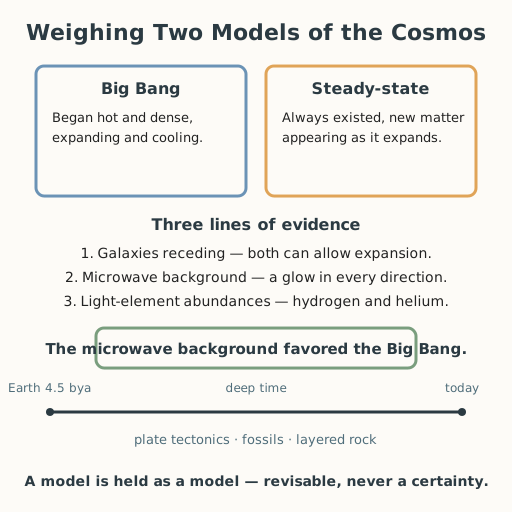
- Meet the two models (10 min). The Big Bang: the universe began hot and dense and has been expanding and cooling ever since (S-002, S-018). The steady-state: the universe has always existed, with new matter appearing as it expands (S-497). Both are models — guesses to be tested.
- Worked example — weigh the evidence (15 min). Three lines of evidence: (1) galaxies receding — both models can allow expansion, but the Big Bang predicts it began from a dense state; (2) the cosmic microwave background — a faint glow in every direction, predicted by the Big Bang as leftover heat, which steady-state could not naturally explain; (3) light-element abundances — the Big Bang predicts the observed amounts of hydrogen and helium (S-002). The microwave background, in particular, favored the Big Bang. Fill the table with which model each line of evidence favors.
- Read the rocks (10 min). Geological evidence reads as deep time: the Earth is about 4.5 billion years old (S-308); plates drift and build mountains over millions of years (S-186); fossils record life’s changes in layered rock (S-111). Place these on your deep-time strip.
- Model, not certainty (7 min). A model is held because it fits the evidence so far and could be revised by new evidence — not because it is beyond question (S-018). Say — or write, sign, gesture, or use AAC to show — the difference between “best-supported model” and “revealed truth.”
- Close (2 min). Say — or write, sign, gesture, or use AAC to express — which line of evidence you found most decisive, and why.
Differentiation
- Support: Match pre-written evidence cards to the model each favors, before writing any explanations.
- Extension: Name one observation that could, in principle, revise the current model, and explain what “revisable” means for a claim about the universe’s origin.
- Number access (dyscalculia): Deep time is felt on the paper strip as relative distance, not years — use “long before,” “later,” and “billions of years” as words; provide the models-and-evidence sheet pre-printed so the learner places check marks rather than computing, and allow every explanation in words with any figures read aloud or offloaded to a partner.
- Communication access: Every spoken step — saying, naming, reading aloud, discussing, or closing — can be done in writing, sign, gesture, or AAC instead. Learners who are non-speaking, d/Deaf, hard-of-hearing, or who use AAC complete every task in their preferred mode; no step requires producing or hearing sound.
Assessment
- Formative (peer + self): Can the learner weigh the two models against the three lines of evidence, name which evidence was decisive, and explain why a model is held as a model rather than a certainty?
- Portfolio artifact (unit): The completed models-and-evidence sheet with a written sentence on “model, not certainty,” opened in the science journal.
Home connection
Look at the night sky (or a picture of it) and write two sentences: what you see, and what evidence in that light helped scientists choose among models of where it all came from.
Resources
- On the Big Bang and its evidence: NASA — The Big Bang (S-002); NASA Space Place — What Is the Big Bang? (S-018).
- On the competing steady-state model: Encyclopaedia Britannica — Steady-state theory (S-497).
- On geological deep time: USGS — Age of the Earth (S-308); National Geographic Education — Plate Tectonics (S-186); BBC Bitesize (KS2) — What can fossils tell us? (S-111).
- On other ways of knowing about origins, held with dignity: Te Ara — Ranginui and Papatūānuku (S-202); Smithsonian NMAI — Haudenosaunee creation (S-203); Encyclopaedia Britannica — Olorun (S-500), Viracocha (S-501), Rigveda (S-502), Allah (S-503).