Lesson 05 — A Sustained Body of Music: Skill and Voice
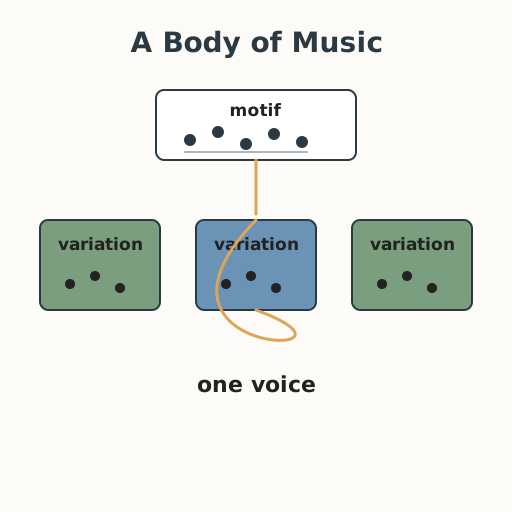
Learners meet the musical parallel of Lesson 1: a *body of music* is several pieces held together by one voice — a recurring motif, a shared framework, a consistent feel. They study how a single melodic framework can generate many pieces across time (the raga), then make three short pieces of their own that share a voice, using voice, body, or instrument.
Objectives
Objectives
- D07.S2.12.01 Produce and perform or present a sustained body of musical work that shows skill and a coherent personal voice, with a written statement.
Essential question
How do several pieces of music become one sustained body of work with a voice of its own — and how do I begin mine?
Key vocabulary
Materials
Standard materials
- Music-capstone journal · 1 per learner For motif sketches, listening notes, statements, and critiques — the unit-long record
- Motif-to-body sheet · 1 per learner Three motif boxes (or three pieces) and a line naming what ties them into one voice
Low-tech / no-cost
- Voice, body, and found sound Clapping, tapping, humming, or improvised instruments (a struck cup, a plucked string) — no instrument required
- A listening partner To hear and respond to three short pieces made with the voice or body
Enriched / lab & device
- Free recording or notation tool (BandLab, or any recorder) · 1 per learner or pair To capture the three pieces and listen back; BandLab is free and browser-based (S-443)
Works in different contexts
- large-group Model one motif-and-variation set whole-class, then learners make three short pieces in pairs
- multi-age Younger learners clap or hum three variations of one rhythm; older learners notate or record and name the shared voice
- self-directed A learner makes three pieces, records or notates them, and writes the line naming the shared voice
- level-grouped A ready group also identifies the element (rhythm, melody, timbre) that most carries their voice
- outdoor-only Build the three pieces from environmental sounds and rhythms — footsteps, wind, water, work-sounds
Lesson 5 — A Sustained Body of Music: Skill and Voice
Summary
Learners meet the musical parallel of Lesson 1: a body of music is several pieces held together by one voice — a recurring motif, a shared framework, a consistent feel. They study how a single melodic framework can generate many pieces across time (the raga), then make three short pieces of their own that share a voice, using voice, body, or instrument.
Objectives
- Produce and perform or present a sustained body of musical work that shows skill and a coherent personal voice, with a written statement. (D07.S2.12.01)
Connection
Think of a lullaby, a work-song, a chant, or a tune you know from home — one melody that comes back in different versions, faster or slower, sung by different people, each time recognizably the same. That is a body of music: not one performance but a voice that returns. Everywhere people make music, they do this — repeat and vary a pattern until it becomes theirs.
Materials
- Music-capstone journal
- Motif-to-body sheet
- Low-tech: voice, body, and found sound; a listening partner
- Enriched: BandLab or any recorder
Preparation
- Copy or draw the motif-to-body sheet (three pieces + a “shared voice” line).
- Retrieval: from Grade 11 (D07.S2.11.01), composing a piece that responds to an issue; from Grade 10 (D07.S2.10.01), composing and recording an original piece with a clear idea. Today we begin the sustained musical body for this unit’s capstone.
- Prepare a short recorded or sung example of a motif varied three ways to model (S-011).
Facilitator note
This lesson is written to the learner (“you”). The idea to land: a body of music is several pieces united by one voice — a recurring motif, a shared framework, a consistent feel — showing skill that develops across the set. Teach motif-and-variation explicitly, then let learners make three pieces (S-011). Remind learners that “skill” here is audible intention — a repeated rhythm, a chosen scale, a returning phrase — not only virtuosity.
The ethics lens: a musical voice is a responsibility — when a body of work borrows from a tradition, the maker must credit it and its living keepers. The egalitarianism lens: a body of music can be made with nothing but the voice and body — clapped, hummed, tapped — so no instrument and no money is a barrier. The global lens: the raga of Indian classical music is a melodic framework with a scale, characteristic phrases, and an associated mood and time, from which performers have generated countless pieces across centuries — a living tradition, honored with respectful questions, never imitated carelessly (S-366). The technology lens: recording tools let a maker hear their own voice back and build a body over time; free tools such as BandLab put this in any learner’s hands (S-443). The environment lens: found sound — rain, wind, footsteps, work — can be the material of a body of music, tying the voice to a place. Preview: Lesson 6 puts the body into words.
Procedure
- Recall (5 min). From Grade 11: name a piece that responded to a social or environmental issue. Today we ask what it takes to make not one piece but a body of music with one voice.
- Meet the idea (8 min). A body of music is several pieces held together by a voice: a recurring motif (a short, remembered phrase), a shared framework (a scale or mode), and a consistent feel. One melody, varied many ways, is the oldest form of this.
- Worked example — the raga (12 min). In Indian classical music, a raga is a melodic framework: a particular scale, a typical order of notes, and characteristic phrases, each raga with its own mood and even its own time of day or season (S-366). Across centuries, performers have improvised and composed countless pieces within one raga — one framework, many works, one voice. Listen to (or have described) two pieces in the same raga, and name what ties them together: the scale and its phrases.
- Name the move (5 min). A body of music is a decision: I will keep returning to this motif or mode. The voice is what stays recognizable when everything else changes.
- Make three pieces (18 min). Choose one short motif — a rhythm you clap, a phrase you hum, a few notes you play. Make three short pieces from it, each a little different in speed, mood, or decoration but the same at the core. Record or notate them if you can. Then write one line: what stays the same across all three.
- Share and check (5 min). With a partner, play or describe your three pieces and read your line. Ask: could a listener tell these three belong together, and how? Give one specific improvement.
- Close (2 min). Say — or write, sign, gesture, or use AAC to express — the difference between “three tunes” and “a body of music.”
Differentiation
- Support: Use the motif-to-body sheet with a given motif; the learner varies it three ways (faster, slower, higher) rather than inventing a motif cold.
- Extension: Name the single element (rhythm, melody, timbre, or mode) that most carries the voice, and note where the skill improves across the three pieces.
- Number access (dyscalculia): No arithmetic is required; “three pieces” is a simple count the sheet already structures with three boxes, and a learner may make any number of pieces while still meeting “several pieces, one voice.” Notation is optional; the voice can be captured by ear, gesture, or description.
- Communication access: Every spoken step — singing, playing aloud, discussing, sharing, or closing — can be done in sign, gesture, writing, notation, or AAC instead. Learners who are d/Deaf, hard-of-hearing, non-speaking, or who use AAC make and describe their pieces through felt vibration, visual notation, gesture, or written description; no step requires producing or hearing sound. A learner who is blind or has low vision works by ear, touch, and verbal description.
Assessment
- Formative (peer + self): Can the learner state the difference between a single piece and a body of music, make three pieces from one motif, and name what stays the same?
- Portfolio artifact (unit): The three pieces (recorded, notated, or described) with the one-line “shared voice” statement, opened in the music-capstone journal.
Home connection
Ask someone at home to sing or hum a tune they know in two different ways — and describe what stays the same. Write one sentence naming their “motif” and one naming what you would keep and vary in your own music.
Resources
- On worked examples and guided practice for a new concept: Kirschner, Sweller & Clark (2006) (S-011).
- On the raga as a living melodic framework: Encyclopaedia Britannica — Raga (S-366).
- On a free, browser-based recording tool: BandLab (S-443).