Lesson 01 — Weighing Accounts of Change and Continuity
Learners meet the unit's core skill: weighing competing accounts of the same change. They learn that two honest people can describe one change differently because each notices change or continuity more, and that weighing means asking who is telling the account, what it notices and leaves out, and whether accounts agree. They practice on the global shift from village life to city life, told from two sides.
Objectives
Objectives
- D08.S1.12.01 Weigh competing accounts of change and continuity across global history and form a reasoned synthesis of the evidence.
Essential question
When two people describe the same change differently, how do I weigh their accounts fairly instead of just picking the louder one?
Key vocabulary
Materials
Standard materials
- Weighing-an-account sheet · 1 per learner A two-column organizer — 'what this account notices' and 'what this account leaves out' — with a bottom row for 'change vs continuity'
- Capstone history journal · 1 per learner The unit-long notebook for weighings, syntheses, and reflections
Low-tech / no-cost
- Two short written accounts of one change Hand-copied or printed from the lesson examples, or two local tellings of the same event
- Scratch paper To draw the weighing organizer by hand
Enriched / lab & device
- Two contrasting news reports or oral-history clips on one change · 1 per pair Any two genuine accounts — a government release and a community testimony, a newspaper and a memoir
Works in different contexts
- large-group Model the weighing whole-class on the worked example, then pairs each weigh a different pair of accounts and report one difference
- multi-age Younger learners answer "what changed and what stayed the same?"; older learners also name who is telling each account and what they leave out
- self-directed A learner reads two accounts, fills the sheet, and writes which parts of each account are best supported
- level-grouped A ready group also names a place where the two accounts contradict each other directly, and what would settle it
- outdoor-only Name one change visible outdoors (a felled tree, a new road, a shifting river) and have two people each tell its story — then weigh the two tellings
Lesson 1 — Weighing Accounts of Change and Continuity
Summary
Learners meet the unit’s core skill: weighing competing accounts of the same change. They learn that two honest people can describe one change differently because one notices the change and the other notices the continuity — and that weighing means asking who is telling the account, what it notices and leaves out, and whether accounts agree. They practice on the global shift from village life to city life, told from two sides.
Objectives
- Weigh competing accounts of change and continuity across global history and form a reasoned synthesis of the evidence. (D08.S1.12.01)
Connection
Ask two people who were there what happened when the road came through, when the factory opened, when the family moved. One says “everything changed”; the other says “underneath, we stayed the same people.” Both are telling the truth. History is like that: it is not one voice describing one change, but many voices, each noticing something real — and the skill is learning to hold two tellings at once and ask, fairly, which parts are best supported.
Materials
- Weighing-an-account sheet
- Capstone history journal
- Low-tech: two written accounts of one change; scratch paper
- Enriched: two contrasting news reports or oral-history clips
Preparation
- Copy or draw the weighing sheet; prepare two short, genuine accounts of one change (or use the lesson’s worked example).
- Retrieval: from Grade 11 (D08.S1.11.01), weighing what a long transformation gained and lost; from Grade 11 (D08.S1.11.02), how the choice of what counts as significant change shapes an account. Today we add the skill of weighing accounts against each other.
- Prepare the worked example to model first (S-011).
Facilitator note
This lesson is written to the learner (“you”). The idea to land: two accounts of one change can both be true and still differ, because each weighs change against continuity differently — and weighing means asking who is telling, what they notice, what they leave out, and where the accounts agree. Teach the weighing move explicitly (S-011), then let learners work a pair. This is the “history from many perspectives” commitment made concrete: we never crown one telling as the only true one, and we never pretend the differences away either.
The ethics lens: weighing is a duty of fairness — we owe every account a careful hearing, and we owe the reader honesty about what we cannot settle. The egalitarianism lens: the account of an elder in a village and the account of a planner in a capital are both evidence; neither is discounted because of who speaks (S-417). The global lens: the village-to-city shift is not one country’s story — for the first time in history, more than half of humanity now lives in cities, a crossing that happened only within recent decades (S-089), and it is told differently in Lagos, Jakarta, and La Paz than in older industrial cities. The technology lens: the tools of a change — the road, the rail line, the phone — appear in some accounts as progress and in others as loss; both are real readings of the same machine. The environment lens: an account that says “the land stayed the same” and one that says “the river changed” can both be true about different scales of time — weigh the scale, not just the words. Preview: Lesson 2 turns a weighing into a reasoned synthesis.
Procedure
- Recall (5 min). From Grade 11, name one transformation you analyzed and one thing it gained and one thing it lost — for different people. Today we weigh accounts: the different tellings people give of the same change.
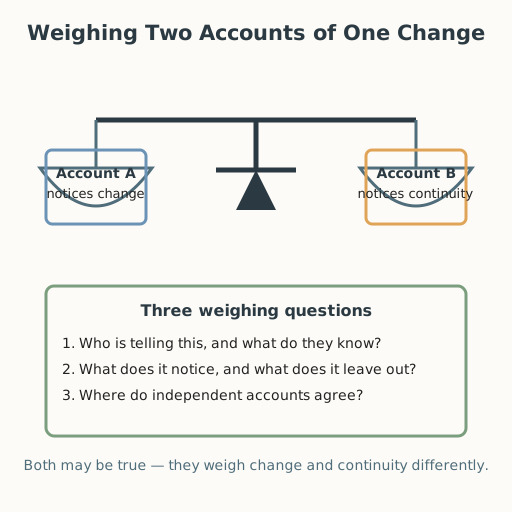
- Meet the idea (8 min). Write it down: a change is what became different; a continuity is what stayed the same. One event is usually both — and two honest accounts can disagree simply because one notices the change and the other notices the continuity. Weighing is not deciding who is “right.” It is asking: who is telling this, what do they notice, what do they leave out, and where do the accounts agree?
- Worked example — village to city (15 min). Read two short accounts of the same shift: a young person who moved to the city for work and calls it opportunity — new skills, a wage, electricity (S-089, S-052); and an elder who stayed in the village and calls it loss — the fields quieter, the young gone, but the songs and the planting still kept. Weigh them on your sheet: what does each notice? what does each leave out? Where do they agree? (Both are true; they notice different things.) Mark the change and the continuity in each.
- Name the move (5 min). The weighing questions are a tool you can carry to any disagreement: (1) sourcing — who says this, and what do they know? (2) perspective — what do they care about and leave out? (3) corroboration — do independent accounts agree? (S-316).
- Weigh your own pair (15 min). With a partner, weigh two accounts of one change — the lesson’s pair, a local pair, or a historical pair you both know. Fill the sheet. Say — or write, sign, gesture, or use AAC to show — one place the accounts genuinely differ and one place they agree.
- Close (2 min). Say — or write, sign, gesture, or use AAC to express — the three questions you ask whenever you weigh two accounts.
Differentiation
- Support: Use the sheet pre-filled with the two accounts already summarized; the learner underlines what each notices and circles what each leaves out, then answers the “agree” question aloud or in writing.
- Extension: Name a place where the two accounts directly contradict each other and write what further evidence would help settle it — without pretending the contradiction away.
- Number access (dyscalculia): This lesson requires no arithmetic. Dates and population figures (e.g., “more than half of humanity is now urban”) are offered on a pre-printed line or read aloud, never as a computation; a learner may complete the whole weighing in spoken or signed words without any numerals.
- Communication access: Every spoken step — naming, reading aloud, discussing, or closing — can be done in writing, sign, gesture, or AAC instead. Learners who are non-speaking, d/Deaf, hard-of-hearing, or who use AAC complete every task in their preferred mode; no step requires producing or hearing sound. Accounts may be provided in print, braille, or audio description.
Assessment
- Formative (peer + self): Can the learner name what each account notices and leaves out, identify one point of agreement and one of difference, and use the three weighing questions?
- Portfolio artifact (unit): The completed weighing sheet, opened in the capstone history journal as the first of the unit’s “weighing” artifacts.
Home connection
Ask two people at home about one change they both lived through — a move, a new road, a change of work. Write one line for each: what did they notice, and what did they leave out? Then one line on where their tellings agree.
Resources
- On worked examples and guided practice for a new skill: Kirschner, Sweller & Clark (2006) (S-011).
- On sourcing, perspective, and corroboration as historical-thinking moves: Stanford History Education Group (S-316).
- On the danger of hearing only one telling: Adichie, “The Danger of a Single Story” (S-417).
- On the world’s shift to city life and its recency: Our World in Data, Urbanization (S-089); and on the spread of electric light: Our World in Data, Light at Night (S-052).