Lesson 02 — Forming a Reasoned Synthesis
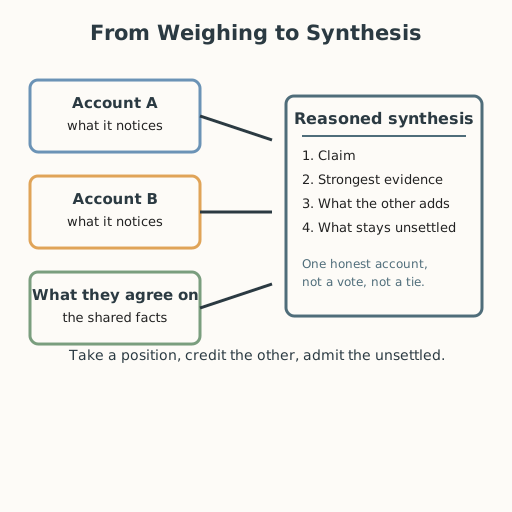
Learners turn a weighing into a synthesis: one honest account of their own that carries the best-supported parts of each competing account, names what the other account adds, and states plainly what remains unsettled. They use a four-line frame (claim, strongest evidence, what the other adds, what stays unsettled) and revise with a partner. The synthesis is presented as a reasoned position, not a verdict.
Objectives
Objectives
- D08.S1.12.01 Weigh competing accounts of change and continuity across global history and form a reasoned synthesis of the evidence.
Essential question
After I have weighed competing accounts, how do I build one honest account of my own that keeps the best of each and admits what I cannot settle?
Key vocabulary
Materials
Standard materials
- Synthesis frame sheet · 1 per learner Four labeled lines — claim, strongest evidence, what the other account adds, what stays unsettled — that assemble into one paragraph
- Capstone history journal · 1 per learner Contains the Lesson 1 weighing, now to be turned into a synthesis
Low-tech / no-cost
- Scratch paper and the Lesson 1 weighing sheet The synthesis can be drafted on any surface with any writing tool
- A partner-listener or voice recorder To speak the synthesis first, then write down what was said
Enriched / lab & device
- A word processor or shared document · 1 per learner or pair To draft, revise, and present the synthesis paragraph
Works in different contexts
- large-group Model the frame whole-class, then learners draft individually and read syntheses to a small group for one revision
- multi-age Younger learners write claim + one piece of evidence; older learners add the counter-account and the unsettled line
- self-directed A learner fills the four lines alone, reads it back, and revises one sentence to be more precise
- level-grouped A ready group also names the warrant — why the evidence supports the claim — in their own words
- outdoor-only Speak the synthesis about an outdoor change to a partner before writing it on any surface
Lesson 2 — Forming a Reasoned Synthesis
Summary
Learners turn a weighing into a synthesis: one honest account of their own that carries the best-supported parts of each competing account, names what the other account adds, and states plainly what remains unsettled. They use a four-line frame (claim, strongest evidence, what the other account adds, what stays unsettled) and revise with a partner. The synthesis is presented as a reasoned position, not a verdict.
Objectives
- Weigh competing accounts of change and continuity across global history and form a reasoned synthesis of the evidence. (D08.S1.12.01)
Connection
When two people you trust disagree about what happened, you do not just repeat one of them — you form your own careful sentence: “Here is what seems true, here is why, here is what the other side rightly reminds me of, and here is what I still do not know.” That sentence is a synthesis. It is how a fair person carries several voices forward into one honest account, without flattening them into a tie.
Materials
- Synthesis frame sheet
- Capstone history journal (with the Lesson 1 weighing)
- Low-tech: scratch paper and the weighing sheet; a partner-listener or voice recorder
- Enriched: a word processor or shared document
Preparation
- Copy or draw the synthesis frame sheet (four labeled lines).
- Retrieval: from Lesson 1, the weighing questions and the learner’s own weighing sheet. Today we assemble the weighing into a synthesis.
- Prepare a model synthesis to show first (S-011).
Facilitator note
This lesson is written to the learner (“you”). The idea to land: a synthesis is not a vote and not a compromise-soup — it is one honest account that states a claim, gives its strongest evidence, credits what the other account adds, and says what is still unsettled. Teach the four-line frame explicitly (S-011). Guard against two traps: a synthesis that picks one side and drops the other, and one that “splits the difference” so nothing is actually claimed. A good synthesis takes a position and stays honest about its limits.
The ethics lens: intellectual honesty is the core value — a synthesis that hides the unsettled part is a small dishonesty. The egalitarianism lens: synthesis is how many voices — elder and planner, villager and migrant — all enter the final account, none erased (S-417). The global lens: this move is not one culture’s method; weighing then synthesizing is what historians, elders’ councils, and judges do across traditions, each in their own idiom. The technology lens: a shared document lets two learners co-write one synthesis and see each other’s edits — a tool for the cooperative version of the skill. The environment lens: a synthesis about land or water must state what the evidence cannot yet settle (how much a river changed, what caused a drought), because honest uncertainty is the first step to good care. Preview: Lesson 3 turns from weighing history to locating yourself inside it.
Procedure
- Recall (5 min). Look at your Lesson 1 weighing sheet. In one sentence, say — or write, sign, gesture, or use AAC to show — the single strongest thing you learned from each account.
- Meet the frame (8 min). Write the four lines: (1) Claim — my reasoned position; (2) Strongest evidence — the best-supported facts that back it; (3) What the other account adds — the part it rightly keeps me honest about; (4) What stays unsettled — what I still do not know or cannot settle. A synthesis is these four, in one paragraph.
- Worked example (12 min). Read or hear a model synthesis of the village-to-city weighing from Lesson 1 (S-089, S-052). Notice it takes a position, cites evidence, credits the other telling, and names the unsettled. Mark each of the four lines in the model as you find it.
- Draft your synthesis (15 min). Using the frame sheet, write your own synthesis of your Lesson 1 pair (or the lesson’s pair). Complete all four lines. Be honest: if something is unsettled, say so rather than asserting it.
- Revise with a partner (10 min). Read your synthesis to a partner (or they read it). Ask: does it state a real position, credit the other account, and admit what is unsettled? Revise one sentence to be more precise or more honest.
- Close (5 min). Say — or write, sign, gesture, or use AAC to express — the four lines your synthesis always contains.
Differentiation
- Support: Use the frame sheet with sentence starters (“I think… because…; the other account rightly adds…; I still cannot settle…”); fill the blanks rather than composing free.
- Extension: Add a fifth line — a warrant — naming why the evidence supports the claim, and mark where your synthesis would change if one piece of evidence were overturned.
- Number access (dyscalculia): The frame is qualitative — no arithmetic; provide it pre-printed with the four lines labeled so the learner fills phrases and single words, and allow the synthesis to be spoken or recorded rather than written.
- Communication access: Every spoken step — reading, drafting aloud, discussing, or closing — can be done in writing, sign, gesture, or AAC instead. Learners who are non-speaking, d/Deaf, hard-of-hearing, or who use AAC complete every task in their preferred mode; no step requires producing or hearing sound.
Assessment
- Formative (peer + self): Does the synthesis state a real claim, give its strongest evidence, credit the other account, and admit what is unsettled?
- Portfolio artifact (unit): The written synthesis paragraph, paired with the Lesson 1 weighing, in the capstone history journal.
Home connection
Write a three-sentence synthesis of a disagreement at home — what seems true, why, and what you still cannot settle. Read it to someone and ask whether it was fair to both tellings.
Resources
- On worked examples and guided practice: Kirschner, Sweller & Clark (2006) (S-011).
- On claim–data–warrant as the shape of a reasoned argument: Toulmin, The Uses of Argument (S-236).
- On historical thinking (sourcing and corroboration): Stanford History Education Group (S-316).