Lesson 13 — Weighing Accounts of Power and Resistance
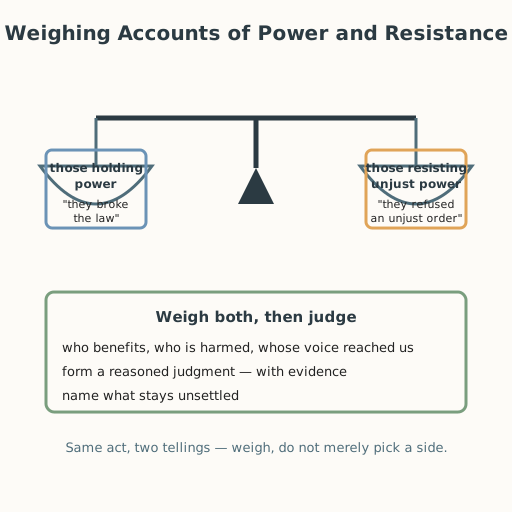
Learners weigh competing accounts of a contested historical event — the Salt March — where one side named an act "resistance for dignity" and the other named it "defiance of lawful order." They apply the weighing skill from Lesson 1 to questions of power and resistance, asking who held power, who resisted and why, who benefits and who is harmed in each telling — and they form a reasoned judgment while naming what stays unsettled, never asserting a single verdict.
Objectives
Objectives
- D08.S4.12.01 Weigh competing accounts of power and resistance in a contested historical event and form a reasoned judgment.
Essential question
When a historical event is contested — when one side calls an act resistance and the other calls it lawlessness — how do I weigh the competing accounts and form a judgment that is reasoned, not just asserted?
Key vocabulary
Materials
Standard materials
- Power-and-resistance weighing sheet · 1 per learner Two columns — the account of those holding power, and the account of those resisting — with a bottom row for the learner's reasoned judgment and what stays unsettled
- Capstone history journal · 1 per learner
Low-tech / no-cost
- Two short written accounts of one contested event Hand-copied or printed from the lesson's case or a local example
- Scratch paper To draw the weighing sheet by hand
Enriched / lab & device
- Two primary-source excerpts on one contested event · 1 per pair A government statement and a participant's or community's testimony
Works in different contexts
- large-group Model the weighing whole-class on the worked example, then pairs each weigh a different case and report one judgment
- multi-age Younger learners name who held power and who resisted; older learners weigh the accounts and form the judgment
- self-directed A learner weighs two accounts and writes a reasoned judgment that names what stays unsettled
- level-grouped A ready group also names where the two accounts contradict directly, and what evidence would weigh more heavily
- outdoor-only Name a contested local event (a road, a fence, a gathering) and have two sides tell it — then weigh the two tellings
Lesson 13 — Weighing Accounts of Power and Resistance
Summary
Learners weigh competing accounts of a contested historical event — the Salt March — where one side named an act “resistance for dignity” and the other named it “defiance of lawful order.” They apply the weighing skill from Lesson 1 to questions of power and resistance, asking who held power, who resisted and why, who benefits and who is harmed in each telling — and they form a reasoned judgment while naming what stays unsettled, never asserting a single verdict.
Objectives
- Weigh competing accounts of power and resistance in a contested historical event and form a reasoned judgment. (D08.S4.12.01)
Connection
When a law is broken on purpose, two tellings appear at once: “they broke the law” and “they refused an unjust order.” Both describe the same act. The difference is not in the facts but in where each telling stands — with the power that made the law, or with the people the law harmed. Weighing a contested event means listening to both, asking who benefits and who is harmed in each, and forming a judgment that is reasoned — not a cheer, not a shrug.
Materials
- Power-and-resistance weighing sheet
- Capstone history journal
- Low-tech: two written accounts; scratch paper
- Enriched: two primary-source excerpts
Preparation
- Copy or draw the weighing sheet; prepare two genuine accounts of the Salt March (the colonial authority’s and the marchers’), or a local contested event.
- Retrieval: from Lesson 1, the three weighing questions (sourcing, perspective, corroboration); from Grade 11 (D08.S4.11.01), comparing social movements. Today we weigh power and resistance against each other in one contested event.
- Prepare the worked example to model first (S-011).
Facilitator note
This lesson is written to the learner (“you”). The idea to land: in a contested event, the account of those holding power and the account of those resisting describe the same act from different places; weighing them means asking who holds power, who resists and why, who benefits and who is harmed in each telling — and then forming a reasoned judgment while naming what stays unsettled. Teach the weighing explicitly (S-011). Hold the Salt March accurately and with care: in 1930, Mahatma Gandhi led a march to the sea to make salt in defiance of a British colonial salt tax, an act of nonviolent resistance against colonial rule (S-087, S-205); the colonial account saw lawlessness and disruption, the marchers’ account saw a refusal of an unjust order. Present both as genuine accounts — do not assert one verdict; the learner weighs and judges.
The ethics lens: the judgment is a reasoned position, and the lesson models that a judgment can be firm and admit what it cannot settle — firmness without humility is dogma. The egalitarianism lens: power is not only force — it is also the ability to set the agenda and to shape what counts as “lawful” (S-275), which is why the account of those holding power can sound neutral while still serving power. The global lens: the Salt March is one of many such moments — the Defiance Campaign in South Africa, the Montgomery bus boycott, the Aba Women’s War — where ordinary people resisted unjust rule across continents (S-146, S-324, S-209); each is weighed in its own terms, not flattened into one template. The technology lens: how an event is recorded — whose account gets printed, broadcast, or archived — shapes whose telling survives; weighing means asking whose voice reached us and whose did not. The environment lens: many resistances are also defenses of land and water — the Chipko movement held trees against felling (S-328); the salt of the sea was, for the marchers, a resource the land and coast freely gave, taxed by a distant power. Preview: Lesson 14 turns the judgment into a reflection on one’s own role in the unfinished struggle for freedom and dignity.
Procedure
- Recall (5 min). From Lesson 1, name the three weighing questions. Today we aim them at power and resistance in one contested event.
- Meet the frame (8 min). Write it: power is the ability to decide, for oneself and for others — and it includes the power to set the agenda and define what is “lawful” (S-275). Resistance is refusing to accept that power when it harms. A contested event is one where the two sides tell it differently. Weighing asks: who holds power? who resists and why? who benefits, and who is harmed, in each telling?
- Worked example — the Salt March (15 min). Read two accounts of 1930: the colonial authority’s (the march broke the salt law and threatened order) and the marchers’ (the salt tax was an unjust burden, and making salt was a refusal of it — S-087, S-205). Weigh them on your sheet: who holds power in each? who resists and why? who benefits and who is harmed in each telling? Where do they agree on the facts? Where do they part on the meaning?
- Form your judgment (12 min). Write a reasoned judgment — a position, with its strongest evidence, crediting what the other account adds, and naming what stays unsettled. Do not assert a verdict; argue one.
- Share and check (8 min). With a partner, read your judgment. Ask: is it reasoned (evidence, not just feeling), and does it name what stays unsettled? Give one specific suggestion.
- Close (2 min). Say — or write, sign, gesture, or use AAC to express — what weighing adds to a contested event that picking a side does not.
Differentiation
- Support: Use the sheet pre-filled with the two accounts summarized; the learner underlines who benefits and who is harmed in each, then answers the judgment with a starter (“I judge that…, because…, though I still cannot settle…”).
- Extension: Name a place where the two accounts directly contradict each other and write what further evidence would weigh more heavily — without pretending the contradiction away.
- Number access (dyscalculia): This lesson requires no arithmetic. The one date (1930) is offered on the pre-printed sheet and read aloud, never required to be computed or ordered; the whole weighing and judgment can be done in words, spoken or signed, without any numerals.
- Communication access: Every spoken step — naming, reading aloud, discussing, or closing — can be done in writing, sign, gesture, or AAC instead. Learners who are non-speaking, d/Deaf, hard-of-hearing, or who use AAC complete every task in their preferred mode; no step requires producing or hearing sound. Accounts may be provided in print, braille, or audio description.
Assessment
- Formative (peer + self): Can the learner weigh two accounts of power and resistance — naming who holds power, who resists and why, and who benefits and is harmed in each — and form a reasoned judgment that names what stays unsettled?
- Portfolio artifact (unit): The completed weighing sheet with the reasoned judgment, opened in the capstone history journal — the strand’s “power and resistance” artifact.
Home connection
Ask someone at home about a time a rule was contested in your community. Write one line for each side’s telling, and one sentence for your own reasoned judgment — naming what you still cannot settle.
Resources
- On worked examples and guided practice: Kirschner, Sweller & Clark (2006) (S-011).
- On the Salt March: Encyclopaedia Britannica, Salt March (S-087); Nobel Prize, Gandhi (S-205).
- On power: Lukes, Power: A Radical View (S-275).
- On other resistances, for parallel weighing: South African History Online, Defiance Campaign (S-146); Britannica, Montgomery bus boycott (S-324); Afigbo, Aba Women’s War (S-209); Britannica, Chipko movement (S-328).