Lesson 14 — The Unfinished Struggle for Freedom and Dignity
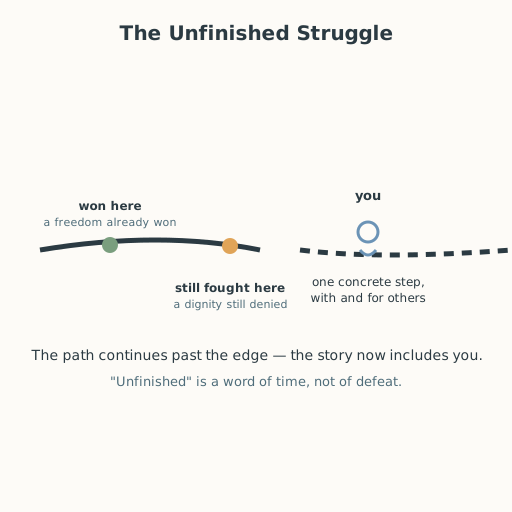
Learners close the unit by locating themselves in the *unfinished* struggle for freedom and dignity. They name one freedom or dignity already won, one still being fought for, and one concrete way they can act, learn, or stand with others — linking the three. The lesson frames "unfinished" as empowerment and agency, never nihilism: the struggle continues, and the next step is partly theirs to take, with and for others.
Objectives
Objectives
- D08.S4.12.02 Reflect on their own role and responsibility in the ongoing, unfinished struggle for freedom and dignity for all people.
Essential question
Freedom and dignity have been won in some places and denied in others, and the struggle is not over — so what is my own role and responsibility in that unfinished work?
Key vocabulary
Materials
Standard materials
- Unfinished-struggle reflection sheet · 1 per learner A frame — one freedom or dignity already won, one still being fought for, and one concrete way I can act, learn, or stand with others — with a line linking them
- Capstone history journal · 1 per learner
Low-tech / no-cost
- Paper and any writing tool To draft the reflection by hand
- A partner-listener To talk the reflection through before writing
Enriched / lab & device
- A shared document · 1 per pair To co-write and revise the reflection
Works in different contexts
- large-group Model the frame whole-class, then learners draft individually and share one action in small groups
- multi-age Younger learners name one freedom already won; older learners link a won freedom to a continuing struggle and an action
- self-directed A learner fills the frame alone and writes which action is genuinely within their reach
- level-grouped A ready group also names the difference between acting for one's own dignity and acting in solidarity with others'
- outdoor-only Name one freedom tied to a place — the right to walk, gather, or gather on the land — and one way you would stand with those still denied it
Lesson 14 — The Unfinished Struggle for Freedom and Dignity
Summary
Learners close the unit by locating themselves in the unfinished struggle for freedom and dignity. They name one freedom or dignity already won, one still being fought for, and one concrete way they can act, learn, or stand with others — linking the three. The lesson frames “unfinished” as empowerment and agency, never nihilism: the struggle continues, and the next step is partly theirs to take, with and for others.
Objectives
- Reflect on their own role and responsibility in the ongoing, unfinished struggle for freedom and dignity for all people. (D08.S4.12.02)
Connection
The right to vote, to marry whom you choose, to keep your language, to drink clean water — none of these was simply given; each was won by people who refused to accept less, and each is still denied to someone, somewhere. “Unfinished” is not a word of defeat. It is a word of time: the struggle is still happening, which means there is still room for you in it — not as a hero, but as one person who learns, speaks, and stands with others.
Materials
- Unfinished-struggle reflection sheet
- Capstone history journal
- Low-tech: paper and any writing tool; a partner-listener
- Enriched: a shared document
Preparation
- Copy or draw the reflection frame (won / still fought / my action).
- Retrieval: from Lesson 13, the reasoned judgment on power and resistance; from the whole unit, the weighings, syntheses, and reflections. Today we locate ourselves in the unfinished work.
- Prepare a model reflection to show first (S-011).
Facilitator note
This lesson is written to the learner (“you”). The idea to land: freedom and dignity have been won in some places and are still denied in others, so the struggle is unfinished — and “unfinished” means there is room for me, not that the work is hopeless. Teach the frame explicitly (S-011). This closing lesson must land on agency and hope, never nihilism: every example of a won freedom is paired with a still-fought one and a concrete action, so the learner leaves with a next step, not a weight. Center the voices of those who struggled — the lesson is about joining, not about speaking for.
The ethics lens: responsibility is specific, not diffuse — it asks what I can do, here, with and for others, not that I save the world alone. The egalitarianism lens: freedom and dignity are not one people’s inheritance — the Universal Declaration of Human Rights states them as belonging to everyone, without distinction (S-149), and the measure of a society is whether the most excluded enjoy them too. The global lens: the struggle is worldwide and ongoing — decolonization, civil rights, labor, and land struggles crossed continents and continue now (S-276, S-146); no region finished it, and none is exempt. The technology lens: the same tools that surveil and suppress also connect, witness, and organize — whose hands hold the tool decides which way it cuts. The environment lens: dignity includes the right to a livable home — clean water, land, a stable climate — so the struggle for freedom and the care of the Earth are one struggle (S-463). Close the unit: the human story is long, many-voiced, and unfinished — and it now includes you.
Procedure
- Recall (5 min). From Lesson 13, name the contested event and your reasoned judgment. Today: where do you stand in the unfinished work that judgment pointed to?
- Meet the frame (8 min). Write the three lines: (1) A freedom or dignity already won (the vote, a language kept, a right recognized — S-149); (2) One still being fought for (somewhere, by someone, right now); (3) One concrete way I can act, learn, or stand with others (listen, learn a history, join a local effort, speak). Link them: the won one shows it is possible; the still-fought one shows it is not done; the action shows I have a part.
- Worked example (10 min). Read or hear a model: the right of a people to self-rule was won in places like Ghana at independence (S-276); the dignity of displaced people is still being fought for today (S-493); and a learner’s action is to learn one local history and stand with a local group, not to “fix” it alone. Mark the three lines and the link.
- Write your reflection (18 min). Fill the three lines and the linking sentence. Keep the action real and within reach; you are joining a struggle, not becoming its savior.
- Share and check (5 min). Share one line with a partner (only what you wish). Ask: is the action real and within reach, and does it stand with others rather than over them? Give one gentle suggestion.
- Close (5 min). Say — or write, sign, gesture, or use AAC to express — the one step you will take, and why “unfinished” is a word of hope.
Differentiation
- Support: Use the frame with starters (“One freedom already won is…; one still being fought for is…; one way I can act or stand with others is…”); fill the blanks.
- Extension: Name the difference between acting for one’s own dignity and acting in solidarity with others’, and write one sentence on which your action is — and what that means for how you proceed.
- Number access (dyscalculia): No arithmetic is required; the three lines are a structure, not a computation, and no dates need be reproduced. A learner may complete the whole reflection in spoken or signed words without any numerals.
- Communication access: Every spoken step — naming, sharing, or closing — can be done in writing, sign, gesture, or AAC instead. Learners who are non-speaking, d/Deaf, hard-of-hearing, or who use AAC complete every task in their preferred mode; no step requires producing or hearing sound. Sharing is always optional.
Assessment
- Formative (peer + self): Can the learner name a freedom already won, one still fought for, and one concrete, within-reach action — linking them so the “unfinished” framing reads as agency, not despair?
- Summative (unit): The reflection is the capstone’s closing artifact, gathered with the unit’s weighings, syntheses, and reflections in the capstone history journal.
Home connection
Ask someone at home what freedom they are grateful was won in their lifetime, and what they still hope to see. Write one sentence on where the struggle continues, and one on the part you could play.
Resources
- On worked examples and guided practice: Kirschner, Sweller & Clark (2006) (S-011).
- On freedom and dignity as universal: UN, Universal Declaration of Human Rights (S-149).
- On decolonization and continuing struggles: Britannica, Kwame Nkrumah (S-276); South African History Online, Defiance Campaign (S-146).
- On dignity and displacement today: UNHCR Global Trends (S-493).
- On dignity, justice, and a livable home: UN, Sustainable Development Goal 16 (S-463).