Lesson 01 — Technology as a System
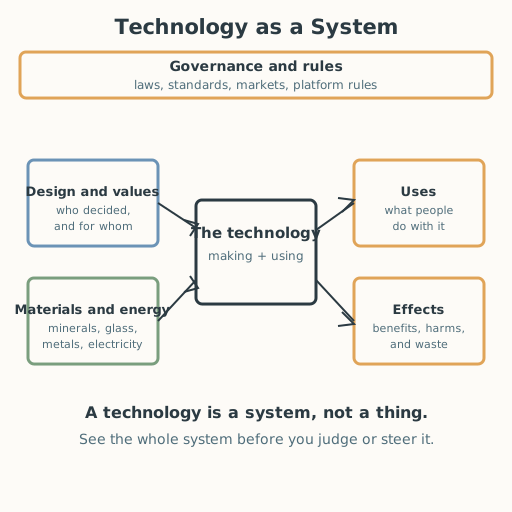
Learners stop seeing technology as a single gadget and start seeing it as a system: the design and values that shape it, the materials and energy it is made of, the uses people put it to, the rules that govern it, and the effects — intended and unintended, on people and on the Earth. They map one familiar technology through the whole system and name an unintended effect, laying the groundwork for arguing about a humane direction in Lesson 2.
Objectives
Objectives
- D10.S1.12.01 Analyze technology as a system shaping society, weighing design, governance, and their own choices, and argue for a humane direction.
Essential question
How do I analyze technology as a system — its design, governance, and effects — instead of as a single, neutral gadget?
Key vocabulary
Materials
Standard materials
- System-map sheet · 1 per learner A blank 'technology as a system' map: design and values, materials and energy, making, use, governance and rules, and effects (benefits, harms, waste)
- Capstone technology & Earth journal · 1 per learner
Low-tech / no-cost
- Blank paper To draw the system map by hand
- A common everyday object Any technology at hand — a pen, a water bottle, a hoe, a bicycle
Enriched / lab & device
- A device with an internet browser · 1 per pair To trace one technology's supply chain and governance rules online
Works in different contexts
- large-group Map one shared technology whole-class first, then pairs map a second one and report back
- multi-age Younger learners map "what it's made of and who uses it"; older learners add governance and unintended effects
- self-directed A learner maps one technology through all six boxes and writes one unintended effect
- level-grouped A ready group also traces one feedback loop — an effect that returns to change how the technology is used
- outdoor-only Map a technology used outdoors — a well, a plow, a fishing net, a solar lamp — with the real object in view
Lesson 1 — Technology as a System
Summary
Learners stop seeing technology as a single gadget and start seeing it as a system: the design and values that shape it, the materials and energy it is made of, the uses people put it to, the rules (governance) that surround it, and the effects — intended and unintended, on people and on the Earth. They map one familiar technology through the whole system and name an unintended effect, laying the groundwork for arguing about a humane direction in Lesson 2.
Objectives
- Analyze technology as a system shaping society, weighing design, governance, and their own choices, and argue for a humane direction. (D10.S1.12.01)
Connection
A phone is not one thing — it is a mine in one country, a factory in another, a cable under an ocean, a data center, a shop, a charger, and a landfill at the end. A water pump is not one thing either — it is a well, a pipe, an energy source, a community agreement about who uses it and when, and a maintenance plan. Every technology you touch is really a whole system of people, materials, rules, and effects, and you are already inside it.
Materials
- System-map sheet
- Capstone technology & Earth journal
- Low-tech: blank paper; a common everyday object
- Enriched: a device with an internet browser
Preparation
- Copy or draw the system-map sheet (six boxes: design and values; materials and energy; making; use; governance and rules; effects).
- Retrieval: from Grade 11 (D10.S1.11.01), technologies are governed by law, standards, and markets; from D10.S1.11.02, benefits and harms are distributed unevenly. Today we widen the frame to the whole system.
- Prepare the worked example (a phone or a water pump) to model first (S-011).
Facilitator note
This lesson is written to the learner (“you”). The idea to land: a technology is a system — design, materials, making, use, governance, and effects — not a neutral object; seeing the whole system is the first step to judging it and steering it. Model the map explicitly, then let learners map a technology of their own (S-011). Hold the “neither worship nor fear” stance: technology is neither a savior nor a monster but a human-made system with real, uneven effects that can be examined and changed.
The ethics lens: a system that hides its costs lets us use it without consenting to those costs — the ethics of technology begins with making the hidden parts visible. The egalitarianism lens: the benefits of a technology and its harms rarely fall on the same people; the people who mine the minerals are not usually the people who enjoy the phone, a fact the map makes hard to ignore (S-398, S-281). The global lens: the same technology takes different shapes in different places — a shared well with community rules, a solar lamp where the grid does not reach, a smartphone in a crowded city — and the map looks different each time (S-281). The technology lens: recommendation and ranking algorithms, advertising models, and platform rules are part of the governance box of a system like social media, not accidents (S-481). The environment lens: every technology has a material life cycle — extraction, manufacture, use, and disposal — and e-waste is one of its real, documented harms (S-371, S-397). Preview: Lesson 2 turns the system map into an argument for a humane direction.
Procedure
- Recall (5 min). From Grade 11, name one way a technology is governed — a law, a standard, a market price, a platform rule. Today we pull back to see the whole system.
- Worked example — the phone as a system (15 min). Follow the map together: design and values (who decided what it should do, and for whom); materials and energy (minerals such as cobalt, glass, metals, electricity — S-398); making (factories and workers); use (calls, maps, messages, endless scroll); governance and rules (laws, platform rules, prices, repair restrictions); effects (connection and access, but also attention, e-waste, and uneven mining conditions — S-397). Notice the unintended effect: something the designers did not aim for, like a landfill of old phones.
- Map your own technology (20 min). Choose one technology you actually use — a pen, a water bottle, a bicycle, a water pump, a messaging app. Fill all six boxes. Say — or write, sign, gesture, or use AAC to show — one hidden part you had not noticed before.
- Find an unintended effect (10 min). Under “effects,” write at least one thing that happened that nobody designed on purpose. With a partner, ask: who benefits, and who carries the harm? (S-281)
- Close (5 min). Say — or write, sign, gesture, or use AAC to express — one complete sentence: “A technology is not just a thing; it is…” and finish it in your own words.
Differentiation
- Support: Use a system-map sheet with six pre-labeled boxes and starters (“made of…; used for…; ruled by…; costs…”); the learner fills one line per box.
- Extension: Trace one feedback loop — an effect that returns to change how the technology is designed or used — and draw it as an arrow curving back to an earlier box.
- Number access (dyscalculia): The lesson is diagram-based and requires no arithmetic. Provide the six-box sheet pre-drawn so the learner labels arrows rather than measuring or counting, and allow every relationship to be stated in words with no numeric work.
- Communication access: Every spoken step — saying, reading aloud, discussing, or closing — can be done in writing, sign, gesture, or AAC instead. Learners who are non-speaking, d/Deaf, hard-of-hearing, or who use AAC complete every task in their preferred mode; no step requires producing or hearing sound.
Assessment
- Formative (peer + self): Can the learner map a technology through design, materials, making, use, governance, and effects, and name one unintended effect?
- Portfolio artifact (unit): The completed system map, opened in the capstone technology & Earth journal.
Home connection
Pick one thing in your home — a kettle, a broom, a phone charger — and ask an older family member where it comes from and what happens to it when it breaks. Write two sentences.
Resources
- On worked examples and guided practice: Kirschner, Sweller & Clark (2006) (S-011).
- On a technology’s life cycle: EPA — Sustainable Materials Management (S-371); on e-waste: WHO e-waste fact sheet (S-397); on cobalt and supply chains: Amnesty International (S-398).
- On who controls platforms: Encyclopaedia Britannica — Social media (S-481); on the uneven spread of digital benefits: World Bank WDR 2016 — Digital Dividends (S-281).