Lesson 02 — Arguing for a Humane Direction
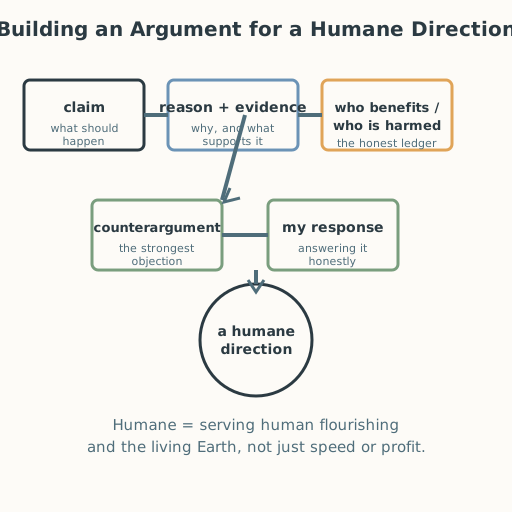
Learners turn Lesson 1's system map into an argument. They learn the shape of a reasoned argument — claim, reason, evidence, who benefits and who is harmed, a counterargument, and a response — and use it to argue for a *humane* direction for a technology: one that serves human flourishing and the living Earth, not only speed, profit, or convenience. They weigh trade-offs honestly and learn that arguing well means naming the values a choice serves.
Objectives
Objectives
- D10.S1.12.01 Analyze technology as a system shaping society, weighing design, governance, and their own choices, and argue for a humane direction.
Essential question
How do I turn a systems analysis of a technology into an argument for a humane direction — one that serves human flourishing and the living Earth, not just efficiency or profit?
Key vocabulary
Materials
Standard materials
- Humane-direction argument sheet · 1 per learner A scaffold: claim, reason, evidence, who benefits and who is harmed, a counterargument, and a response
- Capstone technology & Earth journal · 1 per learner
Low-tech / no-cost
- Blank paper To write the argument by hand
- A list of local stakeholders The people and groups a local technology actually touches
Enriched / lab & device
- Access to one short case study · 1 per pair A real governance debate over a technology to use as the argument's subject
Works in different contexts
- large-group Build one argument whole-class on a shared technology, then pairs each argue a different direction and share
- multi-age Younger learners argue one clear claim with a reason; older learners add a counterargument and response
- self-directed A learner writes a full argument — claim, reason, evidence, counterargument, response — and checks it against the scaffold
- level-grouped A ready group also names which *values* their direction serves and which it trades off
- outdoor-only Argue the humane direction of a technology tied to a real shared place or resource in view
Lesson 2 — Arguing for a Humane Direction
Summary
Learners turn Lesson 1’s system map into an argument. They learn the shape of a reasoned argument — claim, reason, evidence, who benefits and who is harmed, a counterargument, and a response — and use it to argue for a humane direction for a technology: one that serves human flourishing and the living Earth, not only speed, profit, or convenience. They weigh trade-offs honestly and learn that arguing well means naming the values a choice serves.
Objectives
- Analyze technology as a system shaping society, weighing design, governance, and their own choices, and argue for a humane direction. (D10.S1.12.01)
Connection
“Faster,” “cheaper,” and “more” are not the only ways a technology could go. A water system could be built to serve the richest neighborhood or the whole city; a messaging app could be designed to help you connect or to hold your attention as long as possible. The direction a technology takes is not decided by the machine — it is decided by arguments, and arguments are decided by people who show up with reasons. You can be one of them.
Materials
- Humane-direction argument sheet
- Capstone technology & Earth journal
- Low-tech: blank paper; a list of local stakeholders
- Enriched: access to one short case study
Preparation
- Copy or draw the argument scaffold.
- Retrieval: from Lesson 1, the six boxes of the system map. Today we argue about direction.
- Prepare a worked example of an argument (claim, reason, evidence, counterargument, response) to model first (S-011).
Facilitator note
This lesson is written to the learner (“you”). The idea to land: an argument for a humane direction is a claim, a reason, evidence, an honest account of who benefits and who is harmed, a real counterargument, and a response — and “humane” means a direction that serves human flourishing and the living Earth, not just efficiency. Model the argument structure explicitly, then let learners build their own (S-011). Keep evidence and values distinct: who benefits and what a technology does are factual; which direction we ought to choose is a value question to be argued, not assumed (S-236, S-459).
The ethics lens: arguing for a humane direction is the unit’s central ethical move — the step from describing a system to taking responsibility for steering it. The egalitarianism lens: a humane direction is judged by how it treats the people who are usually left out — the miner, the person without access, the downstream neighbor — not only the loudest stakeholder (S-281, S-483). The global lens: what counts as “humane” is argued differently around the world — a direction good for one place may burden another — so the argument must name whose flourishing it serves (S-281). The technology lens: governance choices (a rule, a standard, a repair right, a design decision) are the concrete levers a humane direction pulls; the argument is about which levers to pull (S-481). The environment lens: a direction that serves people but destroys the Earth that sustains them is not humane in the long run, so the argument must weigh the living world alongside human convenience (S-395). Preview: Lesson 3 turns inward — what technology gives you, and what it costs you.
Procedure
- Recall (5 min). From Lesson 1, your system map. Pick the technology you mapped, or choose a shared one — a water system, a messaging app, a road. Today you will argue for its direction.
- Learn the argument shape (10 min). An argument has five parts: claim (what should happen), reason (why), evidence (what supports it), who benefits and who is harmed (the honest ledger), and a counterargument + response (the strongest objection, answered). Say — or write, sign, gesture, or use AAC to show — the five parts in order.
- Worked example (12 min). Follow a model argument about a technology: the claim (“this platform should repair old devices rather than push new ones”), the reason, the evidence, who gains and who loses, a counterargument (“repair slows innovation”), and a response. Note how the model names its values.
- Build your own argument (20 min). Write your own argument for a humane direction. Make the claim specific and doable; give a real reason and evidence; name who benefits and who is harmed honestly; answer the strongest counterargument. End by naming the value your direction serves.
- Peer-check (8 min). Trade arguments. Ask: is the claim specific? is the evidence real? is the counterargument the strongest one, not a straw figure? does it name who is harmed? Give one specific suggestion.
Differentiation
- Support: Use the argument sheet with the five parts as labeled boxes and sentence starters (“We should… because…; the evidence is…; this helps… but harms…; some will say…; my answer is…”).
- Extension: Name the value your direction trades off (what is lost even in the better choice) and say why the trade-off is still worth making.
- Number access (dyscalculia): The lesson requires no arithmetic. The argument is a word scaffold, doable in speech, writing, sign, or gesture; any figures used as evidence may be described in words rather than computed or compared numerically.
- Communication access: Every spoken step — saying, reading aloud, discussing, or peer-checking — can be done in writing, sign, gesture, or AAC instead. Learners who are non-speaking, d/Deaf, hard-of-hearing, or who use AAC complete every task in their preferred mode; no step requires producing or hearing sound.
Assessment
- Formative (peer + self): Can the learner build a claim-reason-evidence-counterargument- response argument for a humane direction that names who benefits and who is harmed?
- Portfolio artifact (unit): The completed argument, opened in the capstone technology & Earth journal.
Home connection
Explain your argument to someone at home in two minutes, and ask them to play the counterargument. Note one thing they said that you had not considered.
Resources
- On argument structure: Toulmin — The Uses of Argument (S-236); on persuasion’s three appeals: Aristotle — Rhetoric (S-346).
- On justice and whose good counts: Rawls — A Theory of Justice (S-459); Sen — Development as Freedom (S-460).
- On the uneven spread of technology’s costs and benefits: World Bank WDR 2016 (S-281); on environmental justice: EPA — Environmental Justice (S-483); on worked examples: Kirschner, Sweller & Clark (2006) (S-011).