Lesson 14 — A Steward of the Earth
Learners close the unit by naming their own responsibility as a steward of the Earth. They gather the unit's threads — technology as a system to steward, media to create and read honestly, the living world they belong to, and action taken with others — into a single steward's compass, and write a short, honest vision of how they will act, individually and with others, for all life. Hope here is not optimism; it is commitment.
Objectives
Objectives
- D10.S4.12.02 Reflect on their own responsibility as a steward of the Earth and how they will act — individually and with others — for all life.
Essential question
What is my own responsibility as a steward of the Earth, and how will I act — individually and with others — for all life?
Key vocabulary
Materials
Standard materials
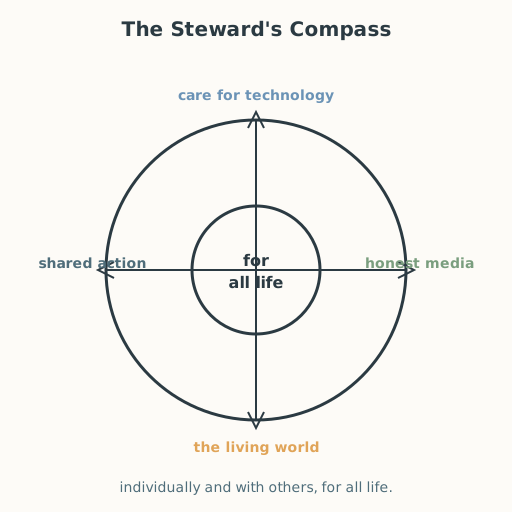
- Steward's compass sheet · 1 per learner A four-direction compass — care for technology, honest media, the living world, and shared action — around a center: 'for all life'
- Capstone technology & Earth journal · 1 per learner
Low-tech / no-cost
- Blank paper To draw the compass by hand
- The unit's own portfolio artifacts The system map, argument, ledger, message, media diet, confidence sheet, cycle map, boundary organizer, web, ripple map, and stewardship plan
Enriched / lab & device
- A quiet space or a recording device · 1 per learner To record the final reflection as voice, sign, or writing
Works in different contexts
- large-group Build the compass whole-class, then each learner completes their own and shares one direction aloud or in writing
- multi-age Younger learners name one direction and one act; older learners synthesize all four directions into a single vision
- self-directed A learner completes the compass, reviews the unit's artifacts, and writes a one-paragraph steward's vision
- level-grouped A ready group also connects the four directions — how caring for technology and honest media serve the living world and shared action
- outdoor-only Complete the compass outside, naming one real living thing your stewardship will serve
Lesson 14 — A Steward of the Earth
Summary
Learners close the unit by naming their own responsibility as a steward of the Earth. They gather the unit’s threads — technology as a system to steward, media to create and read honestly, the living world they belong to, and action taken with others — into a single steward’s compass, and write a short, honest vision of how they will act, individually and with others, for all life. Hope here is not optimism; it is commitment.
Objectives
- Reflect on their own responsibility as a steward of the Earth and how they will act — individually and with others — for all life. (D10.S4.12.02)
Connection
A steward is not a hero and not an owner — a steward is someone who accepts a role of care and keeps it. The Earth does not need a few perfect guardians; it needs many ordinary people who each choose, in their own corner, to keep something alive — a tool, a truth, a place, a promise. This unit has given you the pieces; this lesson is where you say, in your own words, what you will do with them.
Materials
- Steward’s compass sheet
- Capstone technology & Earth journal
- Low-tech: blank paper; the unit’s portfolio artifacts
- Enriched: a quiet space or a recording device
Preparation
- Copy or draw the four-direction compass.
- Retrieval: lay out the unit’s artifacts — the system map, the argument, the ledger, the message, the media diet, the confidence sheet, the cycle map, the boundary organizer, the web, the ripple map, and the stewardship plan. Today we gather them into one role.
- Frame hope as commitment, not optimism: a steward acts because it is right, not because success is guaranteed.
Facilitator note
This lesson is written to the learner (“you”). The idea to land: my responsibility as a steward of the Earth is to act — individually and with others — for all life, and I can say how, because the unit has given me four directions: care for technology, honest media, the living world, and shared action. This is the unit’s capstone reflection. Do not grade the grandness of the vision; grade the specificity and honesty of it. Honor each learner’s vision as their own, never rank them, and keep the door open: stewardship is a practice begun, not a test passed.
The ethics lens: stewardship is an ethics of relationship and reciprocity — because I am given to, I give back, and my responsibility extends to beings and generations I will never meet (S-427). The egalitarianism lens: a steward acts with others, not above them — solidarity and mutual aid, where people meet one another’s needs as equals, is the shape stewardship takes among humans (S-345). The global lens: the four directions are lived differently everywhere — a tree-planting movement in Kenya, river protectors, commons keepers — but they are the same four compass points the world over (S-059, S-416). The technology lens: the unit’s whole stance returns here — technology neither worshiped nor feared, but stewarded, chosen with clear eyes for what it gives and costs (S-281). The environment lens: the compass’s center is the unit’s deepest claim — that human flourishing and the flourishing of the living Earth are not rivals but the same project, and acting for all life is acting for ourselves too (S-004, S-395).
Procedure
- Recall (10 min). Lay out the unit’s artifacts in order — from the system map in Lesson 1 to the stewardship plan in Lesson 13. Notice the arc: seeing a system, judging it, choosing stewardship, creating honestly, staying informed, knowing your place, and designing a response.
- Draw the compass (10 min). Four directions: care for technology (choose, repair, share, steward), honest media (accurate, fair, sourced, open to evidence), the living world (know your place in the web), and shared action (act with others). Write one line under each direction: one thing you will actually do.
- Name the center (5 min). In the middle, write for all life — the people and beings your stewardship serves, present and future. Say — or write, sign, gesture, or use AAC to express — why “all life” and not “just mine” is the center.
- Write the vision (15 min). Write a short, honest paragraph: “As a steward of the Earth, I will…” — naming one act in each direction, and naming who you will do it with. Keep it specific and true to your life.
- Share (10 min). In a pair or small group, share only what you choose. Listen without ranking; note one thing in another’s vision that strengthens your own.
- Close (5 min). Say — or write, sign, gesture, or use AAC to express — the one line from your vision you are most certain you will keep.
Differentiation
- Support: Use the compass sheet with the four directions pre-labeled and starters (“For technology, I will…; for honest media, I will…; for the living world, I will…; with others, I will…”); the learner fills one line each.
- Extension: For each direction, name the ally or group you will act with, and one honest limit you accept — what you cannot do — so the vision is real, not a wish.
- Number access (dyscalculia): The lesson requires no arithmetic. The compass is a word organizer, doable in speech, writing, sign, or gesture; nothing must be counted, ordered, or computed.
- Communication access: Every spoken step — saying, sharing, reading aloud, or closing — can be done in writing, sign, gesture, or AAC instead. Learners who are non-speaking, d/Deaf, hard-of-hearing, or who use AAC complete every task in their preferred mode; no step requires producing or hearing sound.
Assessment
- Formative (self): Can the learner name their responsibility as a steward and write an honest, specific vision that includes action in all four directions and names who they will act with?
- Portfolio artifact (unit): The completed steward’s compass and the written vision, opened in the capstone technology & Earth journal as the unit’s closing artifact.
Home connection
Read your vision to someone you trust, or share it in writing, sign, or a recording. Ask them to remind you of it in a month. A promise shared is a promise kept.
Resources
- On reciprocity and care for the living world: Kimmerer — Braiding Sweetgrass (S-427); on education for stewardship: UNESCO — Education for Sustainable Development (S-004).
- On sustainable development and future generations: Brundtland Report (S-395); on acting with others as equals: Spade — Mutual Aid (S-345); on collective action worldwide: Nobel Prize — Wangari Maathai (S-059); on the commons: Ostrom — Governing the Commons (S-416).