Lesson 13 — Designing a Stewardship Plan
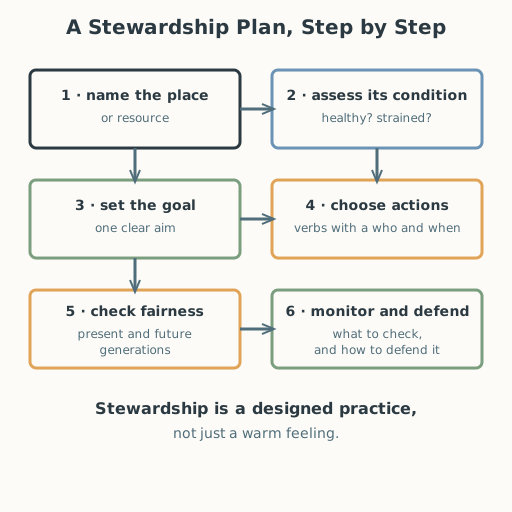
Learners design and defend a stewardship plan for a real place or resource. Working through six steps — name the place or resource, assess its condition, set the goal, choose actions, check fairness to present and future generations, and plan how to monitor and defend it — they learn that stewardship is a designed practice, not a warm feeling, and that a defensible plan weighs who gains, who gives something up, and what the future inherits.
Objectives
Objectives
- D10.S4.12.01 Design and defend a stewardship plan for a real place or resource, weighing fairness to present and future generations.
Essential question
How do I design — and defend — a stewardship plan for a real place or resource, weighing fairness to present and future generations?
Key vocabulary
Materials
Standard materials
- Stewardship-plan template · 1 per learner Six parts: name the place or resource, assess its condition, set the goal, choose actions, check fairness to present and future generations, and plan how to monitor and defend it
- Capstone technology & Earth journal · 1 per learner
Low-tech / no-cost
- Blank paper To write the plan by hand
- A real place or resource in reach A stream, a garden, a shared well, a tool library, a stretch of coast — anything the learner can actually assess
Enriched / lab & device
- A map or a record of the chosen place · 1 per learner or pair To ground the plan in a real place's condition
Works in different contexts
- large-group Model the six parts on one shared place whole-class, then each learner plans for their own place and pairs defend
- multi-age Younger learners name the place, goal, and one action; older learners add assessment, fairness across generations, and monitoring
- self-directed A learner completes all six parts for a real place and writes one defense line for the fairness check
- level-grouped A ready group also names one trade-off their plan makes (who gains, who gives up something) and defends it
- outdoor-only Plan for the place you are standing in — assess it with your own senses and choose actions you can actually take there
Lesson 13 — Designing a Stewardship Plan
Summary
Learners design and defend a stewardship plan for a real place or resource. Working through six steps — name the place or resource, assess its condition, set the goal, choose actions, check fairness to present and future generations, and plan how to monitor and defend it — they learn that stewardship is a designed practice, not a warm feeling, and that a defensible plan weighs who gains, who gives something up, and what the future inherits.
Objectives
- Design and defend a stewardship plan for a real place or resource, weighing fairness to present and future generations. (D10.S4.12.01)
Connection
Caring about a place is easy; caring for it is a design problem. A well, a garden, a river, a shared library of tools — each stays healthy only if someone thinks through what it needs, what to do, who is affected, and what to check later. A stewardship plan is that thinking written down: not a slogan, but a map of how a place or resource can be kept for the people who use it now and the ones who come after.
Materials
- Stewardship-plan template
- Capstone technology & Earth journal
- Low-tech: blank paper; a real place or resource in reach
- Enriched: a map or a record of the chosen place
Preparation
- Copy or draw the six-part plan template.
- Retrieval: from Lessons 9–12, the system, the boundaries, the web, and the ripples. Today we design a response.
- Prepare a worked example of a small plan (a shared well or a garden) to model first (S-011).
Facilitator note
This lesson is written to the learner (“you”). The idea to land: a stewardship plan is six steps — name the place or resource, assess its condition, set the goal, choose actions, check fairness to present and future generations, and plan how to monitor and defend it — and a plan is defensible only when it names who gains, who gives something up, and what the future inherits. Model one small plan explicitly, then let learners design their own (S-011). Grade the thinking, not the scale: a small, real, fair plan for a real place is worth more than a grand plan for nowhere.
The ethics lens: a plan is where care becomes obligation — it names a duty to the place and to the people, present and future, who depend on it. The egalitarianism lens: every plan creates winners and losers of a sort — who gets water, who pays for upkeep, whose use is limited — so a fair plan says so honestly rather than pretending everyone gains equally (S-459). The global lens: communities worldwide have governed shared resources by their own common rules for centuries — the commons — and a good plan can learn from them without assuming any one model fits everywhere (S-416). The technology lens: technology can serve a plan (a pump, a sensor, a repair network) but is not the plan itself; the plan keeps the goal first and the tools in service of it (S-452). The environment lens: the fairness check is the Brundtland test — meeting today’s needs without robbing the future — and real-world stewardship, from tree-planting movements to river protectors, shows the plan in action (S-395, S-059, S-328). Preview: Lesson 14 turns the plan inward and outward — your own responsibility as a steward of the Earth.
Procedure
- Recall (5 min). From Lesson 12, the one change you chose. Today we build something bigger than one choice: a plan.
- Name and assess (10 min). Choose a real place or resource you can actually touch — a stream, a garden, a well, a tool library, a stretch of coast. Write its name and assess its condition honestly: what is healthy, what is strained, whose care it depends on.
- Set the goal and choose actions (15 min). Write one clear goal (“keep this water clean and shared”) and three concrete actions toward it, each a verb with a who and a when. Say — or write, sign, gesture, or use AAC to show — the action you are most confident you could actually do.
- Check fairness (12 min). Ask the hard question: who benefits, and who gives something up? Include future generations — what will they inherit if this plan works, or fails? (S-395). Write the fairness check honestly, including any trade-off.
- Plan to monitor and defend (10 min). Write how you will monitor (what you will check, and when) and how you will defend the plan to someone who questions it — one sentence of evidence and one sentence of values.
- Peer-defense (8 min). With a partner, present your plan in two minutes. Your partner asks one hard fairness question; you answer it. Then switch.
Differentiation
- Support: Use the six-part template with starters (“The place is…; its condition is…; my goal is…; I will…; this benefits… but asks…; I will check…”); the learner fills one line per part.
- Extension: Name the hardest trade-off your plan makes — who gives something up — and argue why the plan is still fair, including to future generations.
- Number access (dyscalculia): The lesson requires no arithmetic. The plan is a word organizer; any quantities (how much water, how often) may be stated in words or marked on a calendar, with nothing to compute, order, or compare numerically.
- Communication access: Every spoken step — saying, presenting, defending, or discussing — can be done in writing, sign, gesture, or AAC instead. Learners who are non-speaking, d/Deaf, hard-of-hearing, or who use AAC complete every task in their preferred mode; no step requires producing or hearing sound.
Assessment
- Formative (peer + self): Can the learner name and assess a real place or resource, set a goal, choose actions, write an honest fairness check including future generations, and defend the plan against one hard question?
- Portfolio artifact (unit): The completed six-part stewardship plan, opened in the capstone technology & Earth journal.
Home connection
Ask someone who uses the place you chose — a neighbor, a family member, a caretaker — what they think it needs. Add one thing you learned from them to your plan.
Resources
- On the commons and shared rules: Ostrom — Governing the Commons (S-416); on sustainable development and future generations: Brundtland Report (S-395).
- On fairness and competing claims: Rawls — A Theory of Justice (S-459); on real stewardship movements: Nobel Prize — Wangari Maathai (S-059); Encyclopaedia Britannica — Chipko movement (S-328); Standing Rock Sioux Tribe (S-485).
- On education for stewardship: UNESCO — Education for Sustainable Development (S-004); on worked examples: Kirschner, Sweller & Clark (2006) (S-011).