Lesson 01 — Naming Our Feelings
Learners name basic feelings, notice them in their own bodies, and practice describing a feeling with words, a drawing, or a movement.
Objectives
Objectives
- D01.S1.K.01 Name and identify basic feelings (happy, sad, angry, scared, calm) in self and others.
- D01.S1.K.02 Describe a feeling using words, a drawing, or a movement.
Essential question
What am I feeling right now, and how do I know?
Key vocabulary
Materials
Standard materials
- Feeling face cards · 1 set Happy, sad, angry, scared, calm faces
- Crayons and paper · per learner
- Mirror (optional) · 1
Low-tech / no-cost
- Hand-drawn feeling faces Draw simple faces together, or use a friend's face as the "card"
- Voice and body Describe each feeling aloud and act it out; no cards or mirror needed
Enriched / lab & device
- Laminated feeling face cards · 1 set per pair Durable, wipeable cards of the five feeling faces for repeated sorting and matching games
- Tablet or camera · 1 per group A photo app to capture learners' own real faces for each feeling and build a class "feelings gallery"
Works in different contexts
- large-group Project or hold up the feeling face card large enough for all to see; invite the whole group to make each face together before pointing to a match
- self-directed A learner works through the card set alone, making each face in a mirror and naming the body feeling for each
- outdoor-only Use the card set as a reference outdoors; invite learners to find a plant, shadow, or sky view that "feels" calm, bright (happy), heavy (sad), sharp (angry), or hidden (scared)
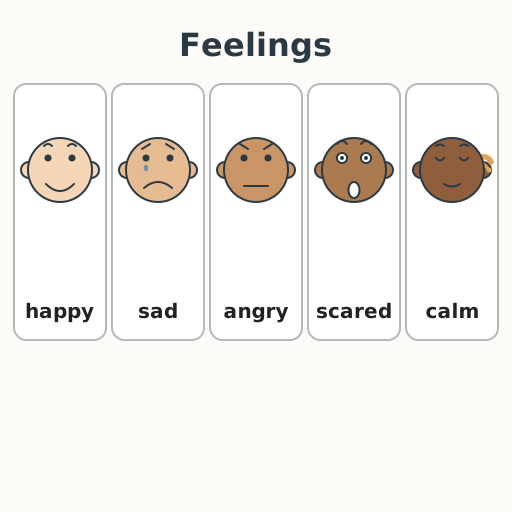
Lesson 1 — Naming Our Feelings
Summary
Learners learn to name five basic feelings and practice recognizing them in themselves and others. They close by expressing one feeling through words, a drawing, or a movement.
Objectives
- Name and identify basic feelings (happy, sad, angry, scared, calm) in self and others. (D01.S1.K.01)
- Describe a feeling using words, a drawing, or a movement. (D01.S1.K.02)
Connection
Everyone has feelings, every single day. When you know what you are feeling, you can share it, ask for help, and understand the people around you — at home, in a classroom, or anywhere people are together. Naming a feeling is the first step to taking care of it.
Materials
- Feeling face cards (happy, sad, angry, scared, calm)
- Crayons and paper
- A mirror (optional)
Preparation
- Print or draw a set of feeling face cards.
- Arrange a circle for gathering and discussion.
Facilitator note
This lesson is written to the learner (“you”) so it works in a classroom and for a self-directed learner. As facilitator, prepare the cards, mirror, and circle, then guide the closing reflection — the learner follows the procedure directly.
Procedure
- Gather (5 min). Sit comfortably. Notice: how does your body feel right now?
- Meet the feeling cards (10 min). Look at each card and name the feeling. Make the face together. Describe each face aloud too — “a frown, eyebrows down” — so everyone can join, even without seeing the card. Point to the card that matches how you feel today.
- Body check (10 min). Slowly scan your body: where do you feel happy? (A warm chest, a smile.) If you have a mirror, look in it to see your own face; if not, feel your face with your hands.
- Express it (15 min). Choose one feeling and show it in one of three ways: a word, a drawing, or a movement. Share with a partner.
- Close (5 min). Remember: everyone has feelings, and feelings change. That is okay.
Differentiation
- Support: Offer a smaller set of cards (two feelings); model a word and gesture.
- Extension: Invite learners to draw two feelings and describe a time they felt each.
Assessment
- Formative (observation): Can the learner point to or name a feeling that matches a scenario?
- Artifact (portfolio): The feeling drawing, kept in the learner’s portfolio.
Resources
- CASEL SEL Framework (foundational competencies): https://casel.org/fundamentals-of-sel/