Lesson 02 — Feelings in Our Bodies
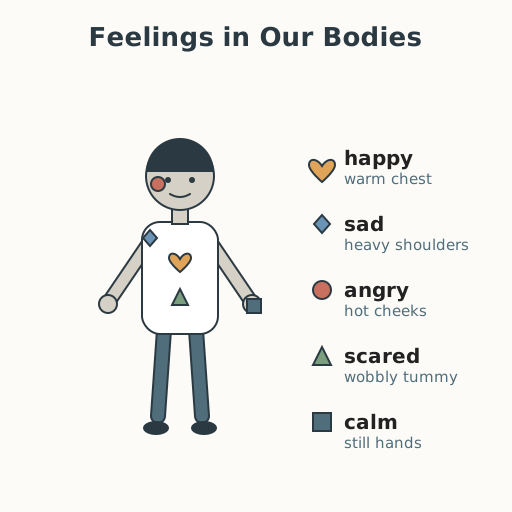
Learners notice that every feeling shows up somewhere in the body — a warm chest, a tight tummy, fast hands — and mark those spots on a body outline.
Objectives
Objectives
- D01.S1.K.01 Name and identify basic feelings (happy, sad, angry, scared, calm) in self and others.
- D01.S1.K.02 Describe a feeling using words, a drawing, or a movement.
Essential question
Where do I feel a feeling in my body?
Key vocabulary
Materials
Standard materials
- Feeling face cards (from Lesson 1) · 1 set Reuse the happy, sad, angry, scared, calm cards
- Crayons and paper · per learner
- A body outline (drawn or printed) · 1 per learner A simple child-shaped outline to color on
Low-tech / no-cost
- Your own body No cards or paper needed; learners point to where a feeling lives on themselves
- A stick or finger in sand or soil Draw a simple body shape on the ground to mark feeling spots
Enriched / lab & device
- A large paper body outline per pair · 1 per pair A life-sized outline a learner can lie on while a partner marks feeling spots with colored tape
- A digital camera or tablet · 1 per group Photograph a learner pointing to where each feeling lives, then compare across learners
Works in different contexts
- large-group Lead the body scan aloud for the whole group; call out a feeling and have everyone point to where it lives on their own body at once
- self-directed A learner works alone, closing their eyes, thinking of each feeling, and touching the place it shows up, then drawing it
- outdoor-only Walk to a quiet spot; feel the sun or wind on the skin and ask where "calm" or "scared" sits in the body, then mark it on a sand-drawn body
Lesson 2 — Feelings in Our Bodies
Summary
Learners discover that feelings are not only in the head — each one shows up somewhere in the body. They scan their bodies for happy, sad, angry, scared, and calm, then mark the spots on a simple body outline.
Objectives
- Name and identify basic feelings (happy, sad, angry, scared, calm) in self and others. (D01.S1.K.01)
- Describe a feeling using words, a drawing, or a movement. (D01.S1.K.02)
Connection
Have you ever felt your tummy rumble when you were hungry, or your legs get bouncy before something exciting? Feelings live in your body too. When you know where a feeling shows up, you can notice it sooner and take care of yourself.
Materials
- Feeling face cards (happy, sad, angry, scared, calm)
- Crayons and paper
- A simple body outline for each learner (drawn or printed)
Preparation
- Draw or print a child-shaped body outline for each learner.
- Reuse the feeling face cards from Lesson 1, or draw them again.
- Arrange space for a body scan where learners can sit or lie quietly.
Facilitator note
This lesson is written to the learner (“you”) so it works in a classroom and for a self-directed learner. As facilitator, lead the body scan slowly and calmly, naming one feeling at a time. Some learners will feel a feeling “everywhere” or “nowhere” — honor both. There is no wrong answer; the goal is noticing, not matching a chart.
Procedure
- Gather (5 min). Sit comfortably and take one slow breath. Put a hand on your tummy. What do you notice?
- Meet the body (10 min). Look at the body outline. Point to your head, chest, tummy, hands, and feet. Every feeling has a home in your body.
- Body scan (15 min). One feeling at a time: think of a time you felt happy. Where does it live? (A warm chest, a smiling mouth.) Now sad — heavy shoulders, a slow head. Angry — hot cheeks, tight hands. Scared — a fast heart, a wobbly tummy. Calm — soft breathing, still hands.
- Mark it (10 min). On your body outline, color the spot where each feeling lives. Use a color that fits the feeling for you.
- Close (5 min). Share one spot with a partner: “When I feel scared, my tummy wobbles.” Remember: your body tells you what you feel.
Differentiation
- Support: Offer two feelings at a time; model by touching your own chest or hands.
- Extension: Invite learners to draw two different spots for one feeling and describe how the feeling can feel big or small.
Assessment
- Formative (observation): Can the learner point to and name a body spot for at least one feeling?
- Artifact (portfolio): The colored body outline, kept in the learner’s portfolio.
Resources
- CASEL SEL Framework (foundational competencies): https://casel.org/fundamentals-of-sel/
Home connection
Ask a grown-up at home: “Where do you feel happy in your body?” Compare your spot with theirs — it might be the same or different.