Lesson 01 — Meet My Five Senses
Learners meet their five senses, match each sense to the body part that does the sensing, and practice using each one with safe, familiar objects.
Objectives
Objectives
- D03.S1.K.01 Name the five senses and identify a body part used for each.
Essential question
How do I learn about the world through my body?
Key vocabulary
Materials
Standard materials
- A mystery bag or covered bowl · 1 Holds a few safe, familiar items to feel, smell, and hear
- Safe mystery items · 4-6 A smooth stone, a leaf, a spoon, a soft cloth, a small bell or shaker
- Crayons and paper · per learner
Low-tech / no-cost
- Found objects Stones, leaves, seeds, cloth, or a friend's hand — anything safe to feel, smell, and listen to
- Voice and body Use your own voice for sounds, your own hand to touch, and describe smells and tastes aloud; no cards or props needed
Enriched / lab & device
- Scent jars · 1 set Small lidded jars holding cotton with safe scents (vanilla, lemon, mint, cocoa) for a smell-matching game
- A sound recorder or tablet · 1 per group Record everyday sounds (rain, birds, a spoon on a cup) and let learners guess each one
Works in different contexts
- large-group Pass a few mystery items around slowly so every learner can hold each one; name each sense aloud and have the whole group point to the matching body part together
- self-directed A learner works alone, reaching into a bag, naming what each item feels, smells, or sounds like, then drawing one thing they noticed
- outdoor-only Use the schoolyard or a nearby path as the mystery bag — find one thing to touch, one sound to hear, and one smell to notice outdoors
Lesson 1 — Meet My Five Senses
Summary
Learners discover that their body has five ways to know the world — seeing, hearing, smelling, tasting, and touching — and match each sense to the body part that does the job. They close by using each sense with safe, familiar objects.
Objectives
- Name the five senses and identify a body part used for each. (D03.S1.K.01)
Connection
Every day your body is quietly learning about the world. You know a mango before you bite it — by its sweet smell and its smooth skin. You know rain is coming when you hear it tapping the roof or the leaves, whether you live by a busy road, a field, the sea, or a mountain. Your senses are how the world comes into you.
Materials
- A mystery bag or covered bowl
- Four to six safe mystery items (a smooth stone, a leaf, a spoon, a soft cloth, a small bell or shaker)
- Crayons and paper
Preparation
- Gather safe items that feel, smell, and sound different from each other.
- Place them in a bag or bowl the learner cannot see into.
- Arrange a circle or a comfortable spot for exploring.
Facilitator note
This lesson is written to the learner (“you”) so it works in a classroom and for a self-directed learner. As facilitator, prepare the mystery items and guide the closing reflection. Describe each sense aloud as you go (“the eyes see — a bright color, a moving shadow”) so learners who cannot see, hear, or use their hands can still join every step. Remind everyone: bodies sense in different ways, and that is wonderful.
Procedure
- Gather (5 min). Sit comfortably. Ask yourself: how did you know what the sky looked like today? How did you know your food was warm? Your body is always busy noticing things.
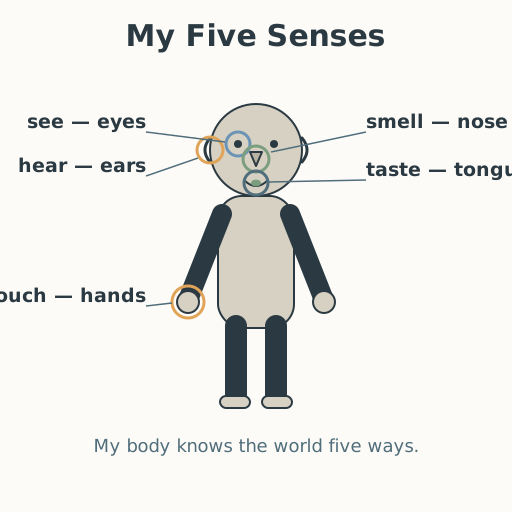
- Meet the senses (10 min). There are five ways your body notices the world. Say each one and touch the body part that does it: see (eyes), hear (ears), smell (nose), taste (tongue and mouth), and touch (skin, especially your hands). If you cannot see or hear, know that your other senses work extra hard, and that is its own kind of strong.
- The mystery bag (15 min). Close your eyes or cover your eyes if you like. Reach in and hold one item. Do not look yet. What does it feel like — smooth, bumpy, soft, cold? Can you hear it if you shake it? Does it have a smell? Guess what it is, then look and check. Which senses did you use?
- Taste and smell together (5 min). With an adult’s help, notice how smell and taste work as a team. Close your nose gently while you take a small taste of something safe, then let go and taste again. Smell helps you taste!
- Draw it (5 min). Draw one thing you noticed today and the body part that helped you notice it.
- Close (5 min). Say the five senses one more time and touch each body part as you go. Your body is always listening to the world.
Differentiation
- Support: Introduce two senses at a time (touch and hearing first), using fewer items.
- Extension: Invite learners to add a sixth “sense” of their own imagining (how do you know you are hungry, tired, or happy?) and share it.
Assessment
- Formative (observation): Can the learner name a sense and point to the body part that does it, for at least three senses?
- Artifact (portfolio): The sense drawing, kept in the learner’s portfolio.
Home connection
Play the mystery bag game at home with a grown-up: hide three safe things and guess each one by feel, sound, and smell before you look.