Lesson 02 — A Senses Walk
Learners take a short walk and use each of the five senses to notice the world, then share one thing they found with each sense.
Objectives
Objectives
- D03.S1.K.01 Name the five senses and identify a body part used for each.
Essential question
What can my senses find in the world around me?
Key vocabulary
Materials
Standard materials
- A senses checklist · per learner Simple pictures of an eye, ear, nose, hand, and mouth to mark as each sense is used
- Crayons or a pencil · per learner
Low-tech / no-cost
- Voice and body Say the five senses aloud and point to the body part; no paper needed — count finds on your fingers
- Found objects Anything safe on the ground or path to touch and smell
Enriched / lab & device
- Magnifying glass · 1 per pair Look closely at bark, leaves, stones, and small creatures
- Field notebook · per learner A small booklet to sketch or mark one find for each sense
Works in different contexts
- large-group Walk in a line and pause at "sense stops" — one stop for listening, one for touching, one for smelling — so the whole group can gather and share
- self-directed A learner walks a short, safe loop alone or with an older peer, stopping to notice one thing for each of the five senses and marking it
- outdoor-only This lesson is at home outdoors — no indoor space needed; use whatever path, garden, shore, or street is safe nearby
- multi-age Pair older learners as "sense guides" who ask younger ones what they notice and help them mark their checklists
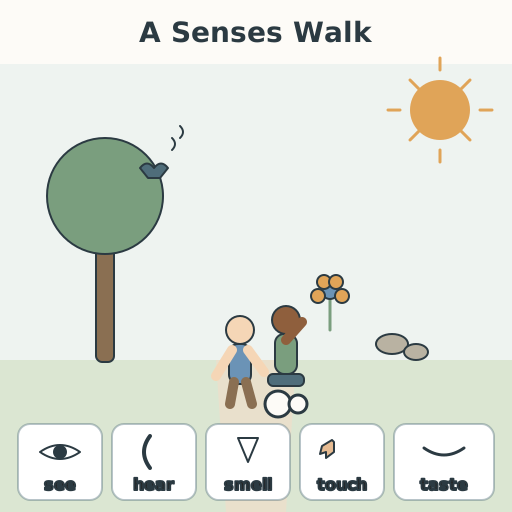
Lesson 2 — A Senses Walk
Summary
Learners bring their five senses outside and onto a short, safe walk, using each sense to notice the world around them. They close by sharing one find for each sense.
Objectives
- Name the five senses and identify a body part used for each. (D03.S1.K.01)
Connection
Wherever you are, the world is full of things to notice. A market hums with voices and banging pots; a field carries the smell of wet earth; the sea roars and sprays salt; a mountain path is quiet except for wind and birds. A senses walk is how you meet the place you live in — with your whole body.
Materials
- A senses checklist with simple pictures (an eye, ear, nose, hand, mouth)
- Crayons or a pencil
Preparation
- Choose a short, safe walking route — a garden, schoolyard, quiet street, or shore.
- Prepare or draw a simple checklist with a picture for each sense.
- Remind learners about safety: stay together, and do not taste anything unless an adult says it is safe.
Facilitator note
This lesson is written to the learner (“you”). As facilitator, choose a safe route and keep the pace gentle. Make the route work for every body: pick a path a wheelchair can roll, or let a learner who cannot walk do a “senses sit” — one comfortable spot where they notice with all their senses without moving. Describe each sense aloud as you go so learners who cannot see or hear fully can still collect finds with their other senses. The only sense we do not use freely outside is taste — make clear that tasting unknown plants or objects is not safe, and offer a safe food to taste afterward if you like.
Procedure
- Gather (5 min). Before you walk, touch the five body parts that sense the world: eyes, ears, nose, tongue, and hands. Today you will use all five to explore the place where you are.
- Start the walk (5 min). Walk slowly and quietly for a moment. If you use a wheelchair, roll; if you cannot walk far, stay in one comfortable spot and let the senses come to you. What is the very first thing you hear? Point to your ear.
- Sense stops (20 min). Pause along the way to collect one find for each sense:
- See: one thing with a color or shape you love.
- Hear: one sound, near or far.
- Smell: one smell in the air.
- Touch: one thing that is safe to touch — rough, smooth, wet, warm, or cool.
- Taste: do not taste anything outside. Instead, remember a taste from your day. Mark each one on your checklist as you go.
- Share (10 min). Find a partner and trade: “I saw…”, “I heard…”, “I touched…” If you cannot see or hear, share what your other senses found — a smell, a texture, a taste you remember.
- Close (5 min). Look at your checklist. Which sense did you use the most today? Which one surprised you?
Differentiation
- Support: Focus on two senses (hearing and touching) and use a shorter route.
- Extension: Invite learners to describe a find using two senses at once (how a leaf looks and feels), and to sketch it from memory.
Assessment
- Formative (observation): Can the learner name a sense and share one thing they found with it during the walk?
- Artifact (portfolio): The completed senses checklist.
Home connection
Take a grown-up on a short senses walk near home. Ask them what they hear, and tell them what you notice that they miss.