Lesson 04 — Little Hands, Little Jobs
Learners practice small hand movements — drawing, stacking, pinching, and threading — with growing control, and discover that little hands can do many little jobs.
Objectives
Objectives
- D03.S2.K.01 Demonstrate big movements (run, hop, balance) and small movements (draw, stack) with growing control.
Essential question
What can my hands do?
Key vocabulary
Materials
Standard materials
- Stacking objects · 1 set Blocks, cups, or small boxes that stack safely
- Drawing tools and paper · per learner Crayons, chalk, or pencils
- Threading objects · 1 set Large beads and a thick string or shoelace
Low-tech / no-cost
- Found objects Stack stones or cups, thread leaves or shells onto a blade of grass, draw in sand or dirt with a finger
- Voice and body Practice the pinch, grip, and stack motions with your hands only; no tools required
Enriched / lab & device
- Play dough or clay · 1 lump per learner Squeezing, pinching, and rolling builds hand strength
- Tweezers or tongs · 1 set Move small objects (beans, pompoms) from one bowl to another for fine control
Works in different contexts
- large-group Set up "little job" stations around the room — stacking, threading, drawing, pinching — and rotate small groups through each
- self-directed A learner works through the stations or a simple list at their own pace, trying each small job and marking it done
- outdoor-only Stack stones or sticks, thread leaves onto grass, and draw in the dirt with a finger or twig
- multi-age Older learners demonstrate each small job first, then help younger learners who are still learning to grip and pinch
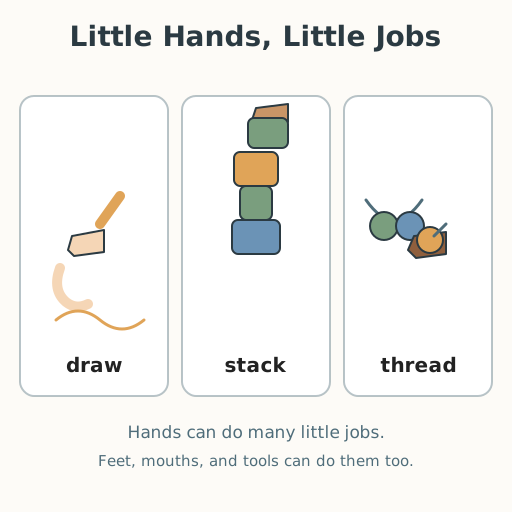
Lesson 4 — Little Hands, Little Jobs
Summary
Learners practice small, careful hand movements — drawing, stacking, pinching, and threading — with growing control. They discover that hands (and feet, mouths, and tools) can do many little jobs that help us every day.
Objectives
- Demonstrate small movements (draw, stack) with growing control. (D03.S2.K.01)
Connection
Your hands do little jobs all day long: buttoning a shirt, peeling fruit, turning a page, stacking cups, picking up a grain of rice, drawing a picture. People everywhere — in a kitchen, a workshop, a garden, or a boat — use their hands for small, careful work. Practice makes hands strong and clever.
Materials
- Stacking objects (blocks, cups, or small boxes)
- Drawing tools and paper
- Threading objects (large beads and a thick string or shoelace)
Preparation
- Set up a few “little job” stations: a stacking spot, a drawing spot, and a threading spot.
- Choose objects that are big enough for small hands to grip safely.
Facilitator note
This lesson is written to the learner (“you”). As facilitator, keep the stations simple and the pace unhurried. Honor every body: a learner who cannot use their hands can do the same jobs with their feet, their mouth, or a helper tool, or use larger objects; a learner with low grip strength can start with bigger, softer items. Growth in control is the goal, not speed or perfection.
Procedure
- Gather (5 min). Look at your hands. Wiggle your fingers, then make a fist, then open wide. Hands can do so many little jobs.
- Stack (10 min). At the stacking spot, build a tower of blocks or cups as high as you can before it falls. Place each one slowly and carefully. If stacking with your hands is hard, use bigger objects or stack with help from a friend.
- Draw (10 min). At the drawing spot, draw one small thing you can see — a leaf, a spoon, your own hand. Hold your drawing tool in a comfortable grip and go slowly.
- Pinch and thread (10 min). Pinch one bead between your thumb and finger, and slide it onto the string. Add more beads one at a time. This is the same pinch you use to pick up a crumb or button a shirt.
- Little job hunt (5 min). Look around. Name one little job your hands do at home or at school — carrying a cup, closing a lid, turning a page.
- Close (5 min). Shake your hands out and rest them. What was the hardest little job today? What felt easy?
Differentiation
- Support: Offer larger, softer objects and one station at a time; model the pinch grip slowly.
- Extension: Challenge learners to stack with the non-dominant hand, or to thread beads in a color pattern (red, blue, red, blue).
Assessment
- Formative (observation): Can the learner stack a few objects and draw with growing control, using an adapted version if needed?
- Artifact (portfolio): The drawing, kept in the learner’s portfolio.
Home connection
Ask a grown-up to show you a little job their hands do (peeling, folding, braiding). Try a little job of your own: stack the cups, thread a button, or sort the beans.