Lesson 06 — Foods That Help Me Grow
Learners connect everyday foods to what a body needs to grow, play, and learn, and explore where food comes from through a seed, a plant, or a story.
Objectives
Objectives
- D03.S3.K.01 Sort common foods into "everyday" and "sometimes" groups with guidance.
Essential question
How does food help my body grow and play?
Key vocabulary
Materials
Standard materials
- Food picture cards · 1 set Pictures of everyday foods that help bodies grow — fruits, vegetables, grains, beans, fish, milk foods, eggs
- A small plant or a sprouting seed · 1 To show that living things need food and water to grow, just like bodies
- Paper and crayons · per learner
Low-tech / no-cost
- A real seed or bean A bean soaked in water to watch it swell and sprout; shows growth needs food and water
- Voice and body Act out growing from a seed into a tall plant, and name the foods that help you grow; no cards needed
Enriched / lab & device
- A class sprouting jar · 1 Grow a bean or lentil in a clear jar to watch roots and shoots appear over days
- Picture book about a garden or farm · 1 A story showing where food comes from — a garden, a farm, a market
Works in different contexts
- large-group Build one big class "grow list" on the board — every learner adds an everyday food that helps bodies grow
- self-directed A learner matches each food card to what it helps (grow, play, or drink water) and draws one meal that would help their body grow
- outdoor-only Visit or imagine a garden; look at a real plant and talk about how food and water help it — and us — grow
- multi-age Older learners explain the seed-to-plant idea to younger ones and help write the class grow list
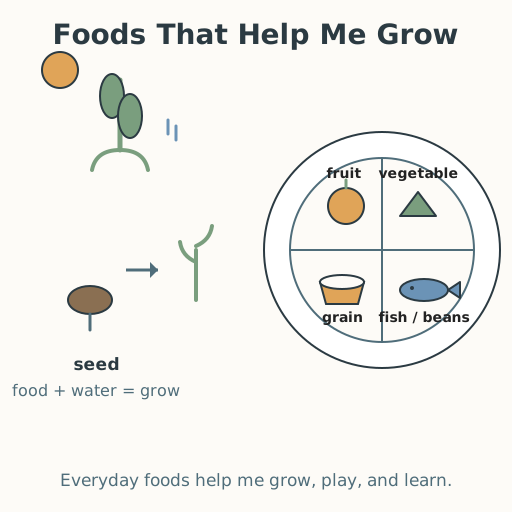
Lesson 6 — Foods That Help Me Grow
Summary
Learners connect everyday foods to what a body needs to grow, play, and learn, and begin to notice where food comes from — a seed, a plant, a garden, a farm, or the sea. They close by drawing one meal that would help their body grow.
Objectives
- Sort common foods into “everyday” and “sometimes” groups with guidance. (D03.S3.K.01)
Connection
Food is not just for filling a tummy — it is the building material for your body and the fuel for your play. A seed becomes a bean sprout with water and food from the soil; a child becomes bigger and stronger with food and water, too. Wherever food comes from — a rooftop pot, a field, a fishing boat — it helps living things grow.
Materials
- Food picture cards (fruits, vegetables, grains, beans, fish, milk foods, eggs)
- A small plant or a sprouting seed
- Paper and crayons
Preparation
- Gather food picture cards focused on everyday foods.
- Have a small plant or a bean sprouting in a jar to show growth.
- Clear a space for acting out and drawing.
Facilitator note
This lesson is written to the learner (“you”). As facilitator, keep the focus on what foods do for a body, not on amounts or weight. Never comment on a child’s size or appetite. Be sensitive: some children have little food at home. Speak of food as something all living things need, and honor the many ways people get it — farming, fishing, gathering, buying, growing in pots.
Procedure
- Gather (5 min). Look at the little plant or seed. What does a plant need to grow? Water and food from the soil. Your body is like that too.
- Grow like a plant (5 min). Curl up small like a seed. Pretend rain falls, the sun shines, and food reaches your roots. Slowly grow tall, stretch your arms like leaves. Food and water help you grow!
- What foods help me grow? (15 min). Look at the food cards. Which foods are everyday foods that help a body grow, play, and learn? Sort them: fruits and vegetables, grains and beans, fish and eggs and milk foods. Talk with a partner about one food and what it helps — “Fish helps my body grow strong,” or “Rice gives me energy to run.”
- Where does food come from? (10 min). Choose one food card and wonder: where did it come from before it was food? A seed in the ground? A tree? The sea? A garden? All food starts as something living.
- Draw a grow meal (5 min). Draw a plate with foods that would help your body grow and play.
- Close (5 min). Share your drawing. Food and water help every living thing grow — including you.
Differentiation
- Support: Use three familiar foods and act out “grow” and “play” energy; skip the where-food-comes-from step if it is too much.
- Extension: Invite learners to sort foods by where they come from — plant, animal, or the sea — and to wonder which take longer to grow.
Assessment
- Formative (observation): Can the learner name an everyday food and connect it to growing or playing, with guidance?
- Artifact (portfolio): The “grow meal” drawing.
Home connection
With a grown-up, plant one seed or bean in a cup and put it in the sun. Give it water and watch it grow — then notice that food and water help you grow, too.