Lesson 01 — Taking Turns
Learners experience taking turns with one shared object and learn that waiting means everyone eventually gets a chance.
Objectives
Objectives
- D02.S1.K.01 Take turns and share materials during play with a gentle reminder.
Essential question
How do we take turns so everyone gets a chance?
Key vocabulary
Materials
Standard materials
- One shared object (ball, tambourine, or shell) · 1 A single object everyone will want, so waiting is real
- A "turn" marker (a stick, card, or pebble) · 1 Shows whose turn it is; passed hand to hand
Low-tech / no-cost
- Voice and body Use a shared song — each learner sings one word and passes the turn with a wave
- A single found object One stick, leaf, or stone that must be passed around
Enriched / lab & device
- A visual turn chart · 1 A card or board showing "my turn" and "your turn" in pictures
- A soft ball or beanbag · 1 Easy to hold and pass to make the turn visible to all
Works in different contexts
- large-group Use the turn marker so everyone can see whose turn it is from across the circle; invite the whole group to chant the next learner's name
- self-directed A learner practices "my turn, your turn" with a grown-up or a friend, passing one object back and forth
- outdoor-only Pass a found object — a smooth stone or a stick — around a sitting circle in the open air
- multi-age An older learner models "now it's your turn" and hands the marker to a younger partner
- level-grouped Learners who already wait well take longer turns with more steps; others practice a single quick pass
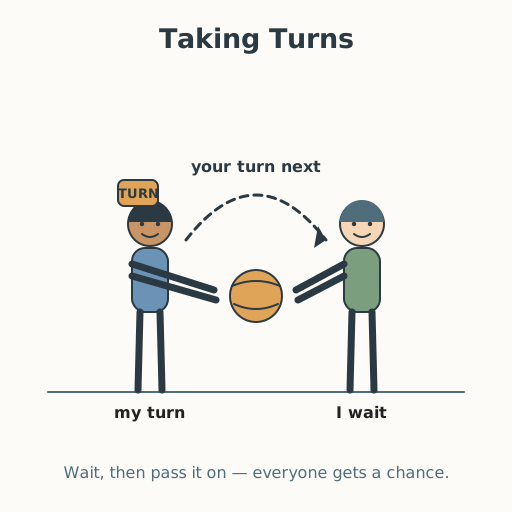
Lesson 1 — Taking Turns
Summary
Learners share one object by taking turns and practice the small skill underneath it: waiting. They close by noticing how turn-taking feels fair — everyone gets a chance, no one is left out.
Objectives
- Take turns with a shared object during play with a gentle reminder. (D02.S1.K.01)
Connection
When many children want the same swing, ball, or drum, only one can use it at a time. Taking turns is the way everyone gets a chance — you wait, then you get your go, then you pass it on. It is fairness you can practice with your own hands.
Materials
- One shared object (ball, tambourine, or shell)
- A “turn” marker (a stick, card, or pebble)
Preparation
- Arrange a circle so everyone can see each other.
- Choose one object worth wanting — the point is that waiting is real.
- Prepare the turn marker that will pass hand to hand.
Facilitator note
This lesson is written to the learner (“you”) so it works in a classroom and for a self-directed learner. As facilitator, keep the tone light: waiting is hard at age five, so celebrate every wait, no matter how short. Give a gentle reminder rather than a correction — the standard itself asks only for turn-taking with a gentle reminder.
Procedure
- Gather (5 min). Sit in a circle. Look at the one object in the middle. If everyone grabbed it at once, what would happen? We would bump and fuss. Instead, we take turns.
- Meet the turn marker (5 min). This marker tells us whose turn it is. Whoever holds it is “in.” Everyone else waits and watches.
- Pass it around (15 min). The first learner holds the object, enjoys it for a moment, then says “your turn” and passes the marker to the next learner. Around the circle it goes. You waited — now it is your turn!
- Try it in play (10 min). Now use one toy or one ball in a small group. Play together, passing the turn. If you forget, a friend gives a gentle reminder: “my turn next.”
- Close (10 min). Talk together: how did waiting feel? How did it feel when your turn finally came? Remember — when we take turns, everyone gets a chance.
Differentiation
- Support: Keep the object with one learner for only a short moment so no one waits too long.
- Extension: Invite learners to invent their own turn-taking game and teach it to a partner.
Assessment
- Formative (observation): Can the learner wait and then take a turn with only a gentle reminder?
- Artifact (portfolio): A note or drawing the learner makes about “my turn, your turn.”
Resources
- CASEL SEL Framework (foundational competencies): https://casel.org/fundamentals-of-sel/
Home connection
At home, play a game that needs turns — a board game, a ball, a story where each person tells one part. Notice: everyone gets a chance.