Lesson 02 — Sharing Our Things
Learners practice sharing by dividing objects so that everyone has some, and see that sharing is a kind of fairness that cares for the group.
Objectives
Objectives
- D02.S1.K.01 Take turns and share materials during play with a gentle reminder.
Essential question
How does sharing what we have make play better for everyone?
Key vocabulary
Materials
Standard materials
- Objects to split (crayons, blocks, or snacks) · 1 set Enough to divide so both partners get some
- Paper and crayons · per learner
Low-tech / no-cost
- Found objects to split Sticks, leaves, or pebbles divided into two piles — one for me, one for you
- Voice and body Act out sharing a pretend snack or toy; no objects needed
Enriched / lab & device
- A set of picture books about sharing · 1 set Stories where characters share and everyone has enough
- A tablet with a drawing app · 1 per pair Two learners draw one shared picture, passing the pen back and forth
Works in different contexts
- large-group Split one big pile of objects so every learner gets the same number, and count together
- self-directed A learner splits a small pile of objects in half for a friend and themselves, then checks both have the same
- outdoor-only Gather one pile of seeds, petals, or pebbles and share it out so everyone gets some
- multi-age An older learner shows a younger one how to divide a pile into two fair shares
- level-grouped Learners who are ready share unequal piles and figure out how to make them fair; others split a pile of two
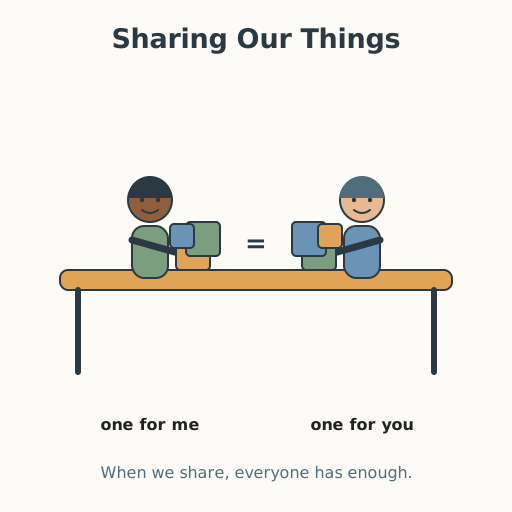
Lesson 2 — Sharing Our Things
Summary
Learners move from taking turns to sharing — dividing what they have so another person also has some. They practice fair sharing with real objects and close by noticing that sharing is a way of caring for the whole group, not a contest.
Objectives
- Share materials during play with a gentle reminder. (D02.S1.K.01)
Connection
Sharing is letting someone else use or enjoy a little of what you have — and sometimes they share with you in return. When everyone shares a little, everyone has enough, whether you are splitting crayons at a table or bread at a family meal. Sharing is caring made into a habit.
Materials
- Objects to split (crayons, blocks, or snacks)
- Paper and crayons
Preparation
- Prepare a pile of objects that can be divided evenly into two or more shares.
- Arrange pairs or small groups so each has a pile to share.
Facilitator note
This lesson is written to the learner (“you”) so it works in a classroom and for a self-directed learner. As facilitator, keep sharing voluntary and warm — never force a child to hand over a beloved object; offer an object that is “ours to share.” The aim is the feeling of fairness and enoughness, not obedience.
Procedure
- Gather (5 min). Look at a pile of crayons. What if one learner took them all? Others would have none. What could we do instead? Share.
- Split it fair (10 min). With a partner, split a pile of objects into two shares — one for you, one for your friend. Count: do you both have the same? Now everyone has some.
- Share in play (15 min). Play with your shared materials. If your friend wants one of your crayons, try saying “yes, we can share.” If you want one of theirs, ask kindly. A gentle reminder helps when we forget.
- Draw it (10 min). Draw a picture of you and a friend sharing — a snack, a toy, or a game. Show what each of you has.
- Close (5 min). Remember: when we share, everyone has enough. That feels good for the whole group.
Differentiation
- Support: Begin with a pile of exactly two objects so sharing is one for me, one for you.
- Extension: Give an uneven pile and ask learners to make the shares fair, then explain how they did it.
Assessment
- Formative (observation): Does the learner share materials with a peer, with at most a gentle reminder?
- Artifact (portfolio): The “sharing” drawing.
Resources
- CASEL SEL Framework (foundational competencies): https://casel.org/fundamentals-of-sel/
Home connection
At your next family meal, help share something out — slices of fruit, cups of water, or a serving of rice — so everyone gets a fair share.