Lesson 13 — Many Languages Are Treasures
Learners see that people speak thousands of languages, that no language is better than another, and that every home language is a treasure to keep and share.
Objectives
Objectives
- D04.S4.K.01 Share a greeting or word from their home language and try one from another language.
Essential question
Why are many languages a treasure to keep and share?
Key vocabulary
Materials
Standard materials
- Greeting cards from many languages · 1 set The greeting for "hello" written and pictured in several languages from around the world
- A "treasure chest" box or basket · 1 Each learner's home-language word is written on a slip and placed inside
Low-tech / no-cost
- Voices of the room The learners themselves are the treasure — each child's home language is shared aloud
- Drawn treasure slips Learners draw a picture for their home-language word instead of writing it
Enriched / lab & device
- Recordings of a song or rhyme in several languages · 1 set Learners hear that the same idea — a lullaby, a hello — sounds different and beautiful in many languages
Works in different contexts
- large-group Build one big class treasure chest together; each child adds a home-language word and the group echoes it
- self-directed A learner makes their own small treasure chest of words — their home-language word plus one they learned from a friend
- outdoor-only Gather "word treasures" on a walk — a leaf for each new word learned — and say the words as you collect
Lesson 13 — Many Languages Are Treasures
Summary
Learners explore the idea that people speak thousands of languages, that no language is better than another, and that every home language is a treasure. They build a “treasure chest” of words from their own languages and new ones they learn.
Objectives
- Share a greeting or word from their home language and try one from another language. (D04.S4.K.01)
Connection
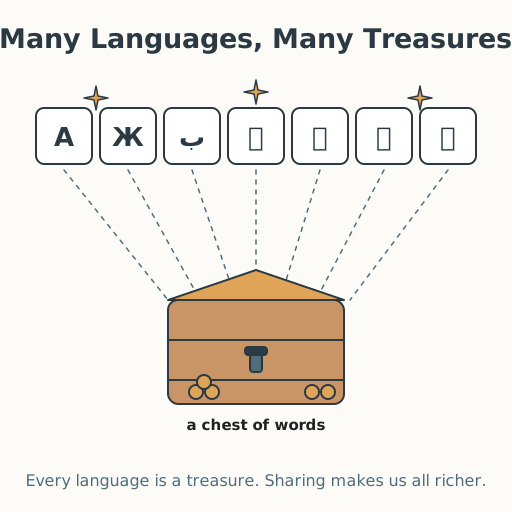
People all over the world greet, sing, and tell stories in thousands of different languages. Each language is a treasure chest of words, songs, and ways of seeing the world. When we share languages, everyone gets richer — and no one has to give up theirs.
Materials
- Greeting cards from many languages (optional)
- A “treasure chest” box or basket
Preparation
- Prepare a few greeting cards from languages around the world.
- Set out the treasure chest and slips of paper for home-language words.
Facilitator note
This lesson is written to the learner (“you”) so it works in a classroom and for a self-directed learner. The central value is egalitarian: no language is “better” or “more correct” than another, and multilingualism is wealth, not a problem. Treat every home language as a treasure the learner gives, never as a barrier. This is a value we teach by modeling — never rank languages, never mock an accent, and let the learners’ own languages fill the room. For the factual claim below, cite UNESCO.
Procedure
- Gather (5 min). How many languages do you think people speak in the whole world? (Guess! There are thousands.)
- Hear the treasure idea (10 min). Each language is like a treasure chest — full of words, songs, and stories found nowhere else. No language is better than another; they are all treasures. Sadly, many people still cannot learn in the language they speak best at home, so we must work to honor every language.
- Fill the treasure chest (15 min). Put one word from your home language into the chest — say it aloud, then add a slip with the word (or a drawing of it). Then learn one word from a friend’s language and put that in too.
- Share the treasures (10 min). Open the chest together and read or say the words inside. Notice how many different languages live in your room.
- Close (5 min). Remember: every language is a treasure, and every person who speaks one is a keeper of that treasure. Sharing them makes us all richer.
Differentiation
- Support: Let a learner offer just a smile or a single sound from their home language; one word is a full contribution.
- Extension: Invite learners to compare the same word — “hello” or “thank you” — across the languages in the room and notice what is alike and different.
Assessment
- Formative (observation): Can the learner offer a word from their home language and show curiosity or respect toward another’s?
- Formative (oral): Can the learner try one word from a language that is not their own?
Resources
- UNESCO, International Mother Language Day (UNESCO reports that around 40 per cent of the world’s people still cannot learn in a language they speak or understand; the value of every learner’s language): https://www.unesco.org/en/days/mother-language
Home connection
At home, ask a grown-up what languages your family or your neighbors speak. Learn one new word together and add it to your family’s word treasure.