Lesson 01 — Counting Real Things
Learners discover that counting means matching one number to one thing, and they practice touch-and-count on real objects they can hold.
Objectives
Objectives
- D05.S1.K.01 Count objects up to 20 and say how many there are.
Essential question
How do I count real things, one number for each thing, and know how many there are?
Key vocabulary
Materials
Standard materials
- Small real objects (pebbles, seeds, shells, bottle caps) · about 10 per learner Any small, safe, easy-to-move objects; found objects are perfect
- A cloth or mat to count on · 1 per learner Gives each counted object a clear "spot"
Low-tech / no-cost
- Found objects Pebbles, seeds, sticks, leaves, or beans collected nearby — no purchased supplies needed
- A drawn line or your hand Counting into a drawn line, a cupped hand, or a small bowl works as the "mat"
Enriched / lab & device
- Counting frame or bead string · 1 per learner A string of 10 beads (or an abacus) to slide one bead per count and see the number grow
- Number cards 1-10 · 1 set Cards showing numerals alongside dots, to pair a counted group with its number mark
Works in different contexts
- large-group Count together as a whole group first, touching one big shared collection; then let small groups each count their own pile while the facilitator rotates
- self-directed A learner gathers their own collection and counts it slowly, touching each thing and saying one number aloud, then recounts to check
- outdoor-only Gather a handful of pebbles, leaves, or seeds outdoors and count them on a flat stone or a patch of earth
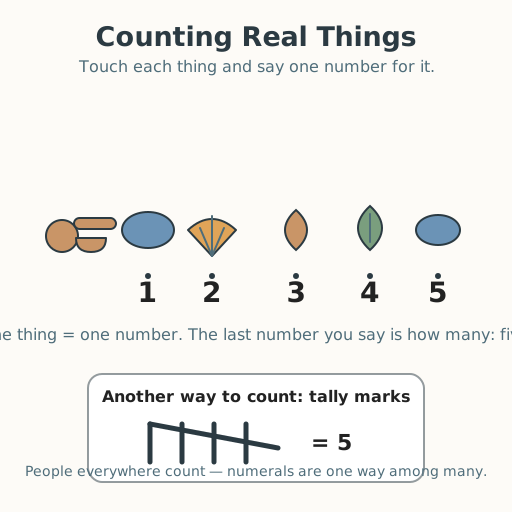
Lesson 1 — Counting Real Things
Summary
Learners learn the heart of counting: saying one number for each thing, without skipping or double-counting. They practice “touch-and-count” on real objects they can hold — pebbles, seeds, shells — and discover that the last number they say tells how many there are.
Objectives
- Count objects by matching one number to one object and say how many there are. (D05.S1.K.01)
Connection
Counting happens all around you, every single day — a seller counts fruit at a market, a child lines up river stones, a runner counts footsteps, you count your own fingers. People everywhere count, but not with the same words or the same marks: counting is done many ways, in many languages, and every way is real counting. Today you will practice your own way of counting the real things in front of you.
Materials
- About 10 small, safe objects per learner (pebbles, seeds, shells, bottle caps)
- A cloth or mat to count on
Preparation
- Gather or help learners gather a collection of small objects (about 10 each).
- Give each learner a cloth, mat, or clear flat space to count on.
Facilitator note
This lesson is written to the learner (“you”) so it works in a classroom and for a self-directed learner. The single most important idea here is one-to-one correspondence — one number for one object — which is a well-documented first step in early counting (Clements & Sarama, 2014). Model it slowly: touch an object, say “one”; touch the next, say “two.” Resist the urge to rush or to correct a learner who is still practicing; accuracy grows with time and many gentle tries. Counting is a skill everyone builds at their own pace, and no one’s speed is a measure of their smartness. Always count in the language the learner understands best — the home language is welcome and just as “real” as any other way of counting. Learners who are blind or low-vision can count by touch (moving each object into a cup) or by sound (tapping, clicking); learners who are deaf or hard of hearing can count in sign, with each signed number matched to one object. All of these are genuine counting. Learners with limited hand or body movement count by voice or sign alone: a partner touches and moves each object while the learner names each number, or the learner chooses each object with eye-gaze or a mouth stick and the partner moves and counts it — the math is in matching number to thing, not in the moving.
Procedure
- Gather (5 min). Sit with your collection of small things in front of you. Look at them. How many do you think there are? You do not need to know yet — you are about to find out.
- Watch touch-and-count (10 min). Counting means giving each thing its own number. Touch one thing and say “one.” Touch the next and say “two.” Never skip a thing, and never give one thing two numbers. Try it with a friend on a few things.
- Count your own collection (15 min). Now count your things slowly, touching each one and saying one number for it. When you finish, the last number you say is how many there are.
- Check it (10 min). Count the same collection again, this time moving each thing onto a cloth or into a line as you count. Did you get the same number both times? If not, try once more, even slower. There is no prize for being fast — slow and careful is how we count true.
- Close (5 min). Remember: counting is a way of paying attention to the things around you. One thing, one number. That is all counting ever is.
Differentiation
- Support: Start with a very small collection (3-5 objects) and count together, hand over hand if helpful; name each number aloud and let the learner echo it.
- Extension: Invite learners to count a larger collection (up to 10) and to count objects they cannot touch, pointing carefully at each one instead.
Assessment
- Formative (observation): Does the learner say one number for each object without skipping or double-counting?
- Formative (oral): Can the learner tell, after counting, how many there are?
Resources
- Clements, D. H., & Sarama, J. (2014). Learning and Teaching Early Math: The Learning Trajectories Approach (2nd ed.). Routledge. (One-to-one correspondence as a foundational counting skill.)
Home connection
At home, count something real: the spoons on the table, the steps to the door, the socks in a pile. Touch each one as you say its number, and tell a grown-up how many there are.