Lesson 02 — Counting to Ten, Then Twenty
Learners stretch their counting from ten all the way to twenty, using their bodies and real objects, and discover that ten fingers and ten toes make a whole-body counting tool.
Objectives
Objectives
- D05.S1.K.01 Count objects up to 20 and say how many there are.
Essential question
How do I count all the way to twenty, one number for each thing?
Key vocabulary
Materials
Standard materials
- A collection of 20 small objects · 20 per learner or pair Pebbles, seeds, buttons, or any safe small things
- Two cups or small bowls · 2 per learner or pair One to hold a group of ten, one for counting on to twenty
Low-tech / no-cost
- Fingers and toes The body is the counting tool — ten fingers and ten toes make twenty
- Twenty found objects Twenty pebbles, seeds, or sticks gathered from the ground
Enriched / lab & device
- Ten-frame cards · 1 set Cards showing a ten-frame and a second ten-frame, to see ten and "ten more"
- Number line to 20 · 1 per learner A strip showing numbers 1-20 with dots, to point and count along
Works in different contexts
- large-group Count to twenty as one voice, then have the group count in rounds — one learner says "one," the next "two," and so on — so everyone holds part of the count
- self-directed A learner counts their collection to ten, puts ten into one cup, then counts the rest and says the total up to twenty
- outdoor-only Count steps, claps, or jumps to twenty outdoors, then count twenty gathered objects (stones, seeds, petals)
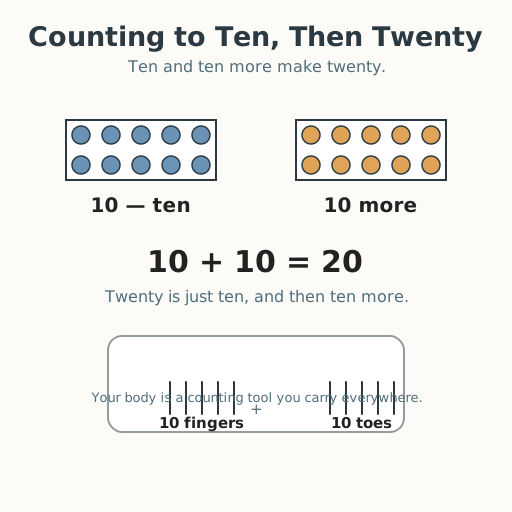
Lesson 2 — Counting to Ten, Then Twenty
Summary
Learners practice counting to ten, then stretch onward to twenty — the “teen” numbers — using their bodies and real objects. They discover that ten fingers plus ten toes make twenty, so the whole body can be a counting tool.
Objectives
- Count objects up to twenty and say how many there are. (D05.S1.K.01)
Connection
Ten is a number you carry with you: ten fingers. Twenty is two sets of ten: your ten fingers and your ten toes. Long before number marks were written down, people in many parts of the world counted on their bodies — fingers, toes, and other parts — and many still do. Counting to twenty is just counting to ten, and then ten more.
Materials
- A collection of about 20 small objects (pebbles, seeds, buttons)
- Two cups or small bowls
Preparation
- Give each learner or pair a collection of about 20 objects and two cups.
- Clear space to move and count aloud.
Facilitator note
This lesson is written to the learner (“you”). Counting to twenty is a bigger stretch than many five-year-olds find easy, and the “teen” numbers (eleven through nineteen) are irregular in many languages — they take time. Keep the tone playful and unhurried; there is no such thing as “too slow” at counting. Count in the home language, since number words differ across languages and all of them are correct. Some learners count on their fingers and toes as a physical anchor; others prefer objects or a spoken chant — honor every method. For learners who are deaf or hard of hearing, count in sign or by touching each object; for learners who are blind or low-vision, count by moving objects from one cup to another so the number grows by feel and sound. Learners with limited hand or body movement count by voice or sign, directing a partner to move each object, or indicating each one with eye-gaze or a mouth stick while the partner counts it. Do not rank learners by how high they can count; mastery arrives at its own pace for each child.
Procedure
- Gather (5 min). Hold up your two hands. Count your fingers: one to ten. Now wiggle your toes — there are ten more. Ten fingers and ten toes make twenty.
- Count to ten (10 min). Count your objects up to ten, touching each one. Put those ten into one cup. Say “ten.”
- Count on to twenty (15 min). Now keep going with the rest of your objects. Count on from ten: eleven, twelve, thirteen … all the way to twenty. Put the second group into the second cup. How many are there now? Twenty.
- Body count game (10 min). With a friend, take turns: one of you says a number from one to twenty, and the other points to that many things — fingers, toes, objects, or claps. Check each other, kindly.
- Close (5 min). Remember: twenty is just ten and ten more. Your own body is a counting tool you carry everywhere, for your whole life.
Differentiation
- Support: Focus only on counting to ten today, then begin the teen numbers one or two at a time, echoing each word.
- Extension: Invite learners to count backward from ten, or to count twenty objects and then count them again starting from a different object to see the total stays the same.
Assessment
- Formative (observation): Does the learner count aloud to twenty with one number for each object, including the teen numbers?
- Formative (oral): Can the learner say the total after counting a group of up to twenty objects?
Home connection
At home, count your fingers and toes with a grown-up — that is twenty. Then count twenty small things you can find: beans, stones, buttons, or steps.
Resources
- Clements, D. H., & Sarama, J. (2014). Learning and Teaching Early Math: The Learning Trajectories Approach (2nd ed.). Routledge. (The verbal counting sequence as a foundational skill.)