Lesson 09 — Building Something
Learners plan, build, and test something with a job — a tower, a bridge, a boat, a little home. Building is thinking with the hands, and every structure has a purpose.
Objectives
Objectives
- D07.S4.K.01 Build or make something from available materials and explain what it does.
Essential question
How do I build something that does a job?
Key vocabulary
Materials
Standard materials
- Blocks, boxes, or cups · a pile per group Anything that stacks and joins
- Tape, string, or cloth · per group For joining parts together
Low-tech / no-cost
- Sticks, stones, sand, or mud Build with what the ground gives; mud joins and holds
- Hands and found objects Cups, leaves, twigs, and stones — build with whatever is near
Enriched / lab & device
- A building set with connectors · 1 set per group Interlocking pieces to make a sturdier structure
- A picture of one local and one far-away structure · 1 set A house, a bridge, a boat, or a basket to inspire ideas
Works in different contexts
- large-group Divide into small build teams, each with its own material pile, and have a quick "show and tell" of what each team made
- multi-age Older learners can plan and hold pieces steady while younger learners stack and press; build one thing together
- self-directed A learner chooses materials, builds something with a job in mind, then explains to a grown-up, friend, or the mirror what it does
- level-grouped Group by build experience — some stack flat pieces, others make a plan and join parts — and give each a matching challenge
- outdoor-only Build from nature — stick bridges, stone towers, leaf boats — and test them right where you are
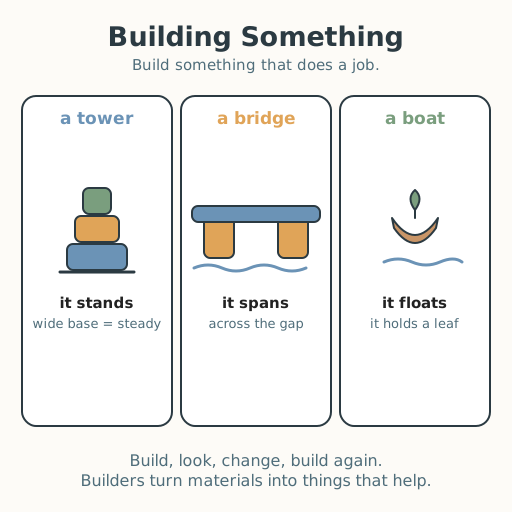
Lesson 9 — Building Something
Summary
Learners build something that does a job: a tower that stands, a bridge that spans, a boat that floats, a little home that holds. They plan a little, build with what is at hand, and explain what their creation does. Building is thinking made visible.
Objectives
- Build or make something from available materials and explain what it does. (D07.S4.K.01)
Connection
Think of the homes, bridges, boats, and baskets people make everywhere in the world. Every one is built from whatever is around — wood, stone, clay, reeds, cloth — to do a job. When you build, you are doing what people have always done: turning an idea and some materials into something useful.
Materials
- Blocks, boxes, or cups
- Tape, string, or cloth for joining
Preparation
- Gather building materials into piles for small groups.
- Set out a few simple joiners (tape, string) so structures can hold together.
Facilitator note
This lesson is written to the learner (“you”) so it works in a classroom and for a self-directed learner. As facilitator, ask “what does it do?” rather than “what is it?” — purpose is the heart of this strand. If a build falls over, treat it as data, not failure: “what could you change so it stands?” Honor every structure; a wobbly tower is still a thinker’s tower.
Procedure
- Gather (5 min). Look at the materials. What could you build with them? Think of one thing with a job: a tower, a bridge, a boat, a home.
- Plan a little (5 min). Before you build, say or think: what will it do? What will hold it up?
- Build (15 min). Stack, join, and arrange. If it falls, that is a clue — try a wider base or a tighter join. Build, look, change, build again.
- Test it (10 min). Try its job: does the tower stand? Does the bridge span the gap? Does the boat hold a leaf?
- Explain it (5 min). Tell a friend or grown-up what you built and what it does. You can say it or point to the part that does the job.
- Close (5 min). Remember: builders everywhere turn materials into things that help. Your hands just did that too.
Differentiation
- Support: Offer a single goal (“make a tower of five blocks”) and model one steady base.
- Extension: Invite learners to improve their build after testing and explain the one change they made and why.
Assessment
- Formative (observation): Does the learner build something and say or show what it does?
- Artifact (portfolio): A photo or drawing of the build, kept in the portfolio.
Home connection
At home, build something small from what you find — boxes, cups, sticks — and show a grown-up what its job is.