Lesson 08 — Moving to Music
Learners move their bodies to music, changing with the music's speed and pauses. They learn that dance is listening with the whole body, and every dance is their own.
Objectives
Objectives
- D07.S3.K.01 Move or pretend to be a person, animal, or character in response to a story or music.
Essential question
How does my body move when the music changes?
Key vocabulary
Materials
Standard materials
- A way to make or play music · 1 A drum, a clap, a voice, or a short recording with fast and slow parts
- Open floor space · enough to move
Low-tech / no-cost
- Voice, claps, and body One person sings or claps fast and slow while everyone else dances; no recording needed
- A beat made by the group The group itself is the music — stamp, clap, and hum while moving
Enriched / lab & device
- A short music recording with clear changes · 1 device A piece that moves between fast and slow, loud and soft, with pauses
- Colored scarves or ribbons · 1 per learner Dance with a scarf to make the music visible
Works in different contexts
- large-group Keep movement to one shared space; start and stop the music so the whole group freezes together, then move again
- multi-age Older learners take turns being the "music" (clapping fast and slow) while younger learners dance to it
- self-directed A learner makes their own music — humming fast and slow — and moves their body to match, noticing when they change
- level-grouped Group by movement confidence — some move one body part, others the whole body — and encourage each to add one new part
- outdoor-only Dance outside to the sounds around you — wind, birds, your own feet — and let the natural music lead
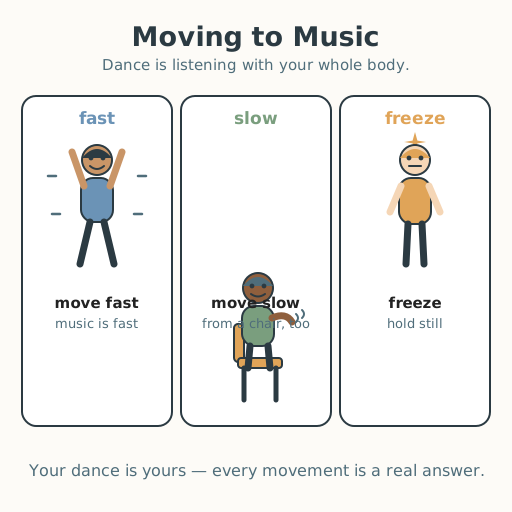
Lesson 8 — Moving to Music
Summary
Learners let music move their bodies. When the music is fast they move fast; when it slows, they slow; when it stops, they freeze. They discover that dance is a kind of listening, and that every person’s dance is their own — there is no wrong way to move.
Objectives
- Move or pretend to be a person, animal, or character in response to a story or music. (D07.S3.K.01)
Connection
Have you ever noticed your feet tapping or your shoulders bouncing when a song comes on? Your body wants to move to music. In every corner of the world, people dance — fast and slow, together and alone — to celebrate, to play, and to feel.
Materials
- A way to make or play music (drum, clap, voice, or recording)
- Open floor space
Preparation
- Clear a safe open space to dance.
- Prepare music with clear fast, slow, and stop parts.
Facilitator note
This lesson is written to the learner (“you”) so it works in a classroom and for a self-directed learner. As facilitator, make the changes in the music very clear — fast, slow, stop — and dance along. Freeze games are great for safety and delight. Never correct a learner’s dance; every movement is a real response to the music. Dance is listening with the whole body, and there is no wrong answer.
Procedure
- Gather (5 min). Stand in open space and listen. Wiggle your fingers to the music. How does it make your body want to move?
- Fast and slow (10 min). When the music is fast, move fast. When it slows, move slow. Let your whole body follow.
- Stop and freeze (10 min). When the music stops, freeze like a statue. When it starts, move again! Try loud and soft, too — big jumps, tiny steps.
- Dance your own way (15 min). Move however the music tells you — no one else’s dance looks like yours. Try moving one part at a time: only your arms, only your head, then everything.
- Close (5 min). Remember: your dance is yours. Music moves everyone a little differently, and that is exactly right.
Differentiation
- Support: Keep to one change (fast vs stop) and let the learner copy your movement.
- Seated/adapted: Dance entirely from a chair — arms, head, shoulders, and a swaying torso all move to the music; “freeze” is holding still wherever you are, and one moving hand is a full dance.
- Deaf/HH path: Make every change visible and feelable — the leader claps or stamps the beat where everyone can see, raises an open hand for “freeze” and drops it to move again. Learners who do not hear can follow the hand signal and feel the beat as vibration through the floor or a drum, so no sound is needed to dance.
- Extension: Invite learners to lead the group’s music (clapping fast and slow) while others dance to their beat.
Assessment
- Formative (observation): Does the learner change their movement when the music changes speed or stops?
- Performance: The learner’s dance, observed live.
Home connection
At home, sing or play a song and dance with someone. Try freezing when the music stops. Ask each other what the music made you feel like doing.