Lesson 03 — Balance and Control
Learners practice balance and body control — walking a line, standing still, and balancing a small object — and learn that wobbling is the body's way of learning to be steady.
Objectives
Objectives
- D03.S2.K.01 Demonstrate big movements (run, hop, balance) and small movements (draw, stack) with growing control.
Essential question
How do I stay steady and in control of my body?
Key vocabulary
Materials
Standard materials
- A line or rope · 1 A chalk line, rope, or low curb to balance along
- A beanbag or soft object · 1 per learner To balance on a hand, knee, or head
- Music (optional) · 1 For slow, steady movement
Low-tech / no-cost
- A drawn or imagined line Draw a line in the dirt or imagine one; no rope or beam needed
- Found objects A leaf, stone, or folded cloth becomes the object to balance
Enriched / lab & device
- Balance pods or stepping stones · 1 set Low, safe objects to step on and balance across
- A wobble board or soft mat · 1 For practicing steady standing on a gentle, safe surface
Works in different contexts
- large-group Have a few balance lines or spots going at once, and take turns so learners can watch and encourage each other
- self-directed A learner practices balancing alone along a line and with an object, trying to hold each balance a little longer
- outdoor-only Use a fallen log, a line in the sand, or the edge of a path; balance a leaf or stone on an open hand
- level-grouped Group by comfort — some balance sitting with an object on a knee, others walk a line or step across low stones; each group works at its own challenge
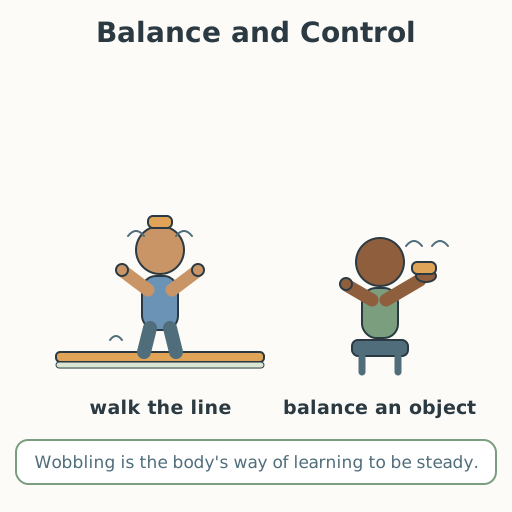
Lesson 3 — Balance and Control
Summary
Learners practice staying steady — walking a line, standing still, and balancing a small object — with growing control. They learn that wobbling is not failing; it is the body’s way of learning, and every body finds its own steady point.
Objectives
- Demonstrate big movements (balance) with growing control. (D03.S2.K.01)
Connection
Balance shows up everywhere in your life. You balance along a curb, a log, or the edge of a boat; you carry a bowl of water without spilling; you stand on one foot to pull on a shoe. People everywhere need balance — a fisher balancing in a boat, a dancer holding a pose, a child crossing a stepping-stone path. Learning to balance helps you move through the world with care and confidence.
Materials
- A line or rope (chalk line, rope, or low curb)
- A beanbag or soft object to balance
- Music (optional)
Preparation
- Lay a straight, low line or rope on the ground for balancing.
- Clear space so learners can move slowly without bumping each other.
- Remind learners that wobbling is normal and expected.
Facilitator note
This lesson is written to the learner (“you”). As facilitator, frame wobbling as learning, never as failure. Honor every body: a learner who cannot stand can balance an object on a knee or open hand while seated; a learner who cannot walk a line can hold a steady seated pose. Pair the “statue” voice with a visual signal — a raised hand or a lifted scarf — so learners who cannot hear the cue know when to freeze. Keep the tone calm and slow — balance grows from stillness and breath, not speed.
Procedure
- Gather (5 min). Stand or sit tall like a mountain. Take one slow breath in and out. Feel your body get still and ready.
- Warm up (5 min). Rock gently side to side, then front to back, finding the middle point where you feel steady.
- Walk the line (10 min). Walk slowly along the line, one careful foot in front of the other. If you wobble, stop, breathe, and begin again. If walking is hard, balance an object on your open hand while you sit or stay still.
- Balance an object (10 min). Place a beanbag or soft object on your open hand, your knee, or your head. Hold it as still as you can, then try moving one slow step while it stays.
- Still as a statue (10 min). When the music or a voice says “statue,” hold your balance completely still. Count quietly to five before you relax. Notice which muscles help you stay steady.
- Close (5 min). Shake out your arms and legs. What helped you stay steady today — slow breathing, watching a fixed point, or something else?
Differentiation
- Support: Allow seated or supported versions of every balance; use a wider line and a lighter object.
- Extension: Invite learners to balance on tiptoe or with eyes open and then closed, and to walk the line while balancing an object on their head.
Assessment
- Formative (observation): Can the learner hold a balance with growing control and recover from a wobble, using an adapted version if needed?
- Self: The learner names one thing that helps them stay steady.
Home connection
Practice balancing at home — walk a crack in the floor, stand on one foot while brushing your teeth, or balance a folded cloth on your head. Tell a grown-up how you found your steady point.