Lesson 03 — Seasons Change
Learners explore how their own place changes through the year — whatever pattern their climate has — and draw it at two different times, honoring that every place has its own seasons.
Objectives
Objectives
- D06.S4.K.02 Observe and describe changes in the natural world (day and night, seasons, growth).
Essential question
How does the world around you change through the year?
Key vocabulary
Materials
Standard materials
- Paper and crayons · per learner
- Change pictures (leaves, rain, sun, snow, wind) · 1 set Simple drawn or printed cards of different weather and land changes
Low-tech / no-cost
- Memory and voice Tell what your place was like earlier this year and what it is like now — no cards needed
- A found object from outside Hold a leaf, a seed, or a stone and tell what season it reminds you of
Enriched / lab & device
- A month-by-month photo of one local tree or field (or a calendar) · 1 Shows how one place changes slowly through the year
Works in different contexts
- large-group Show each change picture big; invite learners to raise a hand for the times of year they have seen each change where they live
- self-directed A learner draws their own place at two different times of the year and tells how they differ
- outdoor-only Stand outside and look for clues about what time of year it is — leaves, rain, flowers, dry ground, wind — and name them
Lesson 3 — Seasons Change
Summary
Learners notice that the world around them changes through the year — and that different places change in different ways. They describe and draw their own place at two different times of the year. There is no one “right” set of seasons.
Objectives
- Observe and describe how the natural world changes through the year. (D06.S4.K.02)
Connection
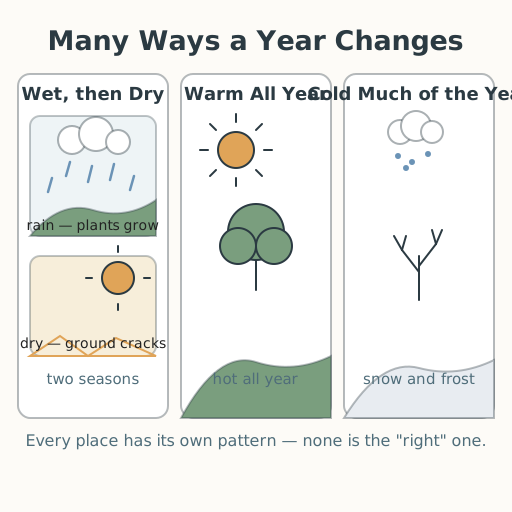
Some places have four seasons; some places have two — a wet time and a dry time; some places stay warm all year, and some are cold much of the year. Where you live, the year has its own pattern. The world around you changes through the year — watch how your place changes.
Materials
- Paper and crayons
- Change pictures (leaves, rain, sun, snow, wind)
Preparation
- Draw or print simple pictures of different changes: rain, dry ground, falling leaves, new leaves, snow or frost, wind, hot sun.
- Think ahead about what changes actually happen where you live, so the examples match.
Facilitator note
This lesson is written to the learner (“you”). This is the one place a temperate “four seasons” assumption can sneak in — do not let it. A learner near the equator has a wet/dry year; a learner near a desert or a coast or the poles has yet another pattern. Celebrate whatever pattern is true locally, and gently add that other places have different patterns. The science is observation, not a calendar.
Procedure
- Gather (5 min). What time of year is it now? What is it like outside today?
- My place through the year (10 min). Look at the change pictures. Point to (or name) the changes you have seen where you live, and when you see them: “The rains come,” “the leaves fall,” “it gets very hot,” “the snow stays.”
- Match the changes (15 min). Match each change to a time of year in your place, or act the change out: fall like a leaf, patter like rain, stretch like a new shoot. Not every picture fits your place — and that is fine.
- Draw your year (10 min). Fold your paper in half. Draw your place at one time of the year on one side, and at a different time of the year on the other.
- Close (5 min). Every place changes through the year in its own way. Your place’s way is worth watching.
Differentiation
- Support: Offer two contrasting change pictures and ask, “Which of these have you seen here?” — just yes or no.
- Extension: Invite learners to draw their place at three different times of the year and put them in order.
Assessment
- Formative (observation): Can the learner name one way their own place changes through the year?
- Artifact (portfolio): The “two times of year” drawing.
Home connection
At home, ask a grown-up what their place looked like when they were small, and whether it has changed over the years. Tell them one change you have seen this year.