Lesson 07 — Asking Why and How
Learners practice asking "why" and "how" about the world, offer their own ideas, and discover that wondering and asking are how every curious person begins.
Objectives
Objectives
- D06.S1.K.01 Ask "why" and "how" questions about things in the world and offer their own ideas.
Essential question
What do you wonder about, and how do you ask it?
Key vocabulary
Materials
Standard materials
- An interesting object or picture · 1 Something to wonder about (a leaf, a shell, a seed, a photo of the sky)
- A wonder box (any container) · 1
- Paper and crayons · per learner
Low-tech / no-cost
- Voice and a partner Take turns asking "why" and "how" about anything in the room; no box or paper needed
Enriched / lab & device
- A question wall or chart · 1 A place to post and keep every question so they can be revisited
Works in different contexts
- large-group Use a spoken or drawn "wonder box" so learners who do not want to speak up can still ask; read a few questions aloud without naming who asked
- self-directed A learner writes or draws their biggest question, offers their own guess, and keeps the page as a starting point
- outdoor-only Find something outside to wonder about, ask a "why" or "how" question about it aloud, and share your own idea
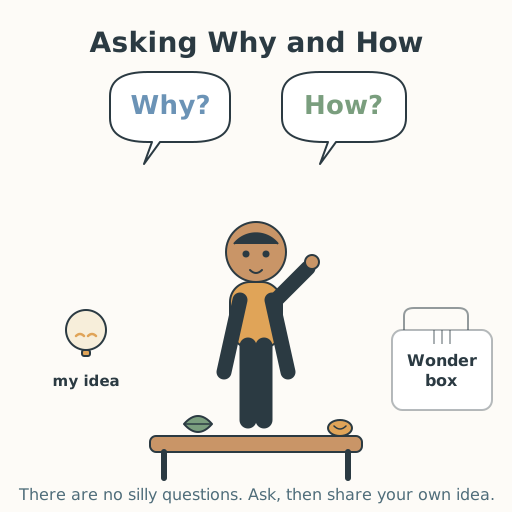
Lesson 7 — Asking Why and How
Summary
Learners practice the two most powerful question words there are — “why” and “how” — and pair each question with their own idea. They learn that wondering out loud is how every scientist and every curious person begins.
Objectives
- Ask “why” and “how” questions about things in the world and offer their own ideas. (D06.S1.K.01)
Connection
You wonder about things all the time: Why is the sky dark at night? How does a seed know to grow? Asking “why” and “how” is how every curious person starts — and your own idea is always a good place to begin.
Materials
- An interesting object or picture
- A wonder box (any container)
- Paper and crayons
Preparation
- Choose one interesting object or picture everyone can look at together.
- Prepare a wonder box (a basket, jar, or bag) where questions can be dropped.
Facilitator note
This lesson is written to the learner (“you”). As facilitator, make wondering safe:
say there are no silly questions, and model your own “why” and “how” questions. In
settings where questioning adults is not safe or usual, frame this as wondering
together, not challenging anyone, and offer the wonder box so learners can ask
without speaking up (see docs/contexts.md).
Procedure
- Gather (5 min). What have you wondered about today? Anything at all.
- Question words (10 min). Look at the object or picture. Ask it questions: “Why is it this color?” “How did it get here?” “Why does it move like that?” “How does it change?” There are no silly questions.
- Wonder box (15 min). Think of your biggest question about the world. Draw it or write it (or have a grown-up write it for you), and drop it in the wonder box — or say it aloud if you want. Then add your own idea: your best guess.
- My idea (10 min). Choose one question and draw or tell your own answer to it. You do not have to be sure — a guess is a great place to start.
- Close (5 min). Asking “why” and “how” — and sharing your ideas — is how we learn about the world. Keep asking.
Differentiation
- Support: Offer a sentence frame: “I wonder why ___” and “I think maybe ___.”
- Extension: Invite learners to write or draw three questions and star the one they most want to explore next.
Assessment
- Formative (observation): Can the learner ask a “why” or “how” question and offer their own idea about it?
- Artifact (portfolio): The drawn or scribed question with the learner’s idea.
Home connection
At home, ask a grown-up a “why” or “how” question about the world, then tell them your own guess. Wonder together.