Lesson 08 — Looking Closely
Learners slow down and look at one small thing very closely, discovering details they missed at first, and draw what they see — learning that careful looking is a tool for asking better questions.
Objectives
Objectives
- D06.S1.K.01 Ask "why" and "how" questions about things in the world and offer their own ideas.
Essential question
What do you notice when you look slowly and closely?
Key vocabulary
Materials
Standard materials
- A small natural object per learner (a leaf, stone, seed, shell) · 1 per learner
- Paper and crayons · per learner
- A magnifier (optional) · 1 per pair
Low-tech / no-cost
- Your eyes and fingers Look slowly and trace the edges gently with a finger — no magnifier needed
- Your fingers, nose, and ears Notice without eyes — feel the bumps and edges, smell it, and tap it gently to hear it
- A hand frame Make a small frame with your fingers to help you focus on one tiny part
Enriched / lab & device
- Magnifying glasses · 1 per pair To see tiny details up close
- A tablet with a camera · 1 per group Take a close-up photo and zoom in to see more
Works in different contexts
- large-group Look at one big shared object together; call out details one at a time while the facilitator points
- self-directed A learner picks one object, studies it for a full minute, and draws every detail they can find
- outdoor-only Choose a leaf, stone, or insect path outside; look at it for a full minute and name three details you did not see at first
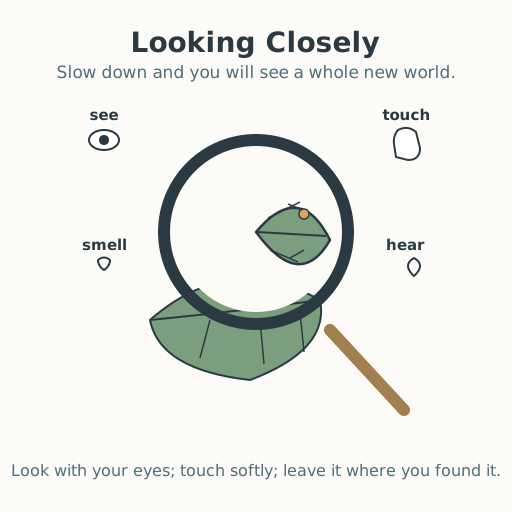
Lesson 8 — Looking Closely
Summary
Learners practice the scientist’s first skill: slow, careful looking. They study one small object for a full minute, find details they missed at first, and draw what they see.
Objectives
- Ask “why” and “how” questions about something by looking closely at it. (D06.S1.K.01)
Connection
Most of us look quickly and miss a lot. When you slow down and look closely — at a leaf, a hand, a shadow — you notice things you never noticed before. “Looking closely” can also mean touching, smelling, and listening closely. Noticing carefully is how good questions are born.
Materials
- A small natural object per learner (a leaf, stone, seed, shell)
- Paper and crayons
- A magnifier (optional)
Preparation
- Gather one small natural object for each learner (a leaf, stone, seed, or shell).
- If using magnifiers, set them out in pairs.
Facilitator note
This lesson is written to the learner (“you”). As facilitator, keep the looking slow and unhurried — a full minute feels long at age five, so count together or watch a timer. “Looking” here means noticing with whatever senses a learner has: eyes, fingers, nose, ears. If the object is a living thing (an insect, a flower still attached), teach gentleness: look with eyes, touch softly, and return it where it was found.
Procedure
- Gather (5 min). Pick up your object. From far away, what do you see? Just the big shape?
- Notice close (15 min). Hold your object and look at it very slowly for a whole minute. Turn it over. Use a magnifier or make a finger frame to look at one tiny part. What new details do you notice — lines, colors, bumps, edges? If you cannot see well, “look” with your other senses: feel the bumps and edges with your fingers, smell it, and tap it gently to hear it.
- Draw what you see (10 min). Draw the small details you found, the ones you missed at first.
- Share a detail (10 min). Tell a partner one detail you noticed that you did not see at the beginning. Ask one “why” or “how” question about it.
- Close (5 min). Looking slowly showed you a world you were missing. Careful looking is where wonder begins.
Differentiation
- Support: Look together and point to one detail at a time; the learner draws just one detail. For learners with low or no vision, notice by touch (bumps, edges), smell, and sound (tap it), and describe the detail aloud.
- Extension: Invite learners to compare two objects closely and tell one way they are the same and one way they are different.
Assessment
- Formative (observation): Can the learner name a detail they did not see at first and ask a question about it?
- Artifact (portfolio): The “close looking” drawing.
Home connection
At home, look closely at one thing with a grown-up — a fruit, a hand, a shoe. Tell them one detail you both notice for the first time.