Lesson 09 — A Wonder Walk
Learners take a slow walk — indoors or out — and practice noticing the living world and asking "why" and "how" about what they see, ending with one thing that made them wonder.
Objectives
Objectives
- D06.S1.K.01 Ask "why" and "how" questions about things in the world and offer their own ideas.
Essential question
What can you wonder about on a walk through your world?
Key vocabulary
Materials
Standard materials
- A small bag for gentle collecting (optional) · 1 per learner
- Paper and crayons · per learner
Low-tech / no-cost
- Just your feet (or a sit spot), eyes, ears, nose, and fingers A wonder walk needs no tools at all — walk or sit, look, listen, smell, feel, and ask
- A counting finger Count the things that make you wonder as you go
Enriched / lab & device
- A simple field guide or picture cards · 1 per group To name a few of the plants, animals, or clouds learners see
- A camera or notebook · 1 per group To photograph or sketch the things that made learners wonder
Works in different contexts
- large-group Walk as a group with a few planned stops; at each stop the group wonders aloud together and the facilitator records questions
- self-directed A learner takes a slow walk alone, notices one thing that makes them wonder, and draws it with a "why" or "how" question
- outdoor-only This lesson is made for outdoors — wander slowly and let every learner's own path and questions set the direction
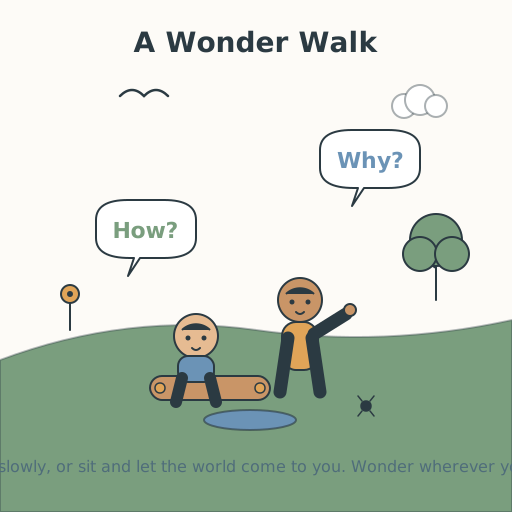
Lesson 9 — A Wonder Walk
Summary
Learners take a slow walk through their own world and practice noticing and asking. At each stop they wonder aloud — “why” and “how” — and offer their own ideas, ending with one thing they want to remember.
Objectives
- Ask “why” and “how” questions about the living world and offer their own ideas. (D06.S1.K.01)
Connection
A walk outside is full of things to wonder about — a bird, a plant, a cloud, a puddle, a bug. You do not need special tools; you just need to notice and ask. Your own neighborhood, field, or path is as full of wonder as any place on Earth.
Materials
- A small bag for gentle collecting (optional)
- Paper and crayons
Preparation
- Plan a slow, safe walk route (indoors or out) with a few good spots to stop and look.
- Remind learners of the one rule: be gentle with every living thing you meet.
Facilitator note
This lesson is written to the learner (“you”). It works best outside, but a hallway or window walk works too. Learners who use wheels or tire easily can hold a “sit spot” or “window wonder” — stay in one place and let the world come to them. The ethical heart is care: look with eyes, touch softly, and return living things to where you found them. Every learner’s local place is worth wondering about — there is no “correct” environment, only the one that is home.
Procedure
- Gather (5 min). You are going on a wonder walk. What will you look for?
- Walk and wonder (20 min). Walk slowly (or sit in one spot and let the world come to you). At each stop, notice something — a plant, a cloud, a shadow, a sound, a smell, a texture. Ask a “why” or “how” question about it, and share your own idea too: “Why is this leaf full of holes? Maybe an insect was eating it.”
- Collect wonder (10 min). Draw (or gently collect) one thing that made you wonder. If you collected a living thing, be gentle and put it back where you found it.
- Share (5 min). Tell a partner your best question and your best idea.
- Close (5 min). The world is full of questions. Keep wondering wherever you go — your walk home is a wonder walk too.
Differentiation
- Support: Stop at just one spot and wonder together; the learner draws that one thing. Wonder found by ear (a bird), nose (a flower), or fingers (rough bark) counts the same as wonder found by eye.
- Extension: Invite learners to keep a “wonder list” all day and share their three best questions at the next gathering.
Assessment
- Formative (observation): Can the learner notice something on the walk and ask a “why” or “how” question about it?
- Artifact (portfolio): The drawing of the thing that made them wonder.
Home connection
On the way home today, find one thing that makes you wonder. Ask a grown-up about it, and tell them your own idea too.