Lesson 01 — Then and Now
Learners meet the idea of "then and now" as a gentle way to talk about the past, and practice sorting and naming things as "then" or "now."
Objectives
Objectives
- D08.S1.K.01 Tell a "then and now" story about themselves or their family and how something changed.
Essential question
How can I tell what was "then" and what is "now"?
Key vocabulary
Materials
Standard materials
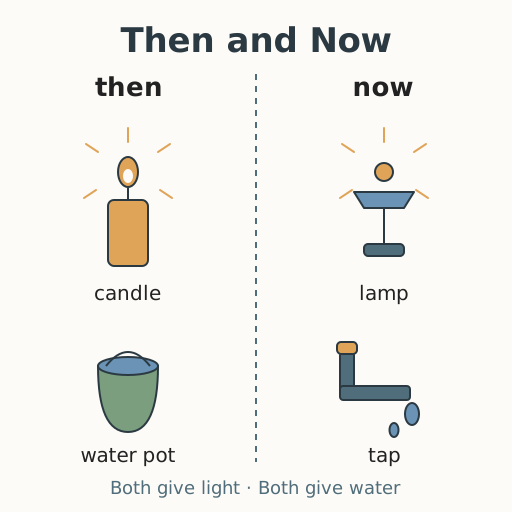
- Then-and-now picture cards · 1 set Pairs showing one thing earlier and later, such as a baby and a child, a seed and a plant, a candle and a lamp
- Paper and crayons · per learner
Low-tech / no-cost
- Two labeled holding spots A drawn "then" spot and a "now" spot on the floor, or two baskets labeled with pictures
- Found object pairs Any pair of things that changed, such as a small shoe and a big shoe
Enriched / lab & device
- Digital photo slideshow · 1 per group A short set of real "then and now" photos, such as a tree in two seasons or a street years apart
- Laminated sorting cards · 1 set per pair Durable pairs of then-and-now cards for repeated sorting
Works in different contexts
- large-group Hold each card up large for all to see; the whole group calls out "then!" or "now!" together before one learner places it
- self-directed The learner sorts the cards alone, then tells a grown-up or peer one "then" and one "now" they chose
- outdoor-only Find a living then-and-now example outside, such as a seed and a grown plant, or a small and a large leaf on the same plant
Lesson 1 — Then and Now
Summary
Learners meet “then and now” as a gentle way to talk about the past. They sort pictures and objects into “then” and “now” and name one thing that changed.
Objectives
- Tell a “then and now” story about themselves or their family and how something changed. (D08.S1.K.01)
Connection
Everything around you was once different: a tiny seed grows into a tall plant, and a baby grows into a child who can run and jump. “Then” is how things were before; “now” is how they are today. People everywhere tell then-and-now stories to remember their past.
Materials
- “Then” and “now” picture cards (pairs such as a baby and a child, a seed and a plant, a candle and a lamp)
- Paper and crayons
Preparation
- Gather or draw pairs of “then” and “now” cards.
- Set up two labeled spots: a “then” spot and a “now” spot.
Facilitator note
This lesson is written to the learner (“you”) so it works in a classroom and for a self-directed learner. Prepare the cards and the two labeled spots, then guide the sorting and the closing story — the learner follows the procedure directly. Keep “then” gentle and personal; there are no wrong pasts, and no one’s way of living is called better or worse.
Procedure
- Gather (5 min). Sit comfortably. Think of one thing that was different a long time ago — a smaller you, a shorter plant, a colder day.
- Meet “then” and “now” (10 min). Look at the two spots. “Then” means before; “now” means today. Hold up a card pair: which is then, which is now? Say it aloud and point.
- Sort together (15 min). Take turns placing cards on the “then” spot or the “now” spot. Say why you chose that spot: “This one is then because it is smaller.”
- Tell your own story (10 min). Choose one pair and tell a tiny then-and-now story about it: “Then it was a seed. Now it is a plant.”
- Close (5 min). Remember: every person, every place, and every thing has a “then” and a “now.”
Differentiation
- Support: Sort just two card pairs; model “then” with a clear gesture toward the “before” spot.
- Extension: Invite learners to draw their own then-and-now pair and explain it.
Assessment
- Formative (observation): Can the learner place a card on the correct spot and say “then” or “now” — or point to the correct spot?
- Formative (oral): Does the learner tell one tiny then-and-now story?