Lesson 06 — What Did I Notice?
Learners return to a story or song, practice noticing more deeply — a sound, a word, a picture, a feeling — and share their noticings with respectful turns.
Objectives
Objectives
- D08.S2.K.01 Listen to a story or song from another culture and share one thing they noticed.
Essential question
How do I share what I noticed in a story or song?
Key vocabulary
Materials
Standard materials
- A story or song from a previous lesson · 1 Reuse a story or song learners already heard, or choose one gentle new one
- "I noticed..." turn marker or soft object · 1 Passed around so one voice is heard at a time
Low-tech / no-cost
- Partner sharing Turn to a partner and say "I noticed..." — no object needed
- A small stone or leaf Any found object can be the turn marker
Enriched / lab & device
- Notice-and-draw sheet · 1 per learner A page with boxes for "a sound," "a word," "a picture," and "a feeling"
- Recording device · 1 per group For learners to record their "I noticed..." sentence and play it back
Works in different contexts
- large-group Pass one turn marker around a circle so every learner gets a turn to say "I noticed..." without interruption
- self-directed The learner listens again, fills the four notice boxes, and shares the page with a grown-up or peer
- outdoor-only Sit in a quiet outdoor circle and pass a found leaf or stone as the turn marker while sharing noticings
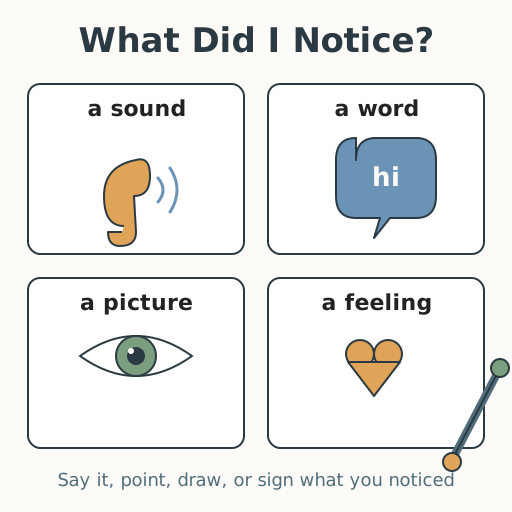
Lesson 6 — What Did I Notice?
Summary
Learners return to a story or song from earlier in the unit and practice noticing more deeply. They share one sound, word, picture, or feeling, taking respectful turns.
Objectives
- Listen to a story or song from another culture and share one thing they noticed. (D08.S2.K.01)
Connection
Listening is not just hearing — it is paying attention to the small things: the sound of a voice, a word that repeats, a feeling that rises. When you notice details in someone’s story or song, you are telling them, “Your story matters to me.” That is how people learn to understand each other.
Materials
- A story or song learners already heard (reused or gently new)
- An “I noticed…” turn marker (stick or soft object)
Preparation
- Choose a story or song to revisit.
- Prepare the turn marker and a calm circle.
Facilitator note
Written to the learner (“you”) so it works in a classroom and for a self-directed learner. This lesson builds noticing as a skill: guide learners from “I liked it” toward “I noticed a sound/a word/a picture/a feeling.” Honor every honest noticing; do not correct a child’s response. Model “I noticed…” yourself, and keep turns kind so all voices are heard.
Procedure
- Gather (5 min). Sit in a circle. Remember the story or song from before. What do you remember first?
- Listen again (15 min). Hear it once more, this time listening for one small thing: a sound, a word, a picture, or a feeling.
- Notice with a helper (10 min). With a partner, finish the sentence “I noticed…” Try to name the kind of thing you noticed: “I noticed the sound of…” or “I noticed the feeling of…”
- Share (10 min). Pass the turn marker. When you hold it, share your “I noticed…” — say it, point to a picture, draw it, or sign it. When you do not hold it, attend to the speaker.
- Close (5 min). Listening closely is a way of respecting someone’s story. The more we notice, the more we understand.
Differentiation
- Support: Offer two starter choices: “Was your noticing a sound or a feeling?”
- Non-speaking: Offer a drawn or picture “I noticed…” board (sound, word, picture, feeling) so a learner can point to or circle their noticing without speaking.
- Extension: Invite learners to notice one detail the first time and a different kind of detail the second time, and compare.
Assessment
- Formative (observation): Does the learner move beyond “I liked it” to a concrete noticing (a sound, word, picture, or feeling)?
- Self-assessment: Does the learner name which kind of thing they noticed?