Lesson 03 — Fair or Unfair?
Learners tell whether simple situations are fair or unfair and say why, using sharing and turn-taking examples.
Objectives
Objectives
- D09.S2.K.01 Tell when something is fair or unfair in a simple situation like sharing or taking turns.
Essential question
When is something fair, and when is it unfair?
Key vocabulary
Materials
Standard materials
- Fair-or-unfair picture cards · 1 set Simple scenes (one child with all the crayons, children taking turns on a swing, one child getting every turn)
- Two sorting trays or hoops · 2 Labeled "fair" and "unfair"
- Crayons and paper · per learner
Low-tech / no-cost
- Voice and body Act out each scene and let learners show "thumbs up" (fair) or "thumbs down" (unfair) instead of sorting cards
- Found objects A few stones or sticks to act out sharing evenly or grabbing them all
Enriched / lab & device
- Laminated fair-or-unfair cards · 1 set per pair Durable cards for repeated sorting games and discussion
- Camera or tablet · 1 per group A photo app to capture learners acting out a fair and an unfair scene for the class "fairness wall"
Works in different contexts
- large-group Hold up each scene and have the whole group show thumbs up or thumbs down, then name why
- self-directed The learner sorts each card into "fair" or "unfair" and says one reason for each
- outdoor-only Use a real shared object — one swing, one ball, a few stones — and act out a fair way and an unfair way to share it
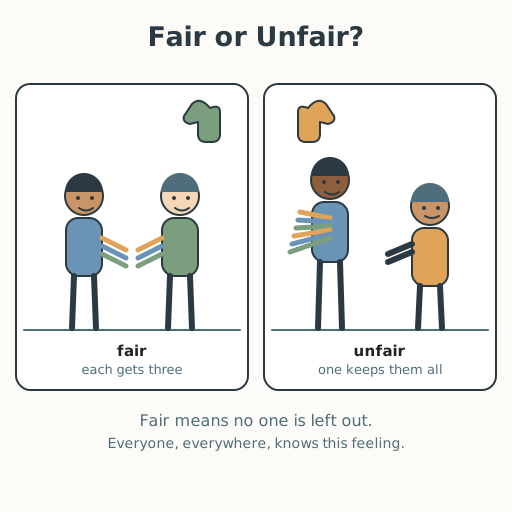
Lesson 3 — Fair or Unfair?
Summary
Learners meet the words fair and unfair and practice telling which is which in simple, familiar situations — sharing, taking turns, being left out. They sort scenes and give a reason for each.
Objectives
- Tell when something is fair or unfair in a simple situation like sharing or taking turns. (D09.S2.K.01)
Connection
Have you ever felt “that’s not fair!” — maybe someone grabbed all the crayons or took every turn? Everyone, in every part of the world, knows that feeling. Fairness is a question we all ask: did everyone get a turn? Did anyone get left out? Learning to see fair and unfair is the first step to making things fairer.
Materials
- Fair-or-unfair picture cards
- Two sorting trays or hoops labeled “fair” and “unfair”
- Crayons and paper
Preparation
- Prepare or draw fair-or-unfair picture cards showing simple scenes.
- Label two sorting spots “fair” and “unfair.”
Facilitator note
Written to the learner (“you”). Fairness here is not a rule to obey but a question to explore together — hold each scene open (“what do you think? why?”) rather than declaring a single right answer. Some scenes are genuinely tricky, and that is good: invite learners to notice when they are unsure. Fairness is universal, but how people share differs across cultures — affirm different ways of being fair. Avoid shaming; name the act (“that leaves someone out”), never the child.
Procedure
- Gather (5 min). Think of a time you felt something was fair or unfair. What happened?
- Meet the words (10 min). Learn the words fair and unfair. Fair means everyone gets a turn or a share and no one is left out. Unfair means someone gets left out or gets everything.
- Sort the scenes (15 min). Look at each card. Is it fair or unfair? Put it in the right tray or hoop, and say why. For example: “Everyone gets a turn — that is fair” or “One child keeps the swing the whole time — that is unfair.”
- Draw one of each (10 min). Draw one fair scene and one unfair scene. Tell a partner which is which and why.
- Close (5 min). Remember: fair means everyone is included; unfair means someone is left out. You can notice both.
Differentiation
- Support: Use just two very clear scenes; model “fair/unfair” with a thumbs-up or thumbs-down gesture.
- Extension: Invite learners to think of a scene that is tricky — fair to one person but not to another — and talk it through with a partner.
Assessment
- Formative (observation): Can the learner sort a simple scene as fair or unfair and give a reason?
- Artifact (portfolio): The “fair and unfair” drawing pair, kept in the learner’s portfolio.
Home connection
At home, notice one fair moment and one unfair moment (like sharing a snack or a toy). Tell a grown-up which was which and why.